


Effectiveness of Exercise Programs for Alleviation of Upper Body Pain in Patients with Spinal Cord Injury: A Systematic Review
- PMID: 38892777
- PMCID: PMC11172569
- DOI: 10.3390/jcm13113066
Effectiveness of Exercise Programs for Alleviation of Upper Body Pain in Patients with Spinal Cord Injury: A Systematic Review
Abstract
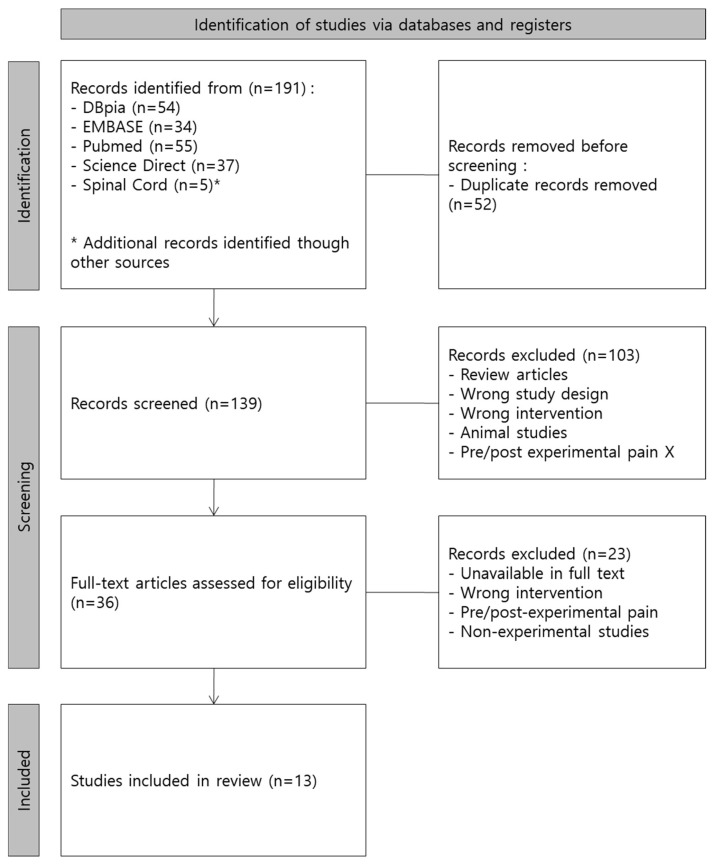
(1) Background: Upper body pain, particularly in the limbs and shoulders, is a common symptom among patients with spinal cord injury (SCI) and wheelchair users. Despite the focus on resistance muscle training as a suitable intervention for SCI individuals, findings across different populations and conditions have been inconsistent. (2) Methods: We conducted a systematic review to elucidate the correlations among exercise interventions, muscle strength enhancement, and pain reduction. A comprehensive literature search was performed using the keywords "spinal cord injury," "pain," "exercise," "disability," "paraplegia," and "tetraplegia" across the DBpia, EMBASE, PubMed, and Science Direct databases. (3) Results: From 191 identified articles, 13 studies (1 from Korea and 12 from other countries) were selected for analysis. The results indicate that exercise interventions are effective in reducing pain in patients with SCI, with a particular emphasis on alleviating shoulder pain. (4) Conclusion: Exercise is essential for pain reduction in patients with SCI, especially those experiencing shoulder pain. However, there is a notable lack of experimental research focusing primarily on pain. The development of appropriate measurement instruments is crucial for the prevention and relief of pain in this patient population.
Keywords: shoulder pain; spinal cord injury; strength; upper body pain; wheelchair.
Conflict of interest statement
The authors declare no conflicts of interest.
Figures
Similar articles
-
Effectiveness of home exercise on pain, function, and strength of manual wheelchair users with spinal cord injury: a high-dose shoulder program with telerehabilitation.Arch Phys Med Rehabil. 2014 Oct;95(10):1810-1817.e2. doi: 10.1016/j.apmr.2014.05.004. Epub 2014 Jun 2. Arch Phys Med Rehabil. 2014. PMID: 24887534 Free PMC article. Clinical Trial.
-
Effectiveness of Exercise Programs for Management of Shoulder Pain in Manual Wheelchair Users With Spinal Cord Injury.J Neurol Phys Ther. 2015 Oct;39(4):197-203. doi: 10.1097/NPT.0000000000000103. J Neurol Phys Ther. 2015. PMID: 26308939 Review.
-
EMG Biofeedback and Exercise for Treatment of Cervical and Shoulder Pain in Individuals with a Spinal Cord Injury: A Pilot Study.Top Spinal Cord Inj Rehabil. 2013 Fall;19(4):311-23. doi: 10.1310/sci1904-311. Top Spinal Cord Inj Rehabil. 2013. PMID: 24244096 Free PMC article.
-
Requirements for Universally Accessible Upper-Body Exercise Equipment: The Case of People with Spinal Cord Injuries in Korea.Occup Ther Int. 2023 Dec 22;2023:6652703. doi: 10.1155/2023/6652703. eCollection 2023. Occup Ther Int. 2023. PMID: 38161738 Free PMC article. Review.
-
Effects of functional electrical stimulation assisted rowing on aerobic fitness and shoulder pain in manual wheelchair users with spinal cord injury.J Spinal Cord Med. 2016 Nov;39(6):645-654. doi: 10.1179/2045772315Y.0000000052. Epub 2016 Apr 1. J Spinal Cord Med. 2016. PMID: 26449780 Free PMC article.
References
-
- Sie I.H., Waters R.L., Adkins R.H., Gellman H. Upper extremity pain in the post rehabilitation spinal cord injured patient. Arch. Phys. Med. Rehabil. 1992;73:44–48. - PubMed
-
- Cratsenberg K.A., Deitrick C.E., Harrington T.K., Kopecky N.R., Matthews B.D., Ott L.M., Coeytaux R.R. Effectiveness of exercise programs for management of shoulder pain in manual wheelchair users with spinal cord injury. J. Neurol. Phys. Ther. 2015;39:197–203. doi: 10.1097/NPT.0000000000000103. - DOI - PubMed
Publication types
Grants and funding
LinkOut - more resources
Full Text Sources
