


Microsatellite Instability Testing and Prognostic Implications in Colorectal Cancer
- PMID: 38893125
- PMCID: PMC11171323
- DOI: 10.3390/cancers16112005
Microsatellite Instability Testing and Prognostic Implications in Colorectal Cancer
Abstract
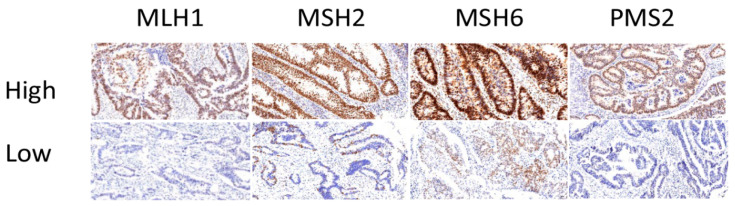
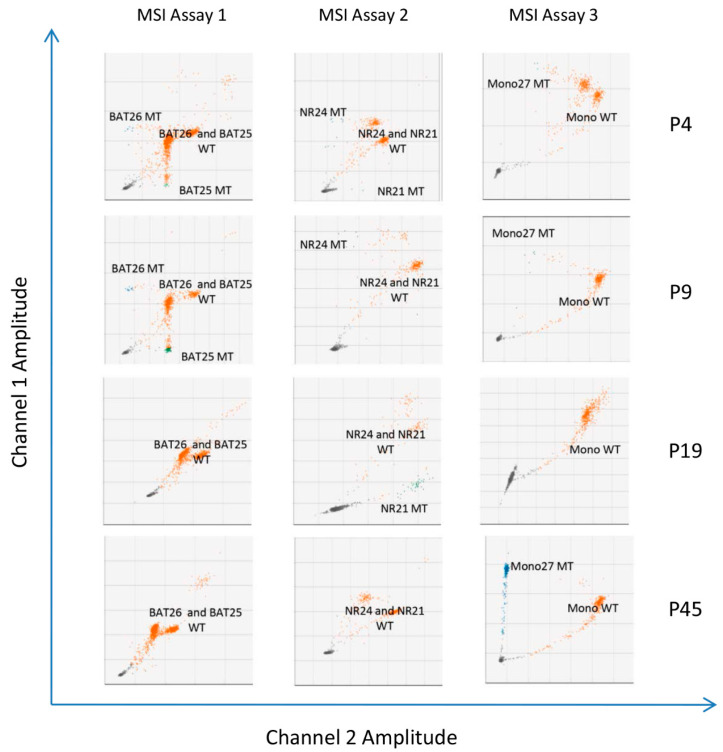
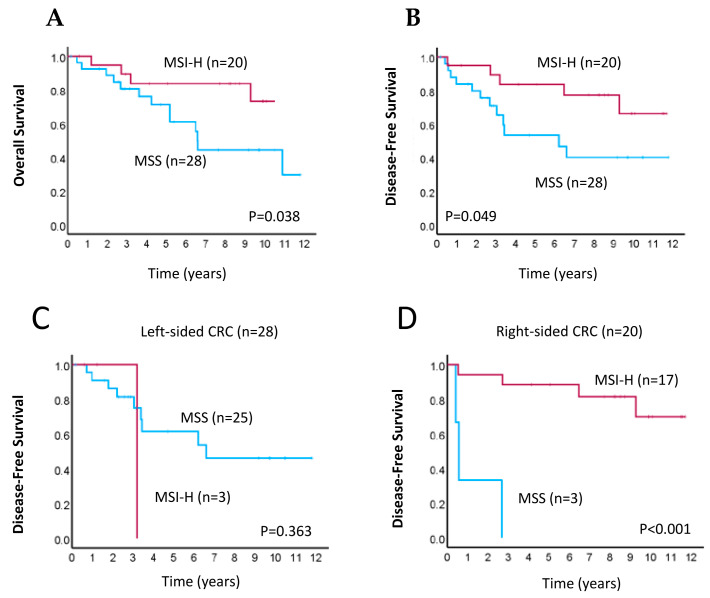
Given the crucial predictive implications of microsatellite instability (MSI) in colorectal cancer (CRC), MSI screening is commonly performed in those with and at risk for CRC. Here, we compared results from immunohistochemistry (IHC) and the droplet digital PCR (ddPCR) MSI assay on formalin-fixed paraffin-embedded tumor samples from 48 patients who underwent surgery for colon and rectal cancer by calculating Cohen's kappa measurement (k), revealing high agreement between the methods (k = 0.915). We performed Kaplan-Meier survival analyses and univariate and multivariate Cox regression to assess the prognostic significance of ddPCR-based MSI and to identify clinicopathological features associated with CRC outcome. Patients with MSI-high had better overall survival (OS; p = 0.038) and disease-free survival (DFS; p = 0.049) than those with microsatellite stability (MSS). When stratified by primary tumor location, right-sided CRC patients with MSI-high showed improved DFS, relative to those with MSS (p < 0.001), but left-sided CRC patients did not. In multivariate analyses, MSI-high was associated with improved OS (hazard ratio (HR) = 0.221, 95% confidence interval (CI): 0.026-0.870, p = 0.042), whereas the loss of DNA mismatch repair protein MutL homolog 1 (MLH1) expression was associated with worse OS (HR = 0.133, 95% CI: 0.001-1.152, p = 0.049). Our results suggest ddPCR is a promising tool for MSI detection. Given the opposing effects of MSI-high and MLH1 loss on OS, both ddPCR and IHC may be complementary for the prognostic assessment of CRC.
Keywords: colorectal cancer (CRC); formalin-fixed paraffin-embedded (FFPE) tissue samples; microsatellite instability (MSI); mismatch repair (MMR); primary site of tumors; prognosis.
Conflict of interest statement
The authors declare no conflicts of interest.
Figures
References
-
- Kinzler K.W. The Genetic Basis of Human Cancer. McGraw-Hill Professional Publishing; New York, NY, USA: 2002.
-
- Hendriks Y.M.C., de Jong A.E., Morreau H., Tops C.M.J., Vasen H.F., Wijnen J.T., Breuning M.H., Bröcker-Vriends A.H.J.T. Diagnostic Approach and Management of Lynch Syndrome (Hereditary Nonpolyposis Colorectal Carcinoma): A Guide for Clinicians. CA Cancer J. Clin. 2006;56:213–225. doi: 10.3322/canjclin.56.4.213. - DOI - PubMed
Grants and funding
LinkOut - more resources
Full Text Sources
