


Revisiting the Role of Sensors for Shaping Plant Research: Applications and Future Perspectives
- PMID: 38894052
- PMCID: PMC11174810
- DOI: 10.3390/s24113261
Revisiting the Role of Sensors for Shaping Plant Research: Applications and Future Perspectives
Abstract
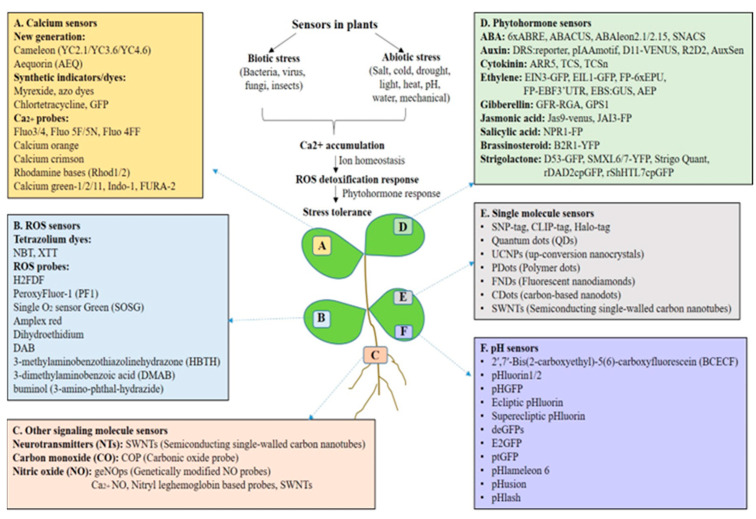
Plant health monitoring is essential for understanding the impact of environmental stressors (biotic and abiotic) on crop production, and for tailoring plant developmental and adaptive responses accordingly. Plants are constantly exposed to different stressors like pathogens and soil pollutants (heavy metals and pesticides) which pose a serious threat to their survival and to human health. Plants have the ability to respond to environmental stressors by undergoing rapid transcriptional, translational, and metabolic reprogramming at different cellular compartments in order to balance growth and adaptive responses. However, plants' exceptional responsiveness to environmental cues is highly complex, which is driven by diverse signaling molecules such as calcium Ca2+, reactive oxygen species (ROS), hormones, small peptides and metabolites. Additionally, other factors like pH also influence these responses. The regulation and occurrence of these plant signaling molecules are often undetectable, necessitating nondestructive, live research approaches to understand their molecular complexity and functional traits during growth and stress conditions. With the advent of sensors, in vivo and in vitro understanding of some of these processes associated with plant physiology, signaling, metabolism, and development has provided a novel platform not only for decoding the biochemical complexity of signaling pathways but also for targeted engineering to improve diverse plant traits. The application of sensors in detecting pathogens and soil pollutants like heavy metal and pesticides plays a key role in protecting plant and human health. In this review, we provide an update on sensors used in plant biology for the detection of diverse signaling molecules and their functional attributes. We also discuss different types of sensors (biosensors and nanosensors) used in agriculture for detecting pesticides, pathogens and pollutants.
Keywords: environmental stressors; nanosensors; plant stress biology; precise agriculture; sensors; signaling molecules; smart agriculture.
Conflict of interest statement
The authors declare no conflicts of interest.
Figures
References
-
- Saiz-Rubio V., Rovira-Más F. From smart farming towards agriculture 5.0: A review on crop data management. Agronomy. 2020;10:207. doi: 10.3390/agronomy10020207. - DOI
-
- Sabu D., Alagumariappan P., Sankaran V., Pittu P.S.K.R. Design and Development of Internet of Things-Based Smart Sensors for Monitoring Agricultural Lands. Eng. Proc. 2023;58:13. doi: 10.3390/ecsa-10-16207. - DOI
-
- Ayaz M., Ammad-Uddin M., Sharif Z., Mansour A., Aggoune E.H.M. Internet-of-Things (IoT)-based smart agriculture: Toward making the fields talk. IEEE Access. 2019;7:129551–129583. doi: 10.1109/ACCESS.2019.2932609. - DOI
Publication types
MeSH terms
Substances
LinkOut - more resources
Full Text Sources
Miscellaneous
