


Making it transparent: A worked example of articulating programme theory for a digital health application using Intervention Mapping
- PMID: 38894945
- PMCID: PMC11185015
- DOI: 10.1177/20552076241260974
Making it transparent: A worked example of articulating programme theory for a digital health application using Intervention Mapping
Abstract
Objective: Digital health interventions for behaviour change are usually complex interventions, and intervention developers should 'articulate programme theory', that is, they should offer detailed descriptions of individual intervention components and their proposed mechanisms of action. However, such detailed descriptions often remain lacking. The objective of this work was to provide a conceptual case study with an applied example of 'articulating programme theory' for a newly developed digital health intervention.
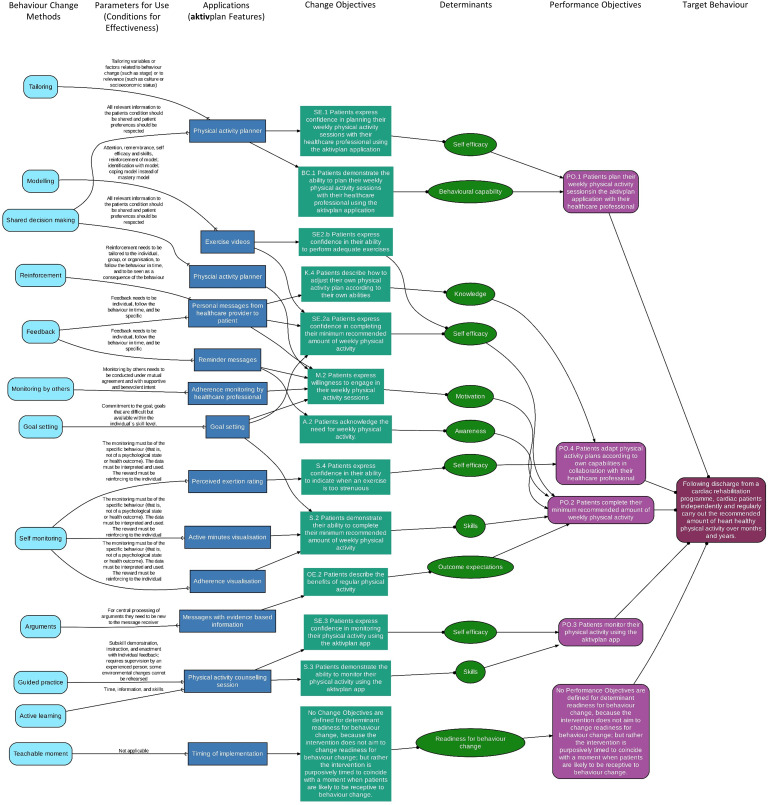
Methods: Intervention Mapping methodology was applied to arrive at a detailed description of programme theory for a newly developed digital health intervention that aims to support cardiac rehabilitation patients in establishing heart-healthy physical activity habits. Based on a Predisposing, Reinforcing, and Enabling Constructs in Educational Diagnosis and Evaluation (PRECEDE) logic model of the problem, a logic model of change was developed. The proposed mechanisms of action were visualised in an acyclic behaviour change diagram.
Results: Programme theory for this digital health intervention includes 4 sub-behaviours of the main target behaviour (i.e. habitual heart-healthy physical activity), 8 personal determinants and 12 change objectives (i.e. changes needed at the determinant level to achieve the sub-behaviours). These are linked to 12 distinct features of the digital health intervention and 12 underlying behaviour change methods.
Conclusions: This case study offers a worked example of articulating programme theory for a digital health intervention using Intervention Mapping. Intervention developers and researchers may draw on this example to replicate the method, or to reflect on most suitable approaches for their own behaviour change interventions.
Keywords: Behavior and behavior mechanisms; Cardiac rehabilitation; Cardiovascular diseases; Digital health; Health promotion; Public health; Secondary prevention; Telemedicine.
© The Author(s) 2024.
Conflict of interest statement
The authors declared no potential conflicts of interest with respect to the research, authorship, and/or publication of this article.
Figures

References
-
- Wang H. GBD Demographics collaborators. Global age-sex-specific fertility, mortality, healthy life expectancy (HALE), and population estimates in 204 countries and territories, 1950–2019: a comprehensive demographic analysis for the global burden of disease study 2019. Lancet 2020; 396: 1160–1203. - PMC - PubMed
-
- Di Cesare M, et al. World heart report 2023: Confronting the world's number one killer. Geneva, Switzerland: World Heart Federation, 2023.
-
- Guidetti D, et al. Inconsistencies across regional strategies. Eur J Phys Rehabil Med 2014; 50: S0140–S6736. - PubMed
-
- Visseren FL, et al. ESC Guidelines on cardiovascular disease prevention in clinical practice: developed by the task force for cardiovascular disease prevention in clinical practice with representatives of the European Society of Cardiology and 12 medical societies with the special contribution of the European association of preventive cardiology (EAPC). Eur J Prev Cardiol 2022; 29: 5–115. - PubMed
LinkOut - more resources
Full Text Sources
