


Radiation-resistant bacteria in desiccated soil and their potentiality in applied sciences
- PMID: 38894973
- PMCID: PMC11184166
- DOI: 10.3389/fmicb.2024.1348758
Radiation-resistant bacteria in desiccated soil and their potentiality in applied sciences
Abstract
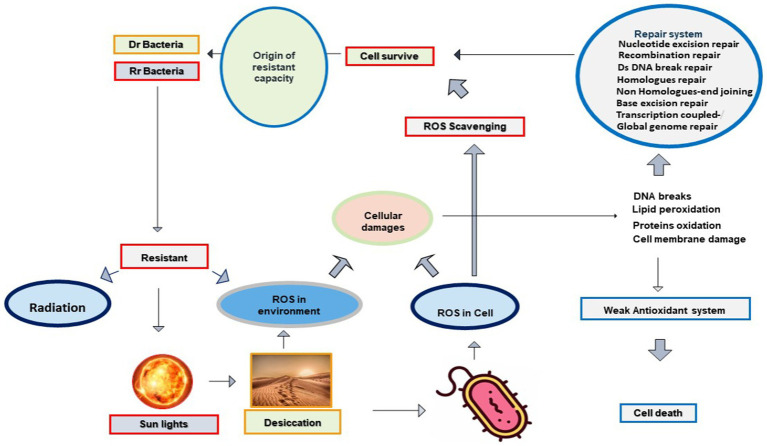
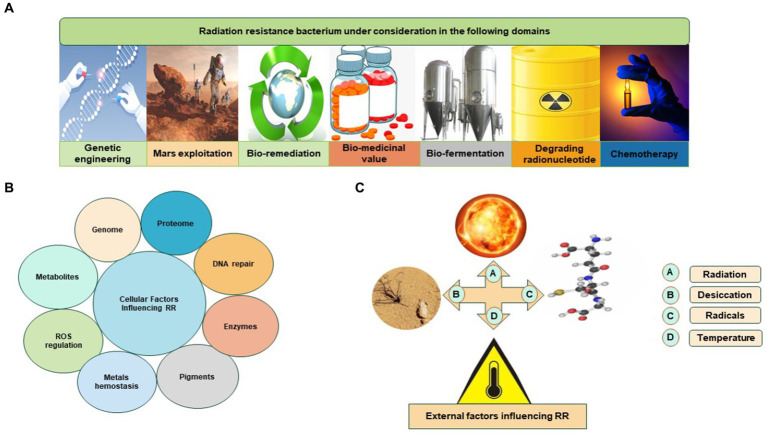
A rich diversity of radiation-resistant (Rr) and desiccation-resistant (Dr) bacteria has been found in arid habitats of the world. Evidence from scientific research has linked their origin to reactive oxygen species (ROS) intermediates. Rr and Dr. bacteria of arid regions have the potential to regulate imbalance radicals and evade a higher dose of radiation and oxidation than bacterial species of non-arid regions. Photochemical-activated ROS in Rr bacteria is run through photo-induction of electron transfer. A hypothetical model of the biogeochemical cycle based on solar radiation and desiccation. These selective stresses generate oxidative radicals for a short span with strong reactivity and toxic effects. Desert-inhibiting Rr bacteria efficiently evade ROS toxicity with an evolved antioxidant system and other defensive pathways. The imbalanced radicals in physiological disorders, cancer, and lung diseases could be neutralized by a self-sustaining evolved Rr bacteria antioxidant system. The direct link of evolved antioxidant system with intermediate ROS and indirect influence of radiation and desiccation provide useful insight into richness, ecological diversity, and origin of Rr bacteria capabilities. The distinguishing features of Rr bacteria in deserts present a fertile research area with promising applications in the pharmaceutical industry, genetic engineering, biological therapy, biological transformation, bioremediation, industrial biotechnology, and astrobiology.
Keywords: ROS species; antioxidant; applications; desert; environmental stresses; radiation.
Copyright © 2024 Khan, Liu, Zhang and Li.
Conflict of interest statement
The authors declare that the research was conducted in the absence of any commercial or financial relationships that could be constructed as a potential conflict of interest.
Figures
References
-
- Atri D., Kamenetskiy M., May M., Kalra A., Castelblanco A., Quiñones-Camacho A. (2022). Estimating the potential of ionizing radiation-induced radiolysis for microbial metabolism in terrestrial planets with rarefied atmospheres arXiv preprint arXiv:2207.14675.
Publication types
LinkOut - more resources
Full Text Sources
Molecular Biology Databases
