


Resident and Fellow Performance and Supervision in Surgical Oncology Procedures
- PMID: 38895939
- PMCID: PMC12287942
- DOI: 10.1097/XCS.0000000000001131
Resident and Fellow Performance and Supervision in Surgical Oncology Procedures
Abstract
Background: Previous research has highlighted concerns among trainees and attendings that general surgery training and fellowship are inadequately preparing trainees for practice. Providing trainees with supervision that matches their proficiency may help bridge this gap. We sought to benchmark operative performance and supervision levels among senior surgery residents (PGY-4 or -5) and fellows performing general surgical oncology procedures.
Study design: Observational data were obtained from the Society for Improving Medical Procedural Learning OR application for core general surgical oncology procedures performed at 103 unique residency and fellowship programs. Procedures were divided into breast and soft tissue, endocrine, and hepatopancreatobiliary. Case evaluations completed by trainees and attendings were analyzed to benchmark trainee operative performance and level of supervision.
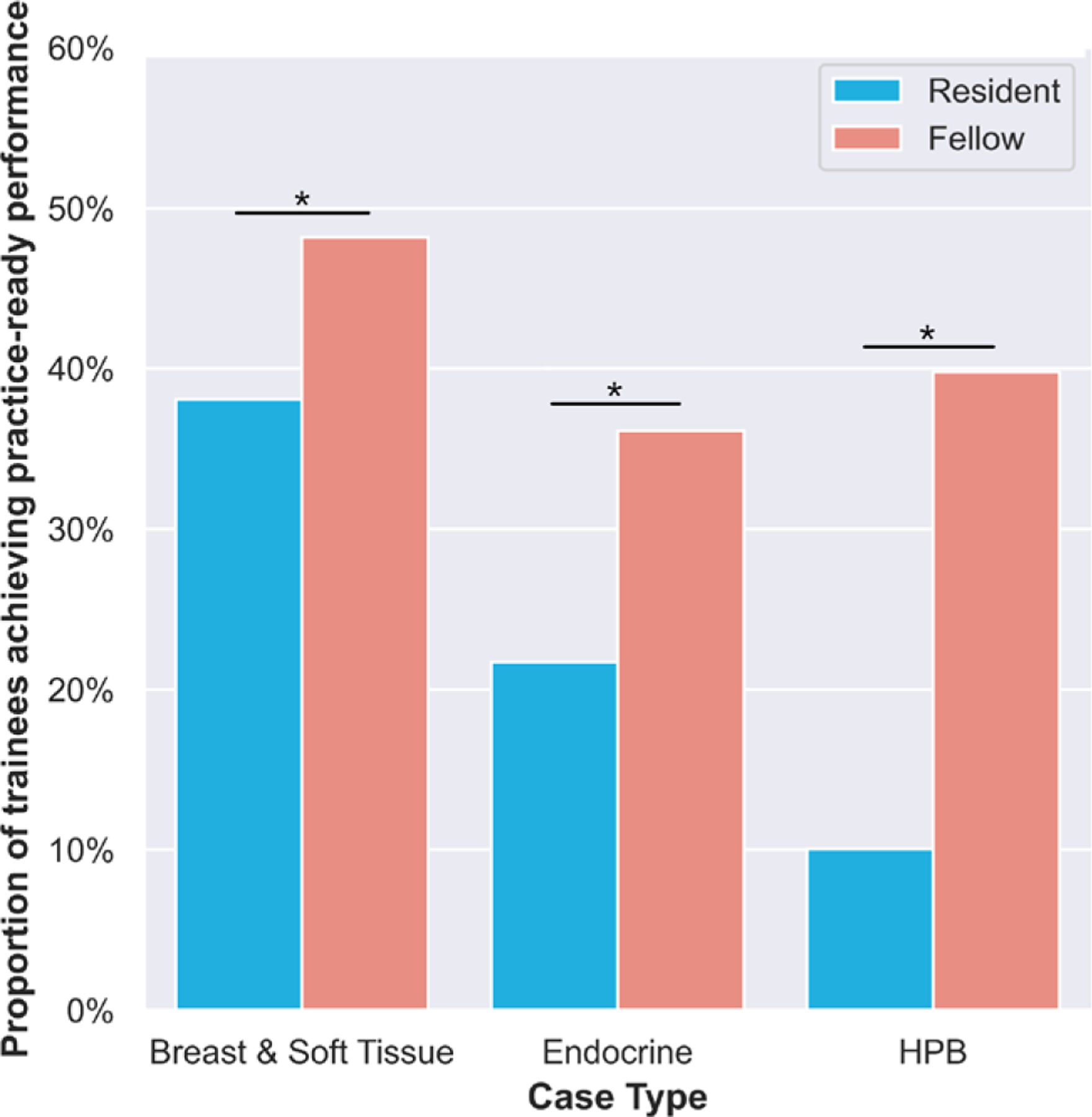
Results: There were 4,907 resident cases and 425 fellow cases. Practice-ready performance, as assessed by trainees and faculty, was achieved by relatively low proportions of residents and fellows for breast and soft tissue cases (residents: 38%, fellows: 48%), endocrine cases (residents: 22%, fellows: 41%), and hepatopancreatobiliary cases (residents: 10%, fellows: 40%). Among cases in which trainees did achieve practice-ready performance, supervision only was provided for low proportions of cases as rated by trainees (residents: 17%, fellows: 18%) and attendings (residents: 21%, fellows 25%).
Conclusions: In a sample of 103 residency and fellowship programs, attending surgeons rarely provided senior residents and fellows with levels of supervision commensurate to performance for surgical oncology procedures, even for high-performing trainees. These findings suggest a critical need for surgical training programs to prioritize providing greater levels of independence to trainees that have demonstrated excellent performance.
Copyright © 2024 by the American College of Surgeons. Published by Wolters Kluwer Health, Inc. All rights reserved.
Figures


References
-
- Mattar SG, Alseidi AA, Jones DB, et al. General surgery residency inadequately prepares trainees for fellowship: results of a survey of fellowship program directors. Ann Surg 2013;258:440–449. - PubMed
-
- Miles VP, Schroll RW, Beaty JS. Empowering the resident learner. J Surg Educ 2022;79:909–917. - PubMed
-
- Napolitano LM, Savarise M, Paramo JC, et al. Are general surgery residents ready to practice? A survey of the American College of Surgeons Board of Governors and Young Fellows Association. J Am Coll Surg 2014;218:1063–1072.e31. - PubMed
-
- George BC, Bohnen JD, Williams RG, et al. Readiness of US general surgery residents for independent practice. Ann Surg 2017;266:582–594. - PubMed
-
- Anderson TN, Payne DH, Dent DL, et al. Defining the deficit in US surgical training: the trainee’s perspective. J Am Coll Surg 2021;232:623–627. - PubMed
Publication types
MeSH terms
Grants and funding
LinkOut - more resources
Full Text Sources
Miscellaneous
