


doi: 10.1016/j.xcrm.2024.101616.
Addressing sociodemographic, socioeconomic, and gendered disparities for equity in menopause care
Affiliations
- PMID: 38897172
- PMCID: PMC11228773
- DOI: 10.1016/j.xcrm.2024.101616
Item in Clipboard
Addressing sociodemographic, socioeconomic, and gendered disparities for equity in menopause care
Cell Rep Med.
.
Abstract
Menopause experiences and care vary widely because of biological, sociodemographic, and sociocultural factors. Treatments for troublesome symptoms are not uniformly available or accessed. Intersectional factors may affect the experience and are poorly understood. Disparities across populations highlight the opportunity for a multifaceted equitable approach that includes patient-centered care, education, and policy change.
Copyright © 2024 The Authors. Published by Elsevier Inc. All rights reserved.
Conflict of interest statement
Declaration of interests The authors declare no competing interests
Figures
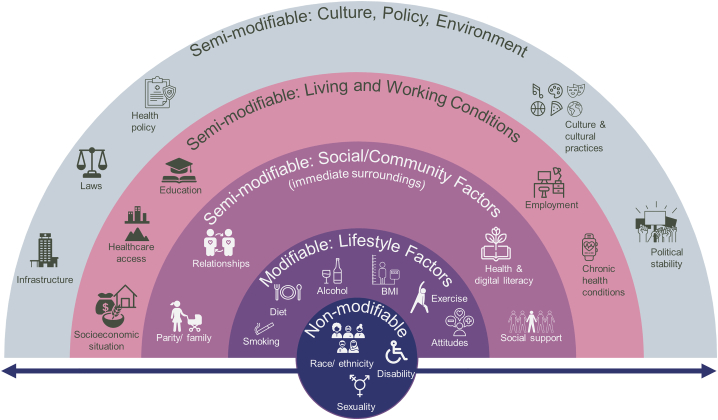
How menopause can be viewed in the context of a social health model
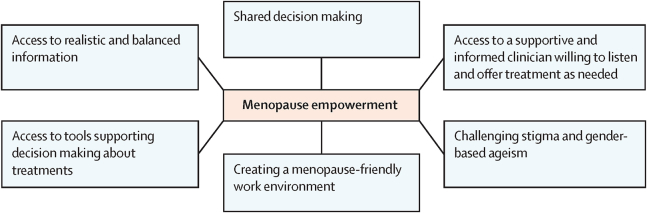
An empowerment model for managing menopause Reprinted from The Lancet, vol. 403, Hickey et al., Copyright 2024, with permission from Elsevier.
References
-
- Avis N.E., Crawford S.L., Greendale G., Bromberger J.T., Everson-Rose S.A., Gold E.B., Hess R., Joffe H., Kravitz H.M., Tepper P.G., et al. Duration of menopausal vasomotor symptoms over the menopause transition. JAMA Intern. Med. 2015;175:531–539. doi: 10.1001/jamainternmed.2014.8063. - DOI - PMC - PubMed
-
- El Khoudary S.R., Greendale G., Crawford S.L., Avis N.E., Brooks M.M., Thurston R.C., Karvonen-Gutierrez C., Waetjen L.E., Matthews K. The menopause transition and women's health at midlife: a progress report from the Study of Women's Health Across the Nation (SWAN) Menopause. 2019;26:1213–1227. doi: 10.1097/gme.0000000000001424. - DOI - PMC - PubMed
MeSH terms
LinkOut - more resources
Full Text Sources
Medical
