


Meaningful consumer involvement in cancer care: a systematic review on co-design methods and processes
- PMID: 38897655
- PMCID: PMC11240760
- DOI: 10.1093/jncics/pkae048
Meaningful consumer involvement in cancer care: a systematic review on co-design methods and processes
Abstract
Objective: Although the benefits of consumer involvement in research and health care initiatives are known, there is a need to optimize this for all people with cancer. This systematic review aimed to synthesize and evaluate the application of co-design in the oncology literature and develop recommendations to guide the application of optimal co-design processes and reporting in oncology research, practice, and policy.
Methods: A systematic review of co-design studies in adults with cancer was conducted, searching MEDLINE, CINAHL, Embase, and PsycINFO databases and included studies focused on 2 concepts, co-design and oncology.
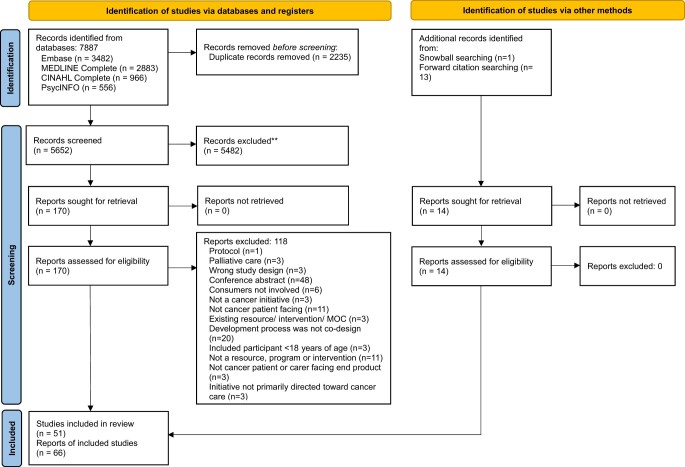
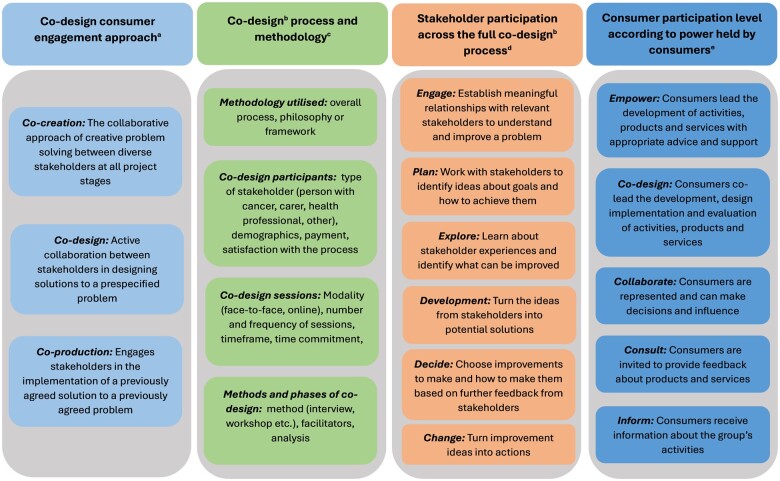
Results: A total of 5652 titles and abstracts were screened, resulting in 66 eligible publications reporting on 51 unique studies. Four frameworks were applied to describe the co-design initiatives. Most co-design initiatives were designed for use in an outpatient setting (n = 38; 74%) and were predominantly digital resources (n = 14; 27%) or apps (n = 12; 23%). Most studies (n = 25; 49%) used a co-production approach to consumer engagement. Although some studies presented strong co-design methodology, most (n = 36; 70%) did not report the co-design approach, and 14% used no framework. Reporting was poor for the participant level of involvement, the frequency, and time commitment of co-design sessions. Consumer participation level was predominantly collaborate (n = 25; 49%).
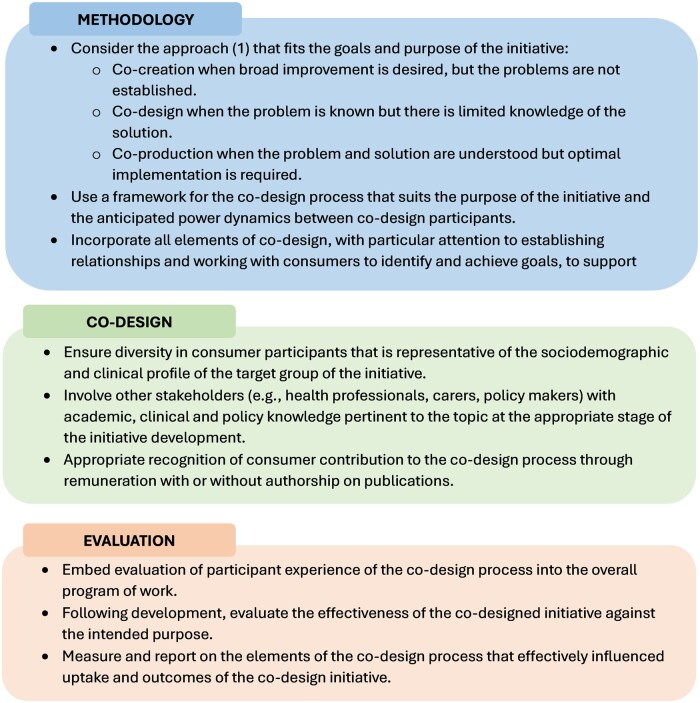
Conclusions: There are opportunities to improve the application of co-design in oncology research. This review has generated recommendations to guide 1) methodology and frameworks, 2) recruitment and engagement of co-design participants, and 3) evaluation of the co-design process. These recommendations can help drive appropriate, meaningful, and equitable co-design, leading to better cancer research and care.
© The Author(s) 2024. Published by Oxford University Press.
Conflict of interest statement
NK reports funding from the Victorian Cancer Agency, Medical Research Future Fund, World Cancer Research Fund, and Medical Nutrition Industry. AU reports funding from the Victorian Cancer Agency, Medical Research Future Fund, and Cancer Australia. SM reports funding from Deakin University. KB and LY report consulting fees from Deakin University. HJ, BB, VW, TL, JB, AB, DS, and SS have no conflicts of interest to report.
Figures
References
-
- Vargas C, Whelan J, Brimblecombe J, Allender S.. Co-creation, co-design, co-production for public health—a perspective on definition and distinctions. Public Health Res Pract. 2022;32(2):e3222211. - PubMed
-
- NHS National Institute for Health Research. Public Involvement in Research: Values and Principles Framework: INVOLVE. Eastleigh: INVOLVE. 2016. https://www.invo.org.uk/posttypepublication/public-involvement-in-resear.... Accessed May 1, 2023.
-
- Patient Centred Outcomes Research Institute. Engagement in Research: PCORI’s Foundational Expectations for Partnerships. Washington, DC: PICORI; https://www.pcori.org/. Accessed November 11, 2023.
-
- National Health and Medical Research Council. Statement on Consumer and Community Involvement in Health and Medical Research. Canberra, ACT: National Health and Medical Research Council; 2016.
-
- American Society of Clinical Oncology. How Advocates Help Create Guidelines. Atlanta, GA, USA: American Society of Clinical Oncology. https://www.cancer.net/blog/2017-03/how-advocates-help-create-guidelines. Accessed May 1, 2023.
Publication types
MeSH terms
Grants and funding
LinkOut - more resources
Full Text Sources
Medical