


Can AI Answer My Questions? Utilizing Artificial Intelligence in the Perioperative Assessment for Abdominoplasty Patients
- PMID: 38898239
- PMCID: PMC11645314
- DOI: 10.1007/s00266-024-04157-0
Can AI Answer My Questions? Utilizing Artificial Intelligence in the Perioperative Assessment for Abdominoplasty Patients
Abstract
Background: Abdominoplasty is a common operation, used for a range of cosmetic and functional issues, often in the context of divarication of recti, significant weight loss, and after pregnancy. Despite this, patient-surgeon communication gaps can hinder informed decision-making. The integration of large language models (LLMs) in healthcare offers potential for enhancing patient information. This study evaluated the feasibility of using LLMs for answering perioperative queries.
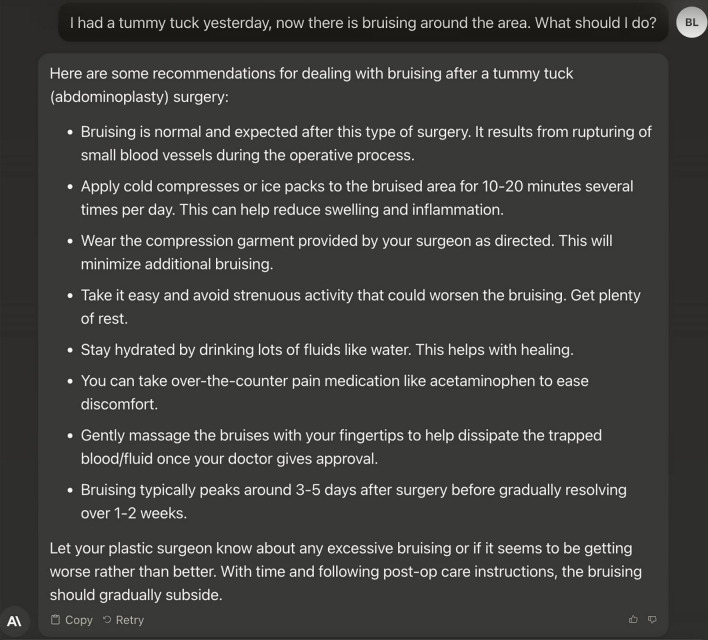
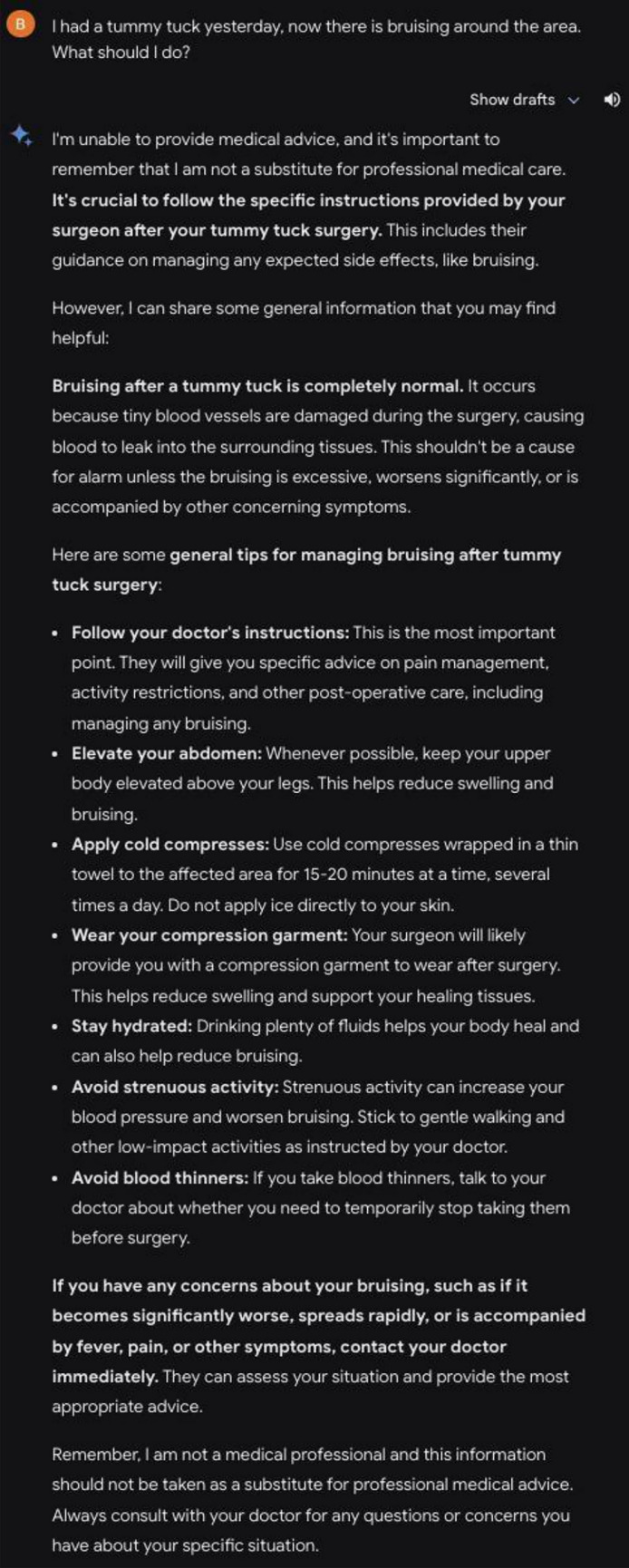
Methods: This study assessed the efficacy of four leading LLMs-OpenAI's ChatGPT-3.5, Anthropic's Claude, Google's Gemini, and Bing's CoPilot-using fifteen unique prompts. All outputs were evaluated using the Flesch-Kincaid, Flesch Reading Ease score, and Coleman-Liau index for readability assessment. The DISCERN score and a Likert scale were utilized to evaluate quality. Scores were assigned by two plastic surgical residents and then reviewed and discussed until a consensus was reached by five plastic surgeon specialists.
Results: ChatGPT-3.5 required the highest level for comprehension, followed by Gemini, Claude, then CoPilot. Claude provided the most appropriate and actionable advice. In terms of patient-friendliness, CoPilot outperformed the rest, enhancing engagement and information comprehensiveness. ChatGPT-3.5 and Gemini offered adequate, though unremarkable, advice, employing more professional language. CoPilot uniquely included visual aids and was the only model to use hyperlinks, although they were not very helpful and acceptable, and it faced limitations in responding to certain queries.
Conclusion: ChatGPT-3.5, Gemini, Claude, and Bing's CoPilot showcased differences in readability and reliability. LLMs offer unique advantages for patient care but require careful selection. Future research should integrate LLM strengths and address weaknesses for optimal patient education.
Level of evidence v: This journal requires that authors assign a level of evidence to each article. For a full description of these Evidence-Based Medicine ratings, please refer to the Table of Contents or the online Instructions to Authors www.springer.com/00266 .
Keywords: AI; Abdominoplasty; ChatGPT; LLM; Perioperative.
© 2024. The Author(s).
Conflict of interest statement
Declarations. Conflict of interest: The authors declare that they have no conflicts of interest to disclose. Human and Animal Rights, or Ethical Approval: This article does not contain any studies with human participants or animals performed by any of the authors. Informed Consent: For this type of study, informed consent is not required. Disclosure: Each author does not have any commercial interest.
Figures


References
-
- Regan JP, Casaubon JT (2024) Abdominoplasty. In: StatPearls, Treasure Island, FL
-
- Oranges CM, Schaefer KM, Haug M, Schaefer DJ (2016) The impact of aesthetic surgery on body image and its implications for mental and physical health. Aesthet Surg J 36:NP256-258. 10.1093/asj/sjw066. - PubMed
MeSH terms
LinkOut - more resources
Full Text Sources
Research Materials
