


Diabetic foot disease carries an intrinsic high risk of mortality and other severe outcomes in type 2 diabetes: a propensity score-matched retrospective population-based study
- PMID: 38898525
- PMCID: PMC11188162
- DOI: 10.1186/s12933-024-02303-1
Diabetic foot disease carries an intrinsic high risk of mortality and other severe outcomes in type 2 diabetes: a propensity score-matched retrospective population-based study
Abstract
Background: To evaluate the association between diabetic foot disease (DFD) and the incidence of fatal and non-fatal events in individuals with type 2 diabetes (T2DM) from primary-care settings.
Methods: We built a cohort of people with a first DFD episode during 2010-2015, followed up until 2018. These subjects were 1 to 1 propensity score matched to subjects with T2DM without DFD. The incidence of all-cause mortality, the occurrence of new DFD, amputations, cardiovascular diseases, or composite outcome, including all-cause mortality and/or cardiovascular events during the follow-up period, were calculated. A Cox proportional hazard analysis was conducted to evaluate the hazard ratios (HR) for different events.
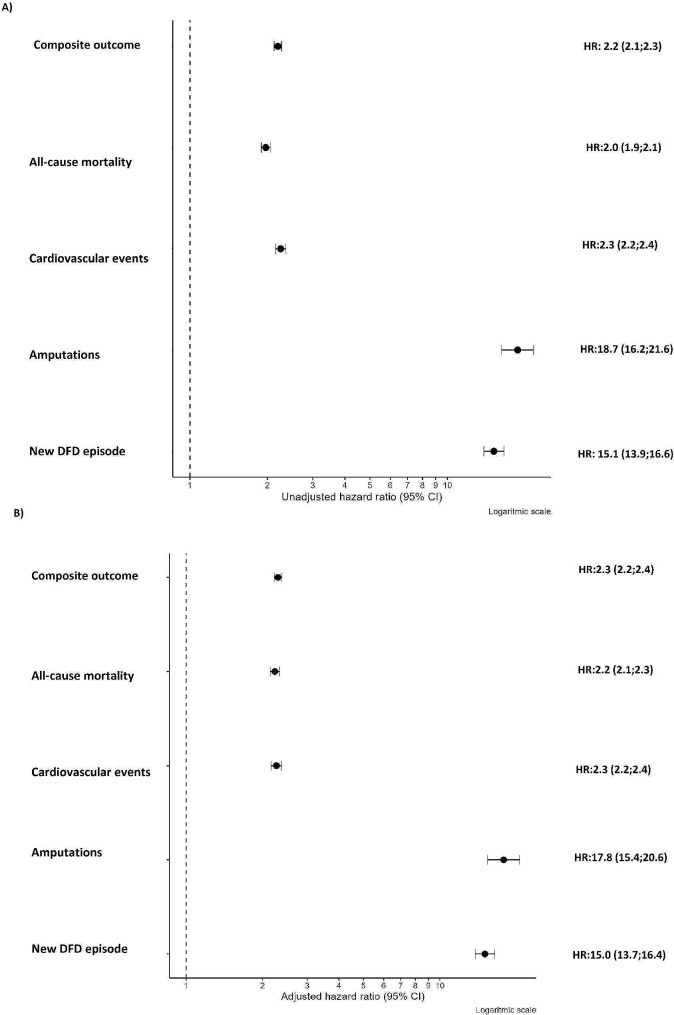
Results: Overall, 11,117 subjects with T2DM with a first episode of DFD were compared with subjects without DFD. We observed higher incidence rates (IRs) for composite outcome (33.9 vs. 14.5 IR per 100 person-years) and a new DFD episode event (22.2 vs. 1.1 IR per 100 person-years) in the DFD group. Compared to those without DFD, those with a first episode of DFD had a higher HR for all events, with excess rates particularly for amputation and new DFD occurrence (HR: 19.4, 95% CI: 16.7-22.6, HR: 15.1, 95% CI: 13.8-16.5, respectively) was found.
Conclusions: Although DFD often coexists with other risk factors, it carries an intrinsic high risk of morbidity and mortality in individuals with T2DM. DFD should be regarded as a severe complication already at its onset, as it carries a poor clinical prognosis.
Keywords: Amputation; Cardiovascular events; Diabetic foot disease; Incidence; Primary healthcare; Severe outcomes.
© 2024. The Author(s).
Conflict of interest statement
Manel Mata-Cases has received advisory and/or speaking fees from Astra-Zeneca, Bayer, Boehringer Ingelheim, GSK, Lilly, MSD, NOVARTIS, NovoNordisk, and Sanofi; he has received research grants to the institution from Astra-Zeneca, GSK, Lilly, MSD, Novartis, NovoNordisk, and Sanofi. Josep Franch-Nadal has received advisory and/or speaking fees from Astra-Zeneca, Ascensia, Boehringer Ingelheim, GSK, Lilly, MSD, Novartis, NovoNordisk, and Sanofi; he has received research grants to the institution from Astra-Zeneca, GSK, Lilly, MSD, Novartis, NovoNordisk, Sanofi, and Boehringer. Dídac Mauricio has received advisory and/or speaking fees from AB Biotics, Almirall, Amgen, Ferrer, Gilead, Lilly, Merck Sharp & Dohme, Menarini, Novo Nordisk and Sanofi. Prof. Mauricio is a co-author of this study and an Editorial Board member of the Cardiovascular diabetology journal. He was not involved in handling this manuscript during the submission and the review processes. Magdalena Bundó, Judit Llussà, have received advisory and speaking fees from MSD. Edward B Jude has received educational, sponsorship and speaker fees from Astra Zeneca, Bayer, Lilly, Menarini, Novonordisk and Sanofi. Xavier Cos has received speaker’s bureau and advisory board honoraria from AstraZeneca, Boehringer Ingelheim, Esteve, Lilly Diabetes, Novo Nordisk A/S, Roche, and Sanofi. Kamlesh Khunti KK has acted as a consultant, speaker or received grants for investigator-initiated studies for Astra Zeneca, Bayer, Novartis, Novo Nordisk, Sanofi-Aventis, Lilly and Merck Sharp & Dohme, Boehringer Ingelheim, Oramed Pharmaceuticals, Pfizer, Roche, Daiichi-Sankyo and Applied Therapeutics. Jordi Real, Diana Tundidor, Francesco Zaccardi and Bogdan Vlacho have no conflict of interest to declare.
Figures
References
Publication types
MeSH terms
Grants and funding
LinkOut - more resources
Full Text Sources
Medical
