


Effect of graft sizing in valve-sparing aortic root replacement for bicuspid aortic valve: The Goldilocks ratio
- PMID: 38899072
- PMCID: PMC11184666
- DOI: 10.1016/j.xjtc.2024.03.025
Effect of graft sizing in valve-sparing aortic root replacement for bicuspid aortic valve: The Goldilocks ratio
Abstract
Objective: To investigate the effect of graft sizing on valve performance in valve-sparing aortic root replacement for bicuspid aortic valve.
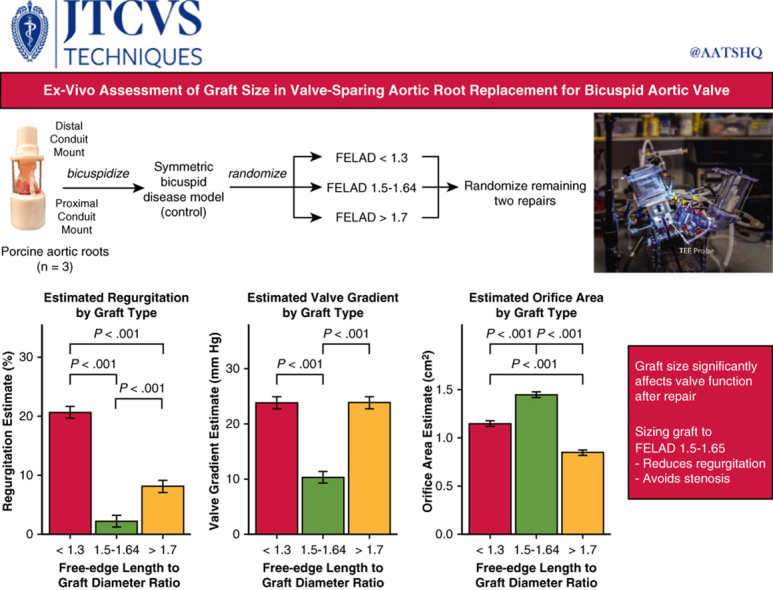
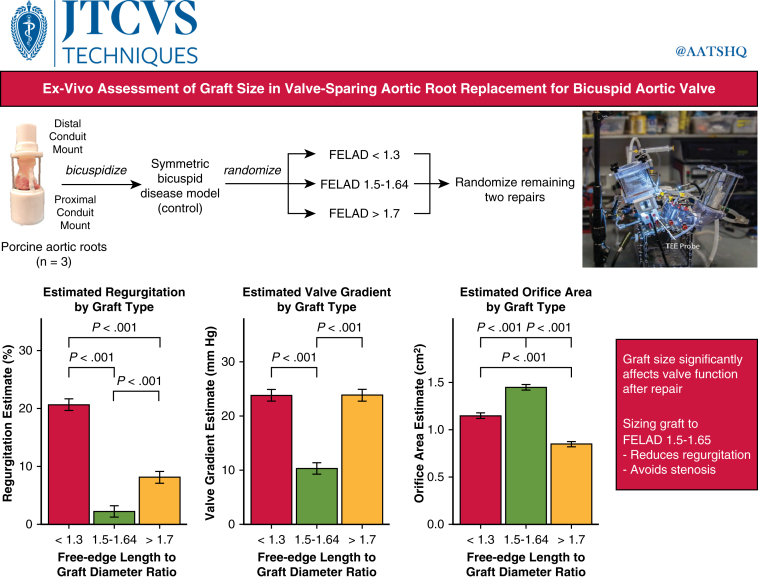
Methods: In addition to a diseased control model, 3 representative groups-free-edge length to aortic/graft diameter (FELAD) ratio <1.3, 1.5 to 1.64, and >1.7-were replicated in explanted porcine aortic roots (n = 3) using straight grafts sized respective to the native free-edge length. They were run on a validated ex vivo univentricular system under physiological parameters for 20 cycles. All groups were tested within the same aortic root to minimize inter-root differences. Outcomes included transvalvular gradient, regurgitation fraction, and orifice area. Linear mixed effects model and pairwise comparisons were employed to compare outcomes across groups.
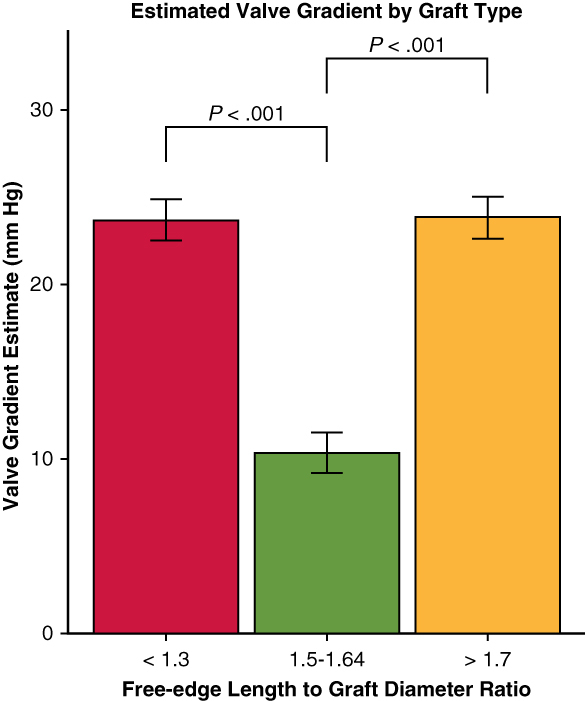
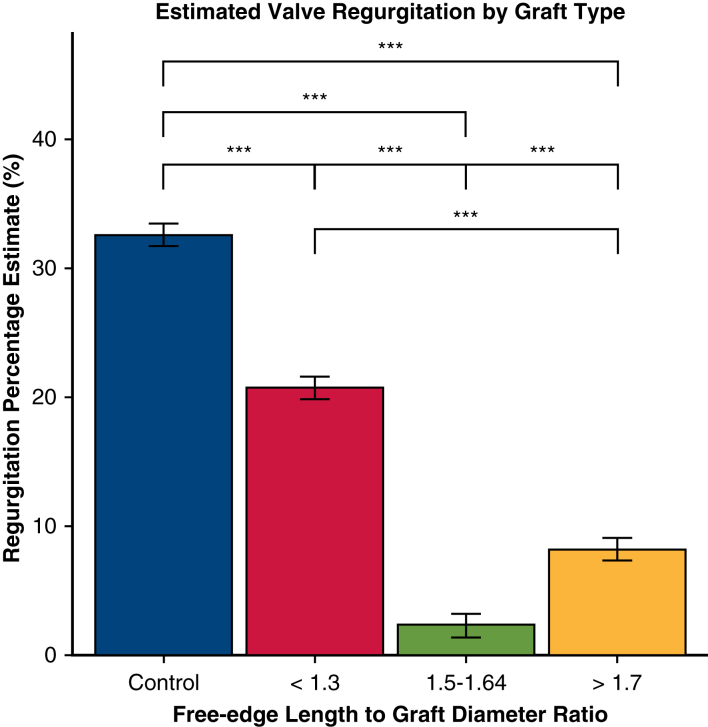
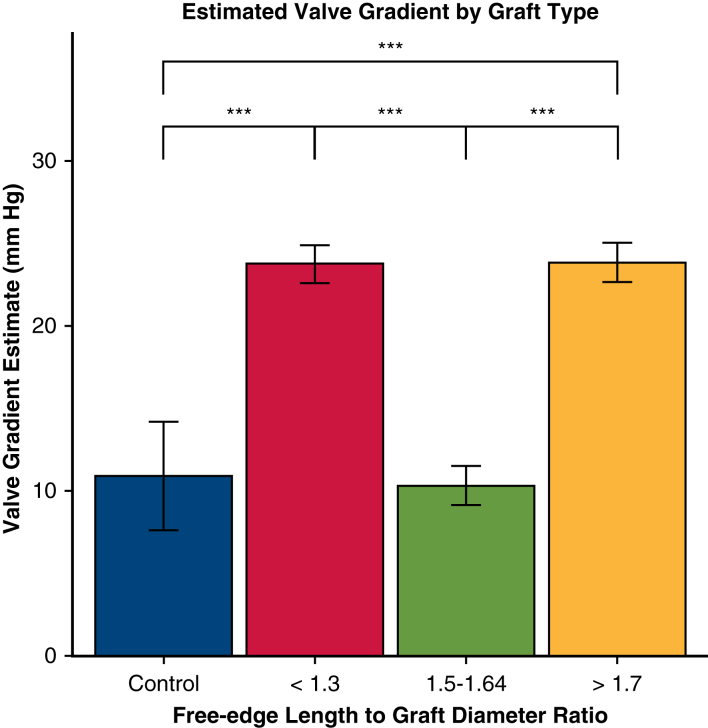
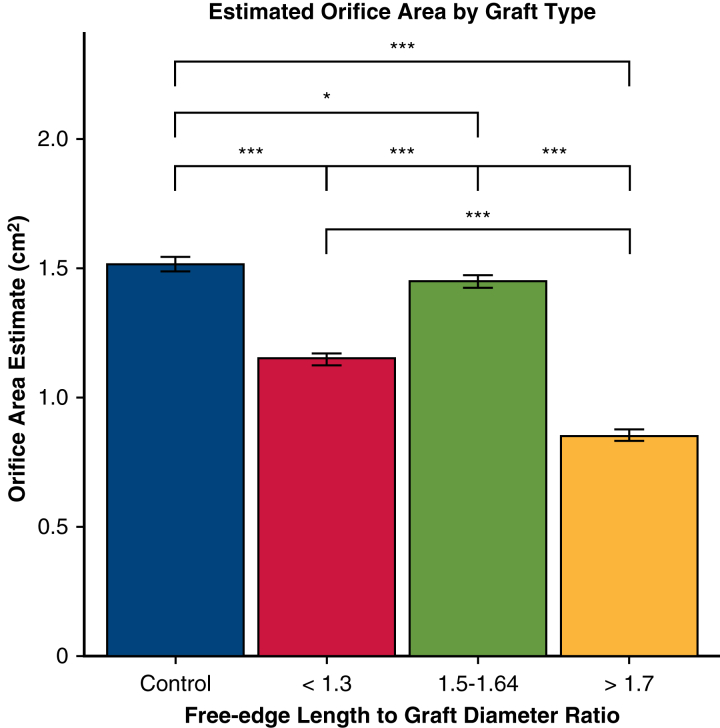
Results: The diseased control had mean transvalvular gradient 10.9 ± 6.30 mm Hg, regurgitation fraction 32.5 ± 4.91%, and orifice area 1.52 ± 0.12 cm2. In ex vivo analysis, all repair groups had improved regurgitation compared with control (P < .001). FELAD <1.3 had the greatest amount of regurgitation among the repair groups (P < .001) and 1.5-1.64 the least (P < .001). FELAD <1.3 and >1.7 exhibited greater mean gradient compared with both control and 1.5 to 1.64 (P < .001). Among the repair groups, 1.5 to 1.64 had the largest orifice area, and >1.7 the smallest (P < .001).
Conclusions: For a symmetric bicuspid aortic valve, performance after valve-sparing aortic root replacement shows a bimodal distribution across graft size. As the FELAD ratio departs from 1.5 to 1.64 in either direction, significant increases in transvalvular gradient are observed. FELAD <1.3 may also result in suboptimal improvement of baseline regurgitation.
Keywords: David procedure; aortic root replacement; aortic valve repair; bicuspid aortic valve; free-edge length; graft size; valve-sparing aortic root replacement.
© 2024 The Author(s).
Conflict of interest statement
The authors reported no conflicts of interest. The Journal policy requires editors and reviewers to disclose conflicts of interest and to decline handling or reviewing manuscripts for which they may have a conflict of interest. The editors and reviewers of this article have no conflicts of interest.
Figures
References
-
- Sá M.P., Jacquemyn X., Van den Eynde J., et al. Long-term outcomes of valve-sparing aortic root versus composite aortic valve graft replacement for aortic root aneurysm: meta-analysis of reconstructed time-to-event data. Am J Surg. 2023;226(3):371–378. doi: 10.1016/j.amjsurg.2023.07.004. - DOI - PubMed
-
- Patel P.M., Chen E.P. Valve sparing root replacement in bicuspid aortic valve disease. Op Tech Thorac Cardiovasc Surg. 2023;28(2):93–109. doi: 10.1053/j.optechstcvs.2022.09.004. - DOI
LinkOut - more resources
Full Text Sources
Research Materials
