. 2024 Jun 20;23(1):211.
doi: 10.1186/s12933-024-02322-y.

Cholesin receptor signalling is active in cardiovascular system-associated adipose tissue and correlates with SGLT2i treatment in patients with diabetes

Affiliations

Cholesin receptor signalling is active in cardiovascular system-associated adipose tissue and correlates with SGLT2i treatment in patients with diabetes

Aleksandra Ryk et al. Cardiovasc Diabetol. .

Abstract

Background: Recently deorphanized G protein-coupled receptor 146 (GPR146) was shown to respond to signal from a newly identified hormone-cholesin-and to play a role in hepatic lipid metabolism. However, the importance of its biological activity in human organism remains elusive, mainly due to the lack of studies on human tissues up to this point. This study aimed to identify the cholesin receptor-associated genes and clinical factors linked with their expression in cardiovascular system and associated adipose tissues.

Methods: Right cardiac auricle, aortic wall, saphenous vein, and adipose tissue (periaortic-PAT, epicardial-EAT, thymic-TAT) samples were collected during coronary artery bypass grafting. Clinical records of the study participants were assessed for the presence of diabetes, medications taken and serum cholesterol levels. GPR146 mRNA expression in all gathered tissues was assessed with qPCR, and RNA seqencing was performed in selected tissues of 20 individuals to identify pathways associated with GPR146 expression.

Results: We included 46 participants [37 male, 23 with type 2 diabetes, median age 68.50 (Q1-Q3: 63.00-72.00) years, BMI 28.39 (26.06-31.49) kg/m2]. GPR146 expression in adipose tissues significantly correlated with BMI, c-peptide, total cholesterol, and LDL concentrations. Selected metabolic pathways were significantly and positively enriched in GPR146-dependent manner. GPR146-coexpressed genes contained key regulators of lipid metabolism involved in such pathways as fatty acid metabolism, tricarboxilic acid cycle and peroxisomal metabolism. Those genes correlated positively with serum concentrations of LDL, HDL, and total cholesterol. SGLT2i treatment was associated with inversion of GPR146-related signature in EAT, suggesting potential impact on cholesin-GPR146 network.

Conclusions: GPR146 expression is associated with serum lipids and metabolically-relevant transcriptomic changes in EAT similar to SGLT2i-associated ones.

Keywords: Adipose tissue; Cholesin; Diabetes; GPR146; SGLT2i.


Conflict of interest statement

AMM and JC have received speaker honoraria from Boehringer Ingelheim. AR, AM, ID, JB, MK and WF have no financial interests to disclose.

Figures
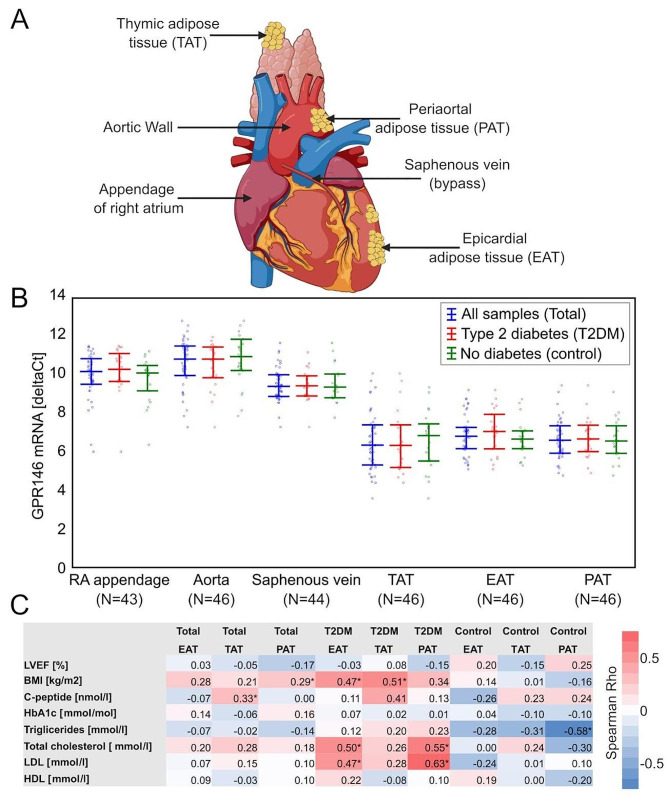
Fig. 1
Fig. 1
Associations of GPR146 expression data in studied tissues with clinical data. A Sources of tissues collected during the surgeries (Adapted from “Coronary artery bypass graft” template by Biorender.com (2024). Retrieved from https://app.biorender.com/biorender-templates); B Expression levels of GPR146 measured using qPCR in the whole group (blue) and individuals with (red), or without (green) diabetes. Values are represented as dCt—higher values represent lower relative expression levels. Expression was uniformly similar across all three types of adipose tissue and significantly greater than in the blood vessel and myocardium samples. C Heatmap of correlation coefficients of GPR146 expression in Epicardial (EAT), Thymic (TAT) and Periaortal (PAT) adipose tissues. Significant (p < 0.05) correlations were marked with asterisk (*). LVEF left ventricle ejection fraction, BMI body mass index, TG triglycerides, LDL low-density lipoprotein, HDL high-density lipoprotein, HbA1c glycated hemoglobin
Fig. 2
Fig. 2
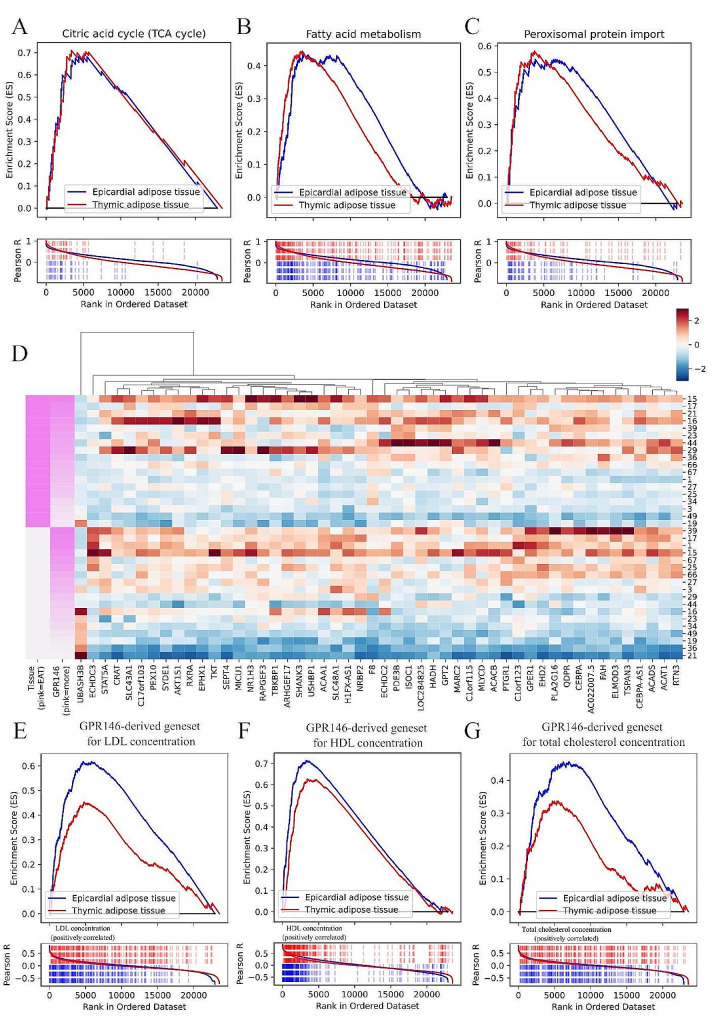
Gene expression landscape in RNA-sequencing data of epicardial (EAT) and thymic (TAT) adipose tissues. AC Enrichment plots of selected genesets enrichment in EAT (blue) and TAT (red): citric acid TCA cycle (A), fatty acid metabolism (B) and peroxisomal protein transport pathways (C). D Heatmap of gene expression (z-score, normalized within gene) of 50 genes with the strongest correlation in both EAT and TAT with GPR146 levels. Pink tissue class marker represents EAT and white TAT. EG Enrichment plots of GPR146-associated geneset which correlated significantly in both EAT and TAT with: LDL (E), HDL (F) and total cholesterol levels (G)
Fig. 3
Fig. 3
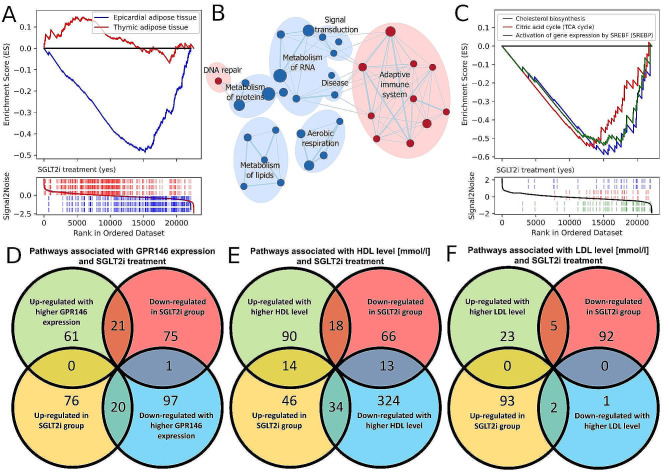
A Enrichment plot of the GPR146-associated geneset which showed significant downregulation in SGLT2-treated individuals in EAT but not in TAT. B Enrichment map of pathways significantly associated with SGLT2i treatment. C Enrichment plot of significant suppression of cholesterol biosynthesis (blue), citric acid cycle (TCA cycle) (red) and activation of gene expression of by SREBF (SREBP) (green) signaling pathways in EAT in patients treated with SGLT2i. DF Venn diagrams of pathways significantly associated with SGLT2i treatment and GPR146 expression (p < 0.0001), HDL (p < 0.0001) or LDL (p = 0.0022)

References

    1. Hu X, Chen F, Jia L, Long A, Peng Y, Li X, et al. A gut-derived hormone regulates cholesterol metabolism. Cell. 2024;187(7):1685–1700.e18. doi: 10.1016/j.cell.2024.02.024. - DOI - PubMed
    1. Han F, Liu X, Chen C, Liu Y, Du M, Zhou Y, et al. Hypercholesterolemia risk-associated GPR146 is an orphan G-protein coupled receptor that regulates blood cholesterol levels in humans and mice. Cell Res. 2020;30:363–365. doi: 10.1038/s41422-020-0303-z. - DOI - PMC - PubMed
    1. Yu H, Rimbert A, Palmer AE, Toyohara T, Xia Y, Xia F, et al. GPR146 deficiency protects against hypercholesterolemia and atherosclerosis. Cell. 2019;179(6):1276–1288.e14. doi: 10.1016/j.cell.2019.10.034. - DOI - PMC - PubMed
    1. Huang J, Xie Y, Chen B, Xia Y, Jiang Y, Sun Z, et al. GPR146 regulates pulmonary vascular remodeling by promoting pulmonary artery smooth muscle cell proliferation through 5-lipoxygenase. Eur J Pharmacol. 2023;961:176123. doi: 10.1016/j.ejphar.2023.176123. - DOI - PubMed
    1. Kaczmarek I, Wower I, Ettig K, Kuhn CK, Kraft R, Landgraf K, et al. Identifying G protein-coupled receptors involved in adipose tissue function using the innovative RNA-seq database FATTLAS. iScience. 2023;26(10):107841. doi: 10.1016/j.isci.2023.107841. - DOI - PMC - PubMed

Publication types

Substances