


Aging trajectories of subscales in higher-level functional capacity among community-dwelling older Japanese adults: the Otassha study
- PMID: 38904857
- PMCID: PMC11192685
- DOI: 10.1007/s40520-024-02791-x
Aging trajectories of subscales in higher-level functional capacity among community-dwelling older Japanese adults: the Otassha study
Abstract
Background: Maintaining higher-level functional capacity is important for independent living in older age. The aging trajectory of the Tokyo Metropolitan Institute of Gerontology Index of Competence (TMIG-IC) has three patterns; however, the subscale patterns are unclear.
Aims: This study aimed to clarify the aging trajectory patterns of the TMIG-IC subscales among community-dwelling older Japanese.
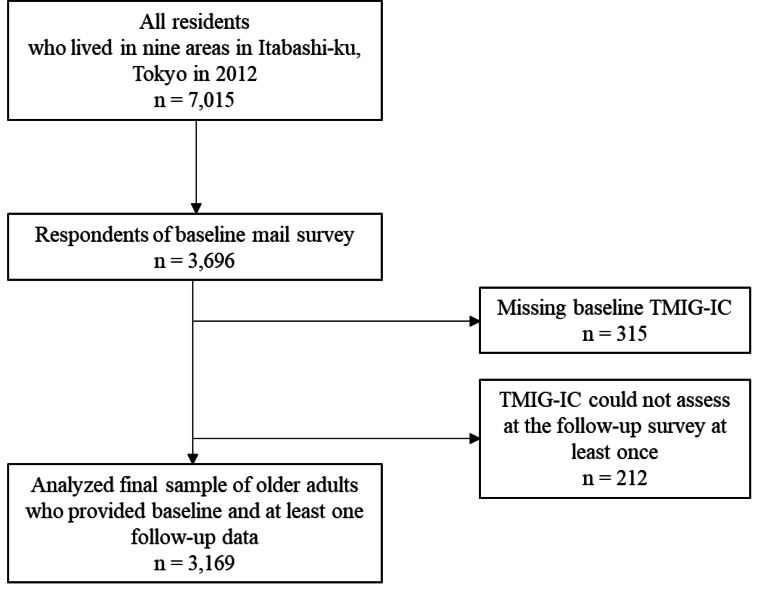
Methods: Participants were 3,169 community-dwelling older Japanese who participated in the 2012-2022 mail survey of the Otassha study. The aging trajectory patterns of the TMIG-IC total and subscale scores for those aged 65-90 years were identified using group-based trajectory modeling. Further, the combination frequency of the subscale trajectory patterns was determined.
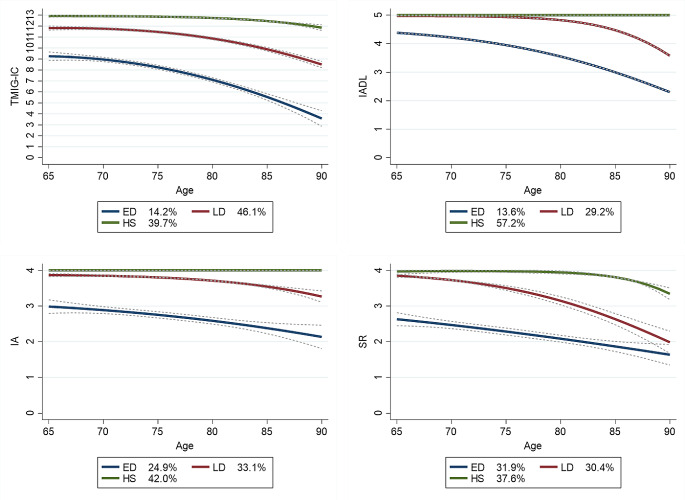
Results: Three patterns were identified: early-onset decreasing, late-onset decreasing, and high-stable.
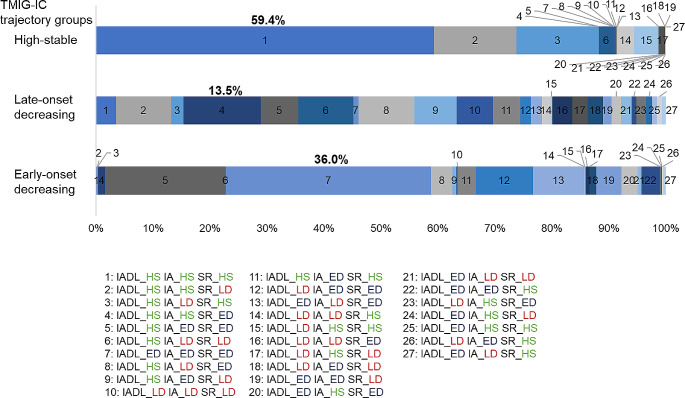
Discussion: The instrumental activities of daily living (IADL) trajectory was maintained until approximately 80 years of age; however, chronic disease prevailed the most in the early-onset decreasing pattern. The early-onset decreasing pattern of intellectual activity (IA) was present in 25% of participants, showing impaired IA from 65 years of age. The late-onset decreasing pattern of social roles (SR) was present in 30% of participants, showing a sharp decline compared to other subscales. For many people, the patterns of decrease in SR and IA overlapped.
Conclusions: To maintain higher-level functional capacity, interventions that include disease management and prevention of decline in IADL and increase the awareness of the social support provided throughout old age and interventions for people with an early decline in IA should be implemented.
Keywords: Group-based trajectory modeling; Higher-level functional capacity; Subscale; Tokyo Metropolitan Institute of Gerontology Index of Competence.
© 2024. The Author(s).
Conflict of interest statement
The authors declare no competing interests.
Figures
References
-
- Lawton M. Research, planning, and action for elderly. In: Kent DP, Kastenbaum R, Sherwood S, editors. The power and potential of social science. New York: Behavioral; 1972. pp. 122–143.
-
- Kawai H, Ejiri M, Imamura K, Ito K, Fujiwara Y, Ihara K, Hirano H, Obuchi S. Impact of combinations of subscale declines in higher-level functional capacity on 8-year all-cause mortality among community-dwelling older Japanese adults. Arch Gerontol Geriatr. 2023;114:105096. doi: 10.1016/j.archger.2023.105096. - DOI - PubMed
-
- Taniguchi Y, Kitamura A, Nofuji Y, Ishizaki T, Seino S, Yokoyama Y, Shinozaki T, Murayama H, Mitsutake S, Amano H, Nishi M, Matsuyama Y, Fujiwara Y, Shinkai S. Association of trajectories of higher-level functional capacity with mortality and medical and long-term care costs among community-dwelling older Japanese. J Gerontol Biol Sci Med Sci. 2019;74(2):211–218. doi: 10.1093/gerona/gly024. - DOI - PubMed
-
- Murakami K, Tsubota-Utsugi M, Satoh M, Asayama K, Inoue R, Ishiguro A, Matsuda A, Kanno A, Yasui D, Murakami T, Metoki H, Kikuya M, Imai Y, Ohkubo T. Impaired higher-level functional capacity as a predictor of stroke in community-dwelling older adults: the Ohasama Study. Stroke. 2016;47(2):323–328. doi: 10.1161/STROKEAHA.115.011131. - DOI - PubMed
MeSH terms
Grants and funding
LinkOut - more resources
Full Text Sources
Medical
Research Materials
