


The roles of lipids and inflammation in the association between the triglyceride-glucose index and arterial stiffness: evidence from two large population-based surveys
- PMID: 38909224
- PMCID: PMC11193289
- DOI: 10.1186/s12944-024-02183-0
The roles of lipids and inflammation in the association between the triglyceride-glucose index and arterial stiffness: evidence from two large population-based surveys
Abstract
Background: The triglyceride-glucose (TyG) index is a risk marker for arterial stiffness; however, the extent to which the TyG index is associated with arterial stiffness via lipids and inflammation remains unknown. The first aim was to probe the relationship between the TyG index and arterial stiffness in two surveys. The second aim was to clarify whether lipids and inflammation mediate this relationship.
Methods: The sample size of 13,726 U.S. individuals from the National Examination Survey (NHANES) and 3,964 Chinese individuals from the China Health and Retirement Longitudinal Study (CHARLS 2015) were enrolled. Weighted multivariate logistic and linear regression models, as well as restricted cubic spline (RCS) and mediation analyses, were utilized to estimate complex relationships between the TyG index, arterial stiffness, lipids (non-high-density lipoprotein cholesterol [non-HDL-C]) and inflammation (C-reactive protein [CRP]) biomarkers.
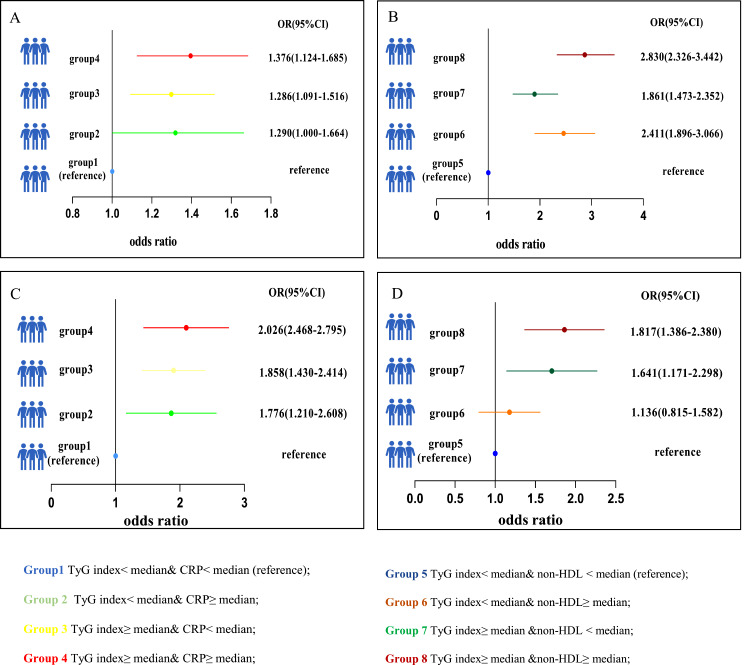
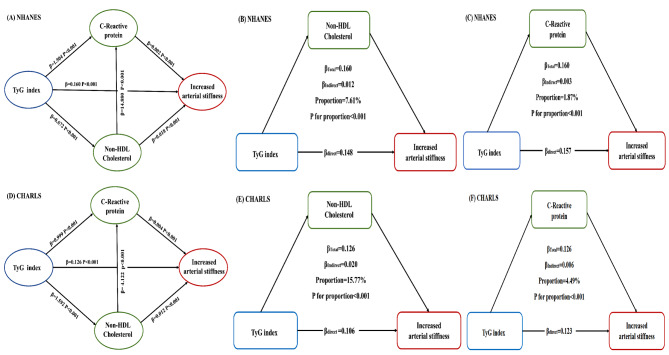
Results: A total of 3,420 U.S. patients and 992 Chinese patients were diagnosed with increased arterial stiffness. Regression analyses demonstrated that higher quartiles of the TyG index were associated with a greater incidence of increased arterial stiffness (NHANES: OR = 2.610, 95% CI = 2.043-3.334, P < 0.001; CHARLS: OR = 1.579, 95% CI = 1.057-2.360, P < 0.001). Participants with a higher TyG index/higher CRP level or with a higher TyG index/higher non-HDL-C level had the highest incidence of increased arterial stiffness in the two surveys. The results were still consistent when the sensitivity analysis was implemented with stricter clinical cut-off values of non-HDL-C. Mediation analysis verified that lipids (mediated effect: β = 0.012, P < 0.001 in NHANES; β = 0.020, P < 0.001 in CHARLS) and inflammation (mediated effect: β = 0.003, P < 0.001 in NHANES; β = 0.006, P < 0.001 in CHARLS) partially mediated this relationship.
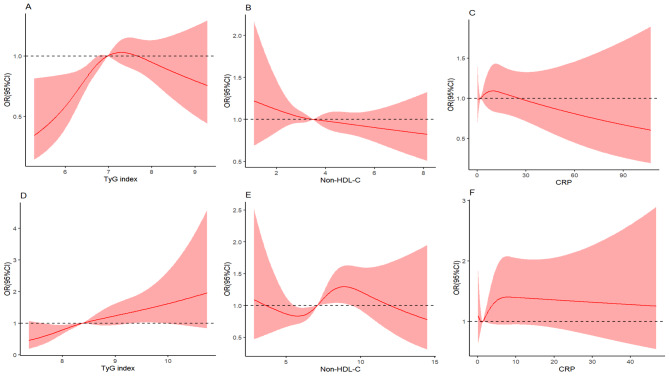
Conclusions: These results indicated a positive linear correlation between the TyG index, non-HDL-C level, CRP level and increased arterial stiffness in two surveys. Furthermore, lipids and inflammation could partly mediate the correlation of the TyG index with arterial stiffness in both surveys.
Keywords: Arterial stiffness; Inflammation; Lipid; Mediation analyses; Triglyceride-glucose (TyG) index.
© 2024. The Author(s).
Conflict of interest statement
The authors declare no competing interests.
Figures


References
MeSH terms
Substances
LinkOut - more resources
Full Text Sources
Medical
Research Materials
Miscellaneous
