Revision of metal-on-metal hip replacements with dual-mobility bearings and acetabular component retention
- PMID: 38910515
- PMCID: PMC11194627
- DOI: 10.1302/2633-1462.56.BJO-2023-0165.R1
Revision of metal-on-metal hip replacements with dual-mobility bearings and acetabular component retention
Abstract
Aims: In metal-on-metal (MoM) hip arthroplasties and resurfacings, mechanically induced corrosion can lead to elevated serum metal ions, a local inflammatory response, and formation of pseudotumours, ultimately requiring revision. The size and diametral clearance of anatomical (ADM) and modular (MDM) dual-mobility polyethylene bearings match those of Birmingham hip MoM components. If the acetabular component is satisfactorily positioned, well integrated into the bone, and has no surface damage, this presents the opportunity for revision with exchange of the metal head for ADM/MDM polyethylene bearings without removal of the acetabular component.
Methods: Between 2012 and 2020, across two centres, 94 patients underwent revision of Birmingham MoM hip arthroplasties or resurfacings. Mean age was 65.5 years (33 to 87). In 53 patients (56.4%), the acetabular component was retained and dual-mobility bearings were used (DM); in 41 (43.6%) the acetabulum was revised (AR). Patients underwent follow-up of minimum two-years (mean 4.6 (2.1 to 8.5) years).
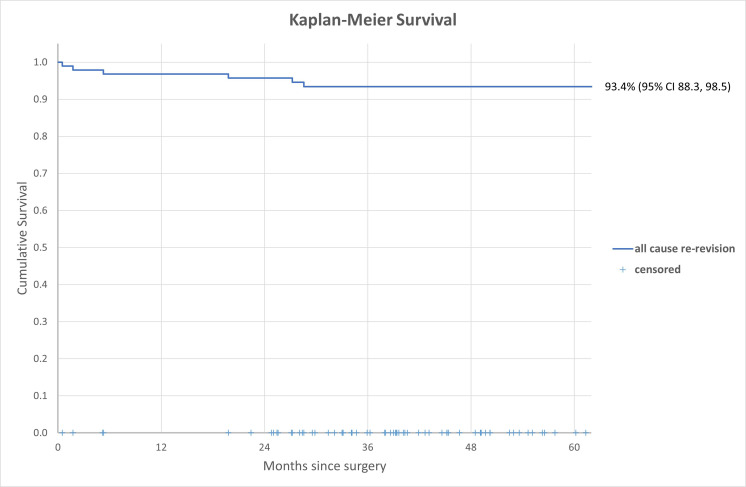
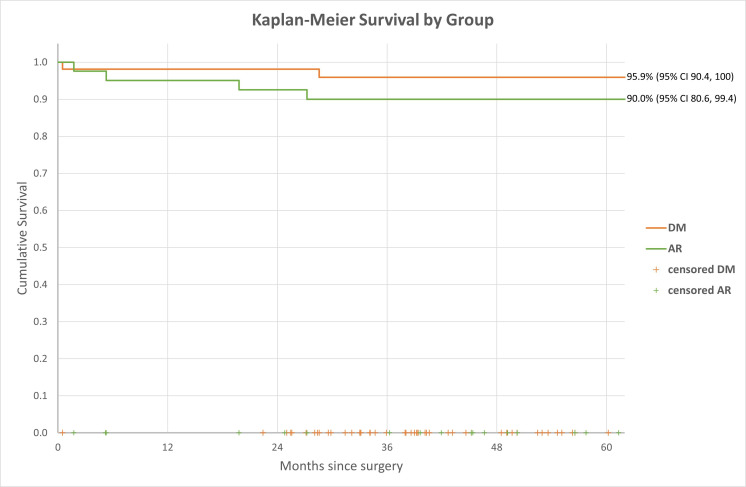
Results: In the DM group, two (3.8%) patients underwent further surgery: one (1.9%) for dislocation and one (1.9%) for infection. In the AR group, four (9.8%) underwent further procedures: two (4.9%) for loosening of the acetabular component and two (4.9%) following dislocations. There were no other dislocations in either group. In the DM group, operating time (68.4 vs 101.5 mins, p < 0.001), postoperative drop in haemoglobin (16.6 vs 27.8 g/L, p < 0.001), and length of stay (1.8 vs 2.4 days, p < 0.001) were significantly lower. There was a significant reduction in serum metal ions postoperatively in both groups (p < 0.001), although there was no difference between groups for this reduction (p = 0.674 (cobalt); p = 0.186 (chromium)).
Conclusion: In selected patients with Birmingham MoM hips, where the acetabular component is well-fixed and in a satisfactory position with no surface damage, the metal head can be exchanged for polyethylene ADM/MDM bearings with retention of the acetabular prosthesis. This presents significant benefits, with a shorter procedure and a lower risk of complications.
© 2024 Fishley et al.
Conflict of interest statement
W. Fishley reports a BOA/ORUK Research Fellowship Grant and Zimmer Biomet/Northumbria Educational Fellowship Grant, unrelated to this study. J. R. Howell reports institutional support for research staff, and royalties on the Exeter Hip Replacement System, from Stryker Orthopaedics, unrelated to this study. M. J. W. Hubble reports an institutional Contract between Royal Devon and Exeter Hospital and Stryker to provide education courses, a long-term follow up database, and research projects. This study was not directly funded by Stryker, but the aforementioned database was used for data retrieval and analysis for this study. M. J. W. Hubble also reports royalties on the Exeter Hip Replacement System from Stryker, unrelated to this study. A. M. Kassam reports an institutional contract for funding of research team and department fellows, and a contract for consulting services and provision of teaching, from Stryker, unrelated to this study. P. F. Partington reports payments for lectures from Heraeus, unrelated to this study. T. Petherham reports education contracts with Stryker and Heraeus, unrelated to this study, and holds unpaid positions as the Webmaster for the British Hip Society, Treasurer for the Bone and Joint Infection Registry (BAJIR), and BAJIR Rep on the BAJIR Executive Committee. M. R. Reed reports institutional payments from Stryker, Zimmer Biomet, Heraeus, Link, Depuy, Smith & Nephew, Implantcast, and Biocomposites, individual payments from Heraeus for management time as Chief Investigator on a randomized controlled trial, consulting fees from Heraeus and Pharmacosmos, an educational grant from Zimmer Biomet, financial support for machine learning risk prediction from Microsoft, and educational event payments from Zimmer Biomet, Heraeus Medical, Stryker, Pharmacosmos, and Ethicon sutures, all of which are unrelated to this study. M. R. Reed is also an unpaid trustee for Orthopaedic Research UK. S. L. Whitehouse and M. J. Wilson report an institutional contract with Stryker to support research and teaching activities, not specifically or solely for this study. M. J. Wilson also reports royalties from Stryker Orthopaedics, unrelated to this study, and is Vice President of the British Hip Society.
Figures

References
-
- No authors listed Australian Orthopaedic Association National Joint Replacement Registry Annual Report. [7 June 2024]; Australian Orthopaedic Association National Joint Replacement Registry. 2008 https://aoanjrr.sahmri.com/annual-reports-2008 date last. accessed.
-
- No authors listed . London, UK: National Joint Registry for England, Wales, Northern Ireland and Isle of Man; 2010. 7th Annual Report.
LinkOut - more resources
Full Text Sources
Research Materials