Review
. 2024 Jun 7:15:1376252.
doi: 10.3389/fphar.2024.1376252. eCollection 2024.

Targeting pyruvate kinase M2 for the treatment of kidney disease

Affiliations
Review

Targeting pyruvate kinase M2 for the treatment of kidney disease

Dan-Qian Chen et al. Front Pharmacol. .

Abstract

Pyruvate kinase M2 (PKM2), a rate limiting enzyme in glycolysis, is a cellular regulator that has received extensive attention and regards as a metabolic regulator of cellular metabolism and energy. Kidney is a highly metabolically active organ, and glycolysis is the important energy resource for kidney. The accumulated evidences indicates that the enzymatic activity of PKM2 is disturbed in kidney disease progression and treatment, especially diabetic kidney disease and acute kidney injury. Modulating PKM2 post-translational modification determines its enzymatic activity and nuclear translocation that serves as an important interventional approach to regulate PKM2. Emerging evidences show that PKM2 and its post-translational modification participate in kidney disease progression and treatment through modulating metabolism regulation, podocyte injury, fibroblast activation and proliferation, macrophage polarization, and T cell regulation. Interestingly, PKM2 activators (TEPP-46, DASA-58, mitapivat, and TP-1454) and PKM2 inhibitors (shikonin, alkannin, compound 3k and compound 3h) have exhibited potential therapeutic property in kidney disease, which indicates the pleiotropic effects of PKM2 in kidney. In the future, the deep investigation of PKM2 pleiotropic effects in kidney is urgently needed to determine the therapeutic effect of PKM2 activator/inhibitor to benefit patients. The information in this review highlights that PKM2 functions as a potential biomarker and therapeutic target for kidney diseases.

Keywords: acute kidney injury; diabetic kidney disease; glycolysis; post-translational modification; pyruvate kinase M2.


Conflict of interest statement

The authors declare that the research was conducted in the absence of any commercial or financial relationships that could be construed as a potential conflict of interest.

Figures
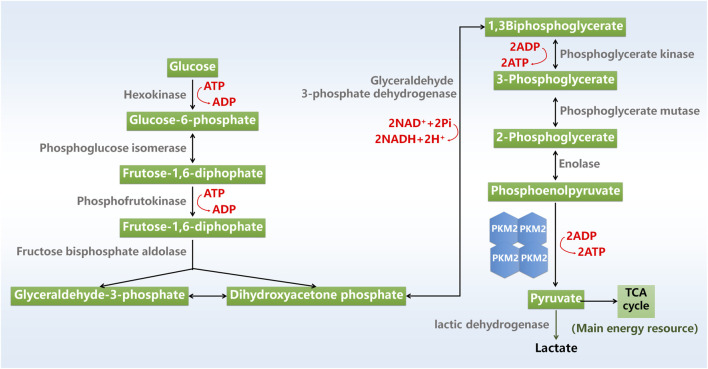
FIGURE 1
FIGURE 1
Glycolysis process. ADP, adenosine triphosphate; ATP, adenosine triphosphate; NAD, nicotinamide adenine dinucleotide; TCA cycle, tricarboxylic acid cycle.
FIGURE 2
FIGURE 2
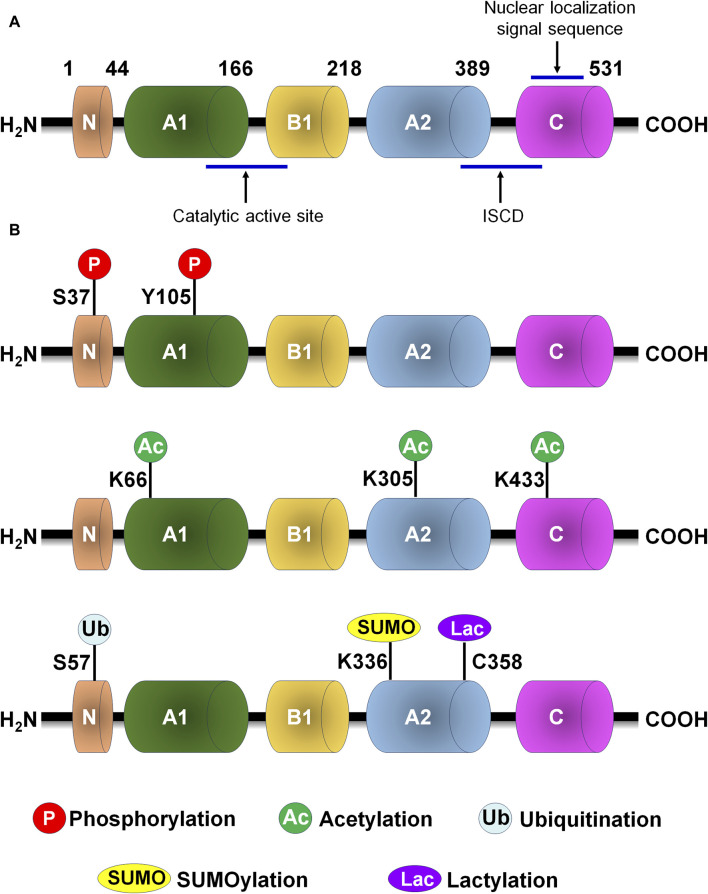
PKM2 protein structure and post-translational modification of PKM2. (A) PKM2 protein structure. (B) The major post-translational modification sites of PKM2, including phosphorylation, acetylation, ubiquitination, SUMOylation and lactylation. C, cysteine; ISCD, intersubunit contact domain; K, lysine; S, serine; Y, tyrosine.
FIGURE 3
FIGURE 3
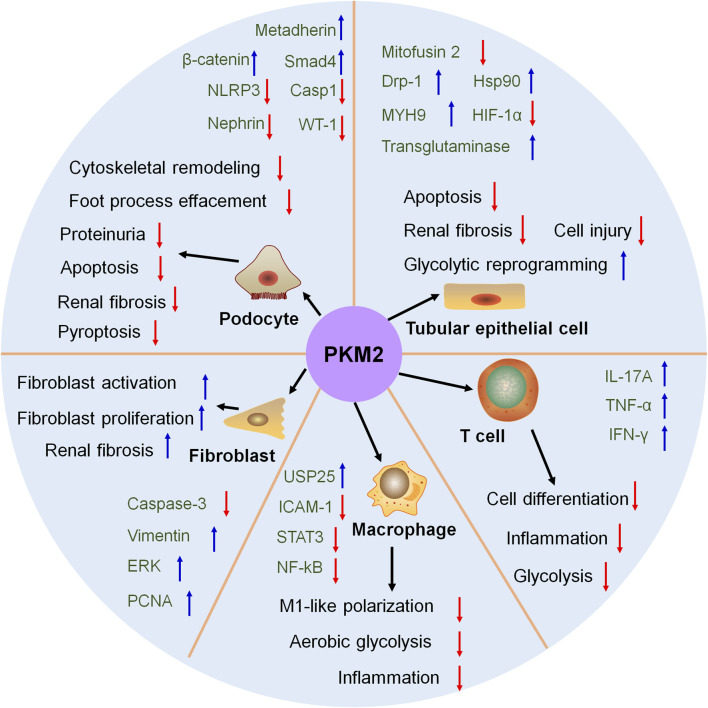
The role of PKM2 in kidney. In tubular epithelial cell, podocyte, fibroblast, macrophage and T cell, PKM2 participate in kidney disease and treatment. Drp-1, dynamin-related protein-1; ERK, extracellular regulated protein kinase; HIF-1α, hypoxia inducible factor-1; HSP90, heat shock protein 90; ICAM-1, intercellular cell adhesion molecule-1; IFN-γ, interferon gamma; IL-17A, interleukin-17A; MYH9, myosin heavy chain 9; NF-κB, nuclear factor kappa-B; NLPR3, NOD-like receptor thermal protein domain associated protein 3; PCNA, proliferating cell nuclear antigen; STAT3, signal transducer and activator of transcription 3; TNF-α, tumor necrosis factor-α; USP25, ubiquitin specific peptidase 25; WT-1, Wilm’s tumor-1.

References

    1. Almousa A. A., Morris M., Fowler S., Jones J., Alcorn J. (2018). Elevation of serum pyruvate kinase M2 (PKM2) in IBD and its relationship to IBD indices. Clin. Biochem. 53, 19–24. 10.1016/j.clinbiochem.2017.12.007 - DOI - PubMed
    1. Alquraishi M., Chahed S., Alani D., Puckett D. L., Dowker P. D., Hubbard K., et al. (2022). Podocyte specific deletion of PKM2 ameliorates LPS-induced podocyte injury through beta-catenin. Cell Commun. 20 (1), 76. 10.1186/s12964-022-00884-6 - DOI - PMC - PubMed
    1. Alquraishi M., Puckett D. L., Alani D. S., Humidat A. S., Frankel V. D., Donohoe D. R., et al. (2019). Pyruvate kinase M2: a simple molecule with complex functions. Free Radic. Biol. Med. 143, 176–192. 10.1016/j.freeradbiomed.2019.08.007 - DOI - PMC - PubMed
    1. Al-Samkari H., Galactéros F., Glenthøj A., Rothman J. A., Andres O., Grace R. F., et al. (2022). Mitapivat versus placebo for pyruvate kinase deficiency. N. Engl. J. Med. 386 (15), 1432–1442. 10.1056/NEJMoa2116634 - DOI - PubMed
    1. An S., Huang L., Miao P., Shi L., Shen M., Zhao X., et al. (2018). Small ubiquitin-like modifier 1 modification of pyruvate kinase M2 promotes aerobic glycolysis and cell proliferation in A549 human lung cancer cells. Onco. Targets Ther. 11, 2097–2109. 10.2147/ott.S156918 - DOI - PMC - PubMed