


Inconsistent Increase in Age at Respiratory Syncytial Virus Hospitalization of Children Aged <2 Years During the Severe Acute Respiratory Syndrome Coronavirus 2 Pandemic: A Retrospective Multicenter Study in 4 European Countries
- PMID: 38912724
- PMCID: PMC11566234
- DOI: 10.1093/infdis/jiae292
Inconsistent Increase in Age at Respiratory Syncytial Virus Hospitalization of Children Aged <2 Years During the Severe Acute Respiratory Syndrome Coronavirus 2 Pandemic: A Retrospective Multicenter Study in 4 European Countries
Abstract
Background: The severe acute respiratory syndrome coronavirus 2 (SARS-CoV-2) pandemic disrupted respiratory syncytial virus (RSV) seasonality. To optimize the use and evaluation of RSV infant immunization strategies, monitoring changes in RSV epidemiology is essential.
Methods: Hospitalizations for acute respiratory infections (ARIs) and RSV-coded ARI in children <2 years were extracted in 4 European hospitals, according to predefined case definitions (International Classification of Diseases, Tenth Revision codes). Prepandemic RSV seasons (2017-2018 to 2019-2020) were compared to 2021-2022 and 2022-2023.
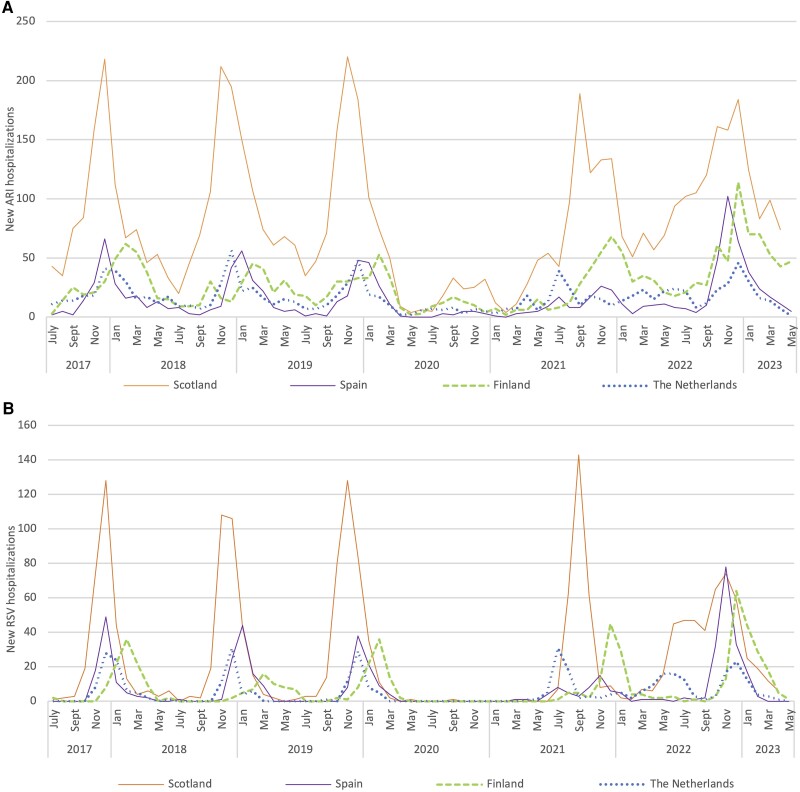
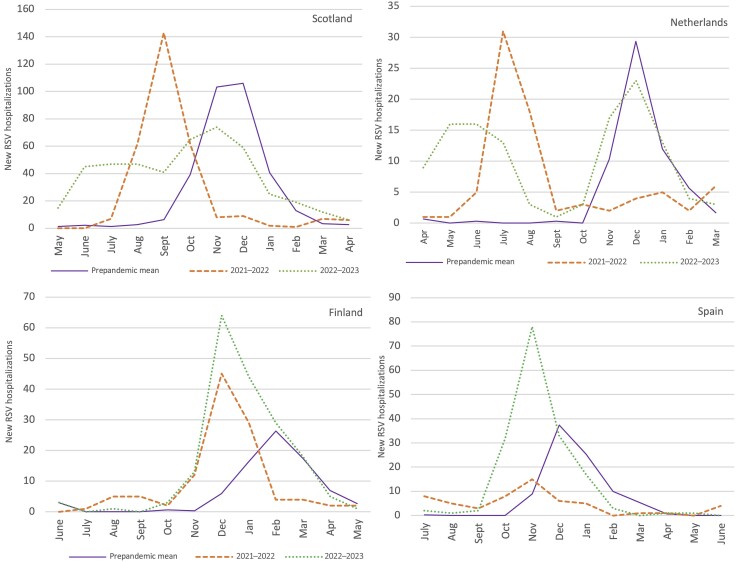
Results: In 2021-2022 and 2022-2023, the peak number of RSV hospitalizations was higher than prepandemic peaks after short periods of RSV circulation, and lower than prepandemic peaks after long periods of RSV circulation. A greater proportion of RSV hospitalizations occurred in children 1 to <2 years in 2021-2022 in the Netherlands (18% vs 9%, P = .04). No increase in age was observed elsewhere. High-risk children represented a greater proportion of RSV hospitalizations during the pandemic. The proportion of pediatric intensive care unit admissions did not increase.
Conclusions: A decrease in population immunity has been linked to older age at RSV hospitalization. We did not observe an increase in age in 3 of the 4 participating countries. Broad age categories may have prevented detecting an age shift. Monitoring RSV epidemiology is essential as Europe implements RSV immunization.
Keywords: COVID-19 pandemic; RSV; children; epidemiology; hospitalization.
© The Author(s) 2024. Published by Oxford University Press on behalf of Infectious Diseases Society of America.
Conflict of interest statement
Potential conflicts of interest. J. G. W. has been an investigator for clinical trials sponsored by pharmaceutical companies, including AstraZeneca, Merck, Pfizer, Sanofi, and Janssen, and participated in the advisory boards of Janssen and Sanofi and was a speaker at a Sanofi sponsored symposium (all fees/honoraria were paid to UMCU). T. H. has received honoraria for lectures or participation in advisory boards or data monitoring committees from Janssen, Sanofi, Enanta, MSD, Pfizer, Moderna, and Shionogi. A. D.-U. participated in clinical trials for vaccines, monoclonals, and antivirals for RSV as a subinvestigator. All honoraria were paid to the institution. F. M.-T. reports honoraria from GSK, Pfizer, Sanofi Pasteur, MSD, Seqirus, Biofabri, and Janssen for taking part in advisory boards and expert meetings and for acting as a speaker in congresses, outside the submitted work; and principal investigator role in randomized controlled trials for GSK, Pfizer, Sanofi Pasteur, MSD, Seqirus, Biofabri, Janssen, Ablynx, Gilead, Regeneron, Roche, Abbott, Novavax, and MedImmune, with honoraria paid to his institution. S. C. has provided consultancy or investigator roles in relation to product development for Ablynx, Janssen, MedImmune, AstraZeneca, Pfizer, GSK, Vertex, AbbVie, and Boehringer Ingelheim, with fees paid to the University of Edinburgh. L. J. B. has regular interaction with pharmaceutical and other industrial partners. He has not received personal fees or other personal benefits. UMCU has received major funding (>€100 000 per industrial partner) for investigator-initiated studies from AbbVie, MedImmune, AstraZeneca, Sanofi, Janssen, Pfizer, MSD, and MeMed Diagnostics. UMCU has received major funding for the RSV GOLD study from the Bill & Melinda Gates Foundation. UMCU has received major funding as part of the public-private partnership IMI-funded RESCEU and PROMISE projects with partners GSK, Novavax, Janssen, AstraZeneca, Pfizer, and Sanofi. UMCU has received major funding by Julius Clinical for participating in clinical studies sponsored by MedImmune and Pfizer. UMCU received minor funding (€1000–€25 000 per industrial partner) for consultation and invited lectures by AbbVie, MedImmune, Ablynx, Bavaria Nordic, MabXience, GSK, Novavax, Pfizer, Moderna, AstraZeneca, MSD, Sanofi, Janssen. L. B. is the founding chairman of the ReSViNET Foundation. All other authors report no potential conflicts. All authors have submitted the ICMJE Form for Disclosure of Potential Conflicts of Interest. Conflicts that the editors consider relevant to the content of the manuscript have been disclosed.
Figures
References
-
- Reeves RM, van Wijhe M, Tong S, et al. . Respiratory syncytial virus–associated hospital admissions in children younger than 5 years in 7 European countries using routinely collected datasets. J Infect Dis 2020; 222(Suppl 7):S599–605. - PubMed
Publication types
MeSH terms
Grants and funding
LinkOut - more resources
Full Text Sources
Medical
Miscellaneous
