


Comprehensive profiling of social mixing patterns in resource poor countries: A mixed methods research protocol
- PMID: 38913670
- PMCID: PMC11195963
- DOI: 10.1371/journal.pone.0301638
Comprehensive profiling of social mixing patterns in resource poor countries: A mixed methods research protocol
Abstract
Background: Low-and-middle-income countries (LMICs) bear a disproportionate burden of communicable diseases. Social interaction data inform infectious disease models and disease prevention strategies. The variations in demographics and contact patterns across ages, cultures, and locations significantly impact infectious disease dynamics and pathogen transmission. LMICs lack sufficient social interaction data for infectious disease modeling.
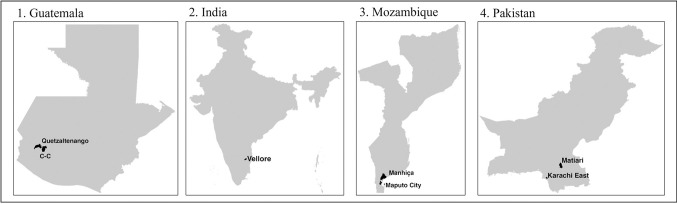
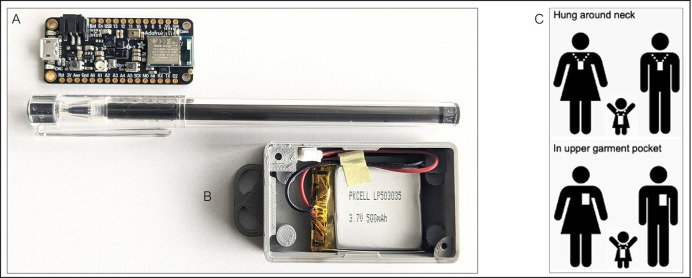
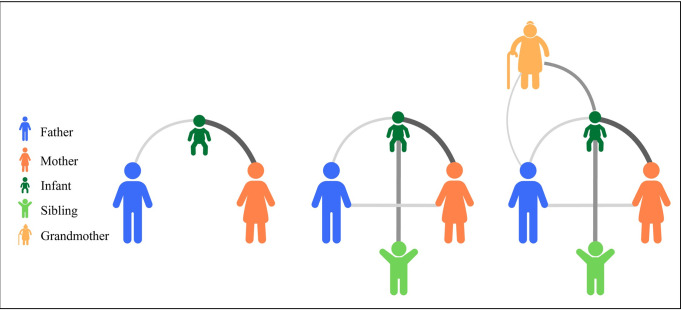
Methods: To address this gap, we will collect qualitative and quantitative data from eight study sites (encompassing both rural and urban settings) across Guatemala, India, Pakistan, and Mozambique. We will conduct focus group discussions and cognitive interviews to assess the feasibility and acceptability of our data collection tools at each site. Thematic and rapid analyses will help to identify key themes and categories through coding, guiding the design of quantitative data collection tools (enrollment survey, contact diaries, exit survey, and wearable proximity sensors) and the implementation of study procedures. We will create three age-specific contact matrices (physical, nonphysical, and both) at each study site using data from standardized contact diaries to characterize the patterns of social mixing. Regression analysis will be conducted to identify key drivers of contacts. We will comprehensively profile the frequency, duration, and intensity of infants' interactions with household members using high resolution data from the proximity sensors and calculating infants' proximity score (fraction of time spent by each household member in proximity with the infant, over the total infant contact time) for each household member.
Discussion: Our qualitative data yielded insights into the perceptions and acceptability of contact diaries and wearable proximity sensors for collecting social mixing data in LMICs. The quantitative data will allow a more accurate representation of human interactions that lead to the transmission of pathogens through close contact in LMICs. Our findings will provide more appropriate social mixing data for parameterizing mathematical models of LMIC populations. Our study tools could be adapted for other studies.
Copyright: © 2024 Aguolu et al. This is an open access article distributed under the terms of the Creative Commons Attribution License, which permits unrestricted use, distribution, and reproduction in any medium, provided the original author and source are credited.
Conflict of interest statement
The authors have declared that no competing interests exist.
Figures
Update of
-
Comprehensive profiling of social mixing patterns in resource poor countries: a mixed methods research protocol.medRxiv [Preprint]. 2023 Dec 5:2023.12.05.23299472. doi: 10.1101/2023.12.05.23299472. medRxiv. 2023. Update in: PLoS One. 2024 Jun 24;19(6):e0301638. doi: 10.1371/journal.pone.0301638. PMID: 38105989 Free PMC article. Updated. Preprint.
References
-
- Liang J, Du Y, Qu X, Ke C, Yi G, Liu M, et al.. The Causes of Death and Their Influence in Life Expectancy of Children Aged 5–14 Years in Low- and Middle-Income Countries From 1990 to 2019. Frontiers in Pediatrics [Internet]. 2022. [cited 2022 Nov 9];10. Available from: https://www.frontiersin.org/articles/10.3389/fped.2022.829201 - DOI - PMC - PubMed
-
- Jamison DT, Summers LH, Alleyne G, Arrow KJ, Berkley S, Binagwaho A, et al.. Global health 2035: a world converging within a generation. The Lancet [Internet]. 2013. Dec 7 [cited 2022 Nov 9];382(9908):1898–955. Available from: https://www.thelancet.com/journals/lancet/article/PIIS0140-6736%2813%296... doi: 10.1016/S0140-6736(13)62105-4 - DOI - PubMed
-
- Department of Data and Analytics (DNA), Division of Data, Analytics and Delivery for Impact (DDI), Department of Data and Analytics (DNA), Division of Data, Analytics and Delivery for Impact (DDI), Department of Data Analytics (DNA) Division of Data, Analytics and Delivery for Impact (DDI) WHO, Geneva. WHO methods and data sources for country-level causes of death 2000–2019 [Internet]. 2020 [cited 2022 Nov 9]. Available from: https://www.who.int/docs/default-source/gho-documents/global-health-esti...
-
- Grimm CA. Hospitals Reported That the COVID-19 Pandemic Has Significantly Strained Health Care Delivery [Internet]. USA: U.S. Department of Health and Human Services Office of Inspector General; 2021. Mar [cited 2022 Nov 19] p. 62. Report No.: OEI-09-21-00140. Available from: https://oig.hhs.gov/oei/reports/OEI-09-21-00140.pdf
-
- Office of the Assistant Secretary for Planning, and Evaluation, U.S. Department of Health and Human Service. Impact of the COVID-19 Pandemic on the Hospital and Outpatient Clinician Workforce: Challenges and policy responses [Internet]. Washington, D.C.: U.S. Department of Health and Human Services Office of Inspector General; 2022 May [cited 2022 Nov 11]. Report No.: Issue Brief No. HP-2022-13. Available from: https://aspe.hhs.gov/sites/default/files/documents/9cc72124abd9ea25d58a2...
MeSH terms
Grants and funding
LinkOut - more resources
Full Text Sources
Miscellaneous
