Review
. 2024 Jul;30(7):1326-1334.
doi: 10.3201/eid3007.231001.

Strategies to Enhance COVID-19 Vaccine Uptake among Prioritized Groups, Uganda-Lessons Learned and Recommendations for Future Pandemics

Review

Strategies to Enhance COVID-19 Vaccine Uptake among Prioritized Groups, Uganda-Lessons Learned and Recommendations for Future Pandemics

Daniel Kiiza et al. Emerg Infect Dis. 2024 Jul.

Abstract

COVID-19 vaccination was launched in March 2021 in Uganda and initially prioritized persons >50 years of age, persons with underlying conditions, healthcare workers, teachers, and security forces. However, uptake remained low 5 months after the program launch. Makerere University's Infectious Diseases Institute supported Uganda's Ministry of Health in optimizing COVID-19 vaccination uptake models by using point-of-care, place of worship, and place of work engagement and the Social Assistance Grant for Empowerment model in 47 of 135 districts in Uganda, where we trained influencers to support mobilization for vaccination outreach under each model. During July-December, vaccination rates increased significantly in targeted regions, from 92% to 130% for healthcare workers, 40% to 90% for teachers, 25% to 33% for security personnel, 6% to 15% for persons >50 years of age, and 6% to 11% for persons with underlying conditions. Our approach could be adopted in other targeted vaccination campaigns for future pandemics.

Keywords: COVID-19; SARS-CoV-2; Uganda; high-priority populations; respiratory infections; vaccine-preventable diseases; vaccines; viruses; zoonoses.


Figures
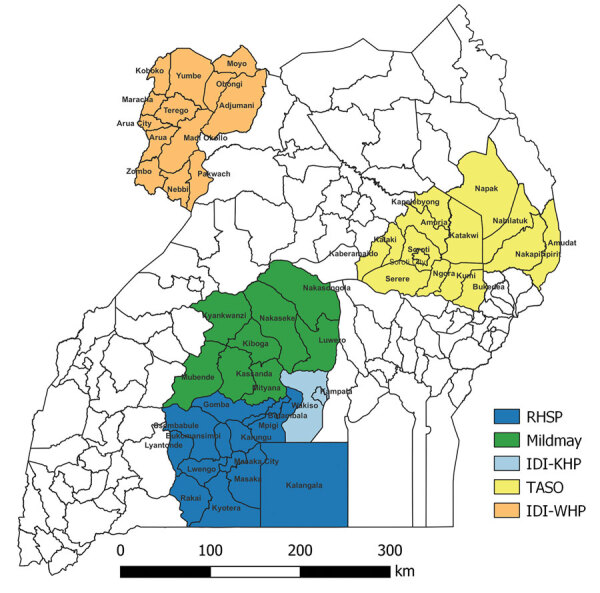
Figure 1
Figure 1
Regional implementation of COVID-19 vaccination project across 47 districts and 5 cities supported by the CDC–PEPFAR Program, Uganda, July 2021–September 2022. CDC, Centers for Diseases Control and Prevention; IDI-KHP; Infectious Diseases Institute–Kampala HIV Project; IDI-WHP, Infectious Diseases Institute–West Nile HIV Project; PEPFAR, US President’s Emergency Plan for AIDS Relief; RHSP, Rakai Health Sciences Program; TASO, The AIDS Support Organization.
Figure 2
Figure 2
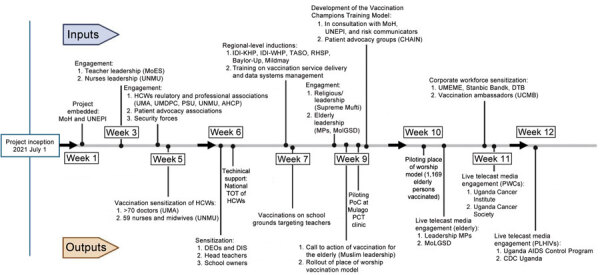
Timeline series of engagements and their respective outputs (starting July 1, 2021) within the first 12 weeks of the COVID-19 vaccination project, Uganda, July–September 2021. ACP, AIDS Control Program; AHPC, Allied Health Practitioners Council; CDC, US Centers for Disease Control and Prevention; CHAIN, Community Health and Information Network; DEOs, District Education Officers; DIS, District Inspector of School; DTB, Diamond Trust Bank; HCWs, healthcare workers; IDI-KHP, Infectious Diseases Institute–Kampala HIV Project; IDI-WHP, Infectious Diseases Institute–West Nile HIV Project; MoES, Ministry of Education and Sports; MoH, Ministry of Health; MoLGSD, Ministry of Gender, Labour, and Social Development; MPs, Members of Parliament; PCT, HIV Prevention Care and Treatment; PoC, point-of-care; PSU, Pharmacy Council, Pharmaceutical Society of Uganda; PWCs, persons with underlying conditions; RHSP, Rakai Health Sciences Program; TASO, The AIDS Support Organization; ToT, training of trainers; UCI, Uganda Cancer Institute; UCMB, Uganda Catholic Medical Bureau; UDA, Uganda Diabetes Association; UHI, Uganda Heart Institute; UMA, Uganda Medical Association; UMDPC, Uganda Medical and Dental Practitioners Council; UNEPI, Uganda National Expanded Program on Immunization; UNMC, Uganda Nurses and Midwives Councils; UNMU, Uganda Nurses and Midwives Union.
Figure 3
Figure 3
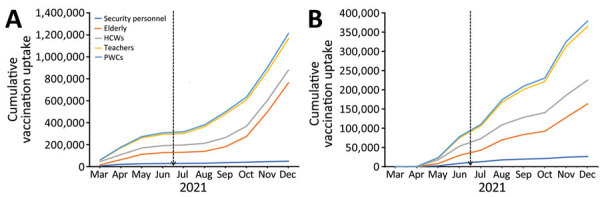
COVID-19 vaccination coverage among priority populations, by receipt of first (A) and second (B) dose, showing project inception date (vertical dashed line) and vaccine uptake trends among priority populations, Uganda, March–December 2021. HCWs, healthcare workers; PWCs, persons with underlying conditions.

References

    1. World Health Organization. Coronavirus disease (COVID-19) weekly epidemiological update and weekly operational update. 2021. [cited 2023 Jan 4]. https://www.who.int/emergencies/diseases/novel-coronavirus-2019/situatio...
    1. World Health Organization. COVID-19 confirmed cases and deaths. 2023. Jan 11 [cited 2023 Jan 12]. https://covid19.who.int
    1. Ministry of Health Uganda. Coronavirus (pandemic) COVID-19. 2022. [cited 2022 Dec 21]. https://www.health.go.ug/covid
    1. Ministry of Health Uganda. COVID-19 response info hub. 2021. [cited 2022 Dec 21]. https://covid19.gou.go.ug/statistics.html
    1. Novida H, Soelistyo SA, Cahyani C, Siagian N, Hadi U, Pranoto A. Factors associated with disease severity of COVID‑19 in patients with type 2 diabetes mellitus. Biomed Rep. 2022;18:8. 10.3892/br.2022.1590 - DOI - PMC - PubMed

Substances