doi: 10.3201/eid3007.231040.
Evidence of Orientia spp. Endemicity among Severe Infectious Disease Cohorts, Uganda
Collaborators
- PMID: 38916638
- PMCID: PMC11210639
- DOI: 10.3201/eid3007.231040
Item in Clipboard
Evidence of Orientia spp. Endemicity among Severe Infectious Disease Cohorts, Uganda
Emerg Infect Dis.
2024 Jul.
Abstract
At 3 severe infection cohort sites in Uganda, Orientia seropositivity was common. We identified 4 seroconversion cases and 1 PCR-positive case. These results provide serologic and molecular support for Orientia spp. circulating in sub-Saharan Africa, possibly expanding its endemic range. Orientia infections could cause severe illness and hospitalizations in this region.
Keywords: Africa; Orientia; Scrub typhus; Uganda; acute febrile illness; bacteria; vector-borne infections.
Figures
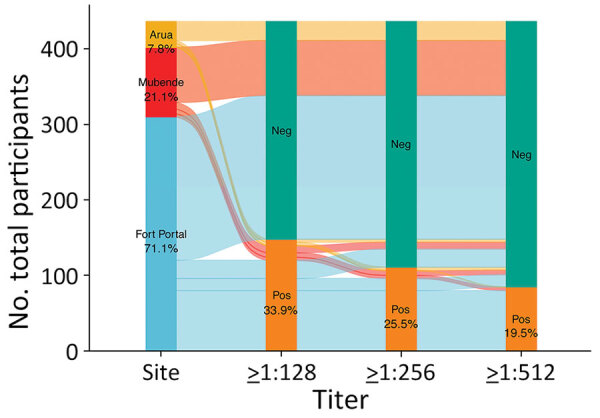
Alluvial diagram of serology from acute serum samples used in a study of Orientia genus endemicity among severe infectious disease cohorts, Uganda. The diagram represents Orientia spp.–positive immunofluorescent assay IgG at > 128, > 256, and > 512 from 3 sites in Uganda. Colored lines indicate total participants from each site with positive or negative serology at 3 different titer cutoffs. Neg, negative; pos, positive.
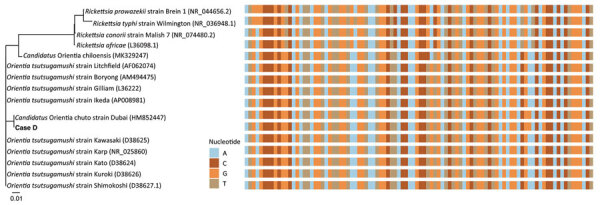
Phylogenetic tree (left) and aligned sequences (right) of Orientia spp. and locally endemic Rickettsia spp. in a study of Orientia genus endemicity among severe infectious disease cohorts, Uganda. We compared the 16S rRNA gene with an Orientia infection (case D) in Uganda. We aligned the 96-bp amplicon region and created the tree by using the neighbor-joining algorithm in R (The R Foundation for Statistical Computing, https://www.r-project.org ). GenBank accession numbers of reference sequences are in parentheses. A single polymorphism aligned with Candidatus O. chuto, possibly differentiating case D from other Orientia spp. Scale bar indicates nucleotide substitutions per site.
References
MeSH terms
LinkOut - more resources
Full Text Sources
Miscellaneous