Review
. 2024 Oct 3;147(10):3286-3305.
doi: 10.1093/brain/awae204.

Brain repair mechanisms after cell therapy for stroke

Affiliations
Review

Brain repair mechanisms after cell therapy for stroke

Ruslan Rust et al. Brain. .

Abstract

Cell-based therapies hold great promise for brain repair after stroke. While accumulating evidence confirms the preclinical and clinical benefits of cell therapies, the underlying mechanisms by which they promote brain repair remain unclear. Here, we briefly review endogenous mechanisms of brain repair after ischaemic stroke and then focus on how different stem and progenitor cell sources can promote brain repair. Specifically, we examine how transplanted cell grafts contribute to improved functional recovery either through direct cell replacement or by stimulating endogenous repair pathways. Additionally, we discuss recently implemented preclinical refinement methods, such as preconditioning, microcarriers, genetic safety switches and universal (immune evasive) cell transplants, as well as the therapeutic potential of these pharmacologic and genetic manipulations to further enhance the efficacy and safety of cell therapies. By gaining a deeper understanding of post-ischaemic repair mechanisms, prospective clinical trials may be further refined to advance post-stroke cell therapy to the clinic.

Keywords: brain injury; iPSC; ischaemia; regeneration; stem cells; therapy.


Conflict of interest statement

L.L. is coinventor on the International Patent WO/2020/226993 filed in April 2020; the patent relates to the use of antibodies which specifically bind interleukin-1a to reduce various sequelae of ischemia-reperfusion injury to the central nervous system.

Figures
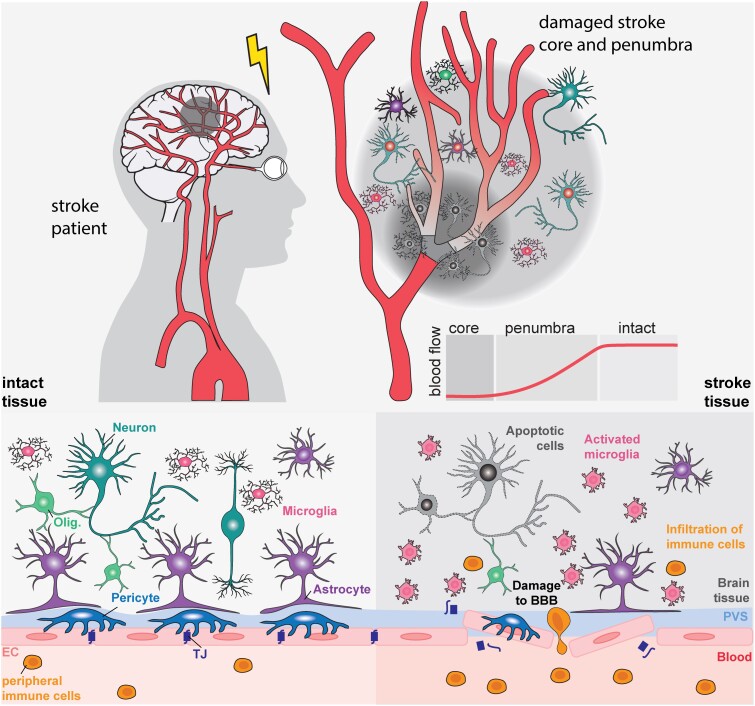
Figure 1
Figure 1
Pathophysiology of stroke. An ischaemic stroke usually occurs when a brain artery becomes blocked, leading to a reduction in oxygen and nutrients in the affected brain areas. These regions can be divided into: the stroke core, an area with severe cerebral blood flow reduction and irreversible necrotic cell death (<10 ml/100 g/min); the penumbra, an area with reversible damage (17–10 ml/100 g per min); and normal, intact tissue (>17 ml/100 g per min). Damage to stroke tissue includes necrotic and apoptotic cell death, damage to the blood–brain barrier, activation of resident microglia and infiltration of peripheral immune cells. EC = endothelial cell; olig = oligodendrocyte; TJ = tight junction.
Figure 2
Figure 2
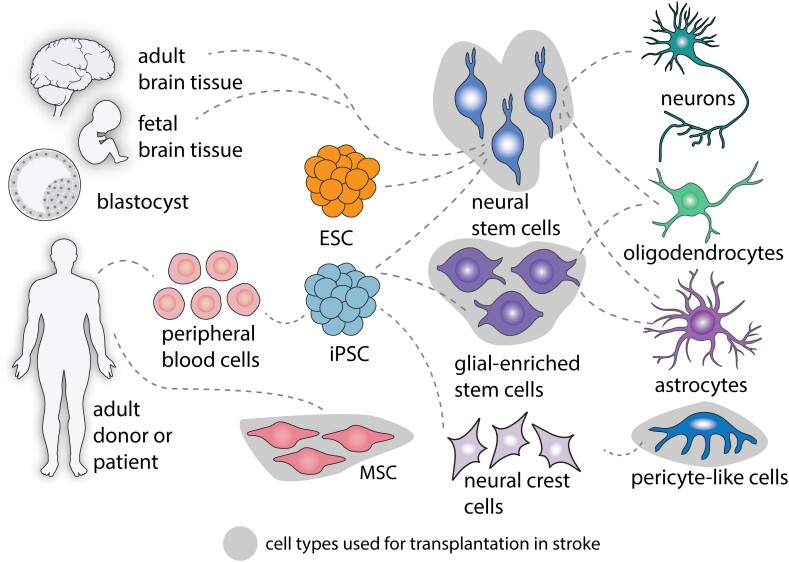
Cell types for cell therapy after stroke. Cell transplants can be derived either from the embryonic/fetal stages or the adult human. Adult stem cells comprise mesenchymal stem cells (MSCs) or differentiated cells from the peripheral blood reprogrammed to generate induced pluripotent stem cells (iPSCs). Both embryonic stem cells (ESC) and iPSCs can be differentiated into neural or glial-enriched stem cells to generate neurons, oligodendrocytes or astrocytes. Pericyte-like cells can be generated from iPSCs through neural crest cell intermediates.
Figure 3
Figure 3
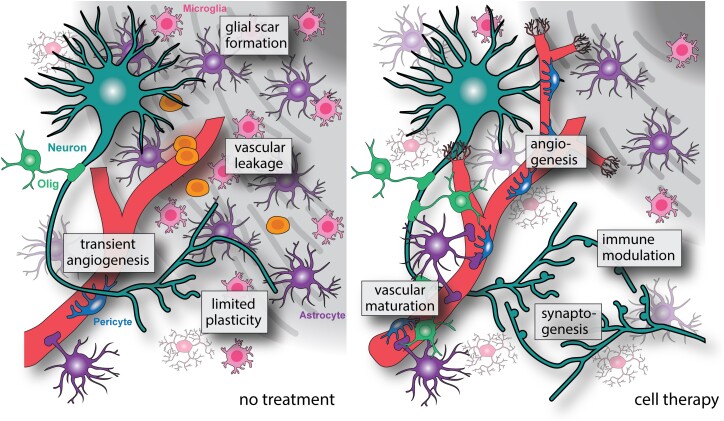
Indirect mechanisms of cell therapy for brain repair. Indirect effects of cell therapy include improved vascular repair and maturation through the release of pro-angiogenic factors in the peri-infarct region. Immunomodulation and an increased anti-inflammatory signature reduce secondary damage and decrease glial scar formation. The release of neurotrophic factors by cell grafts also increases axonogenesis and synaptogenesis in damaged areas.

References

    1. Tsao CW, Aday AW, Almarzooq ZI, et al. Heart disease and stroke statistics-2023 update: A report from the American Heart Association. Circulation. 2023;147:e93–e621. - PMC - PubMed
    1. Pu L, Wang L, Zhang R, Zhao T, Jiang Y, Han L. Projected global trends in ischemic stroke incidence, deaths and disability-adjusted life years from 2020 to 2030. Stroke. 2023;54:1330–1339. - PubMed
    1. Feigin VL, Stark BA, Johnson CO, et al. Global, regional, and national burden of stroke and its risk factors, 1990–2019: A systematic analysis for the global burden of disease study 2019. Lancet Neurol. 2021;20:795–820. - PMC - PubMed
    1. Cirillo C, Brihmat N, Castel-Lacanal E, et al. Post-stroke remodeling processes in animal models and humans. J Cereb Blood Flow Metab. 2020;40:3–22. - PMC - PubMed
    1. Kokaia Z, Llorente IL, Carmichael ST. Customized brain cells for stroke patients using pluripotent stem cells. Stroke. 2018;49:1091–1098. - PMC - PubMed