


Twice weekly dosing with Sebelipase alfa (Kanuma®) rescues severely ill infants with Wolman disease
- PMID: 38918870
- PMCID: PMC11201851
- DOI: 10.1186/s13023-024-03219-5
Twice weekly dosing with Sebelipase alfa (Kanuma®) rescues severely ill infants with Wolman disease
Abstract
Background: Sebelipase alfa (Kanuma®) is approved for patients with Wolman disease (WD) at a dosage of 3-5 mg/kg once weekly. Survival rates in the second of two clinical trials was greater, despite recruiting more severely ill patients, probably related to higher initial and maximal doses. We aimed to evaluate the effective pharmacokinetics and pharmacodynamics of Sebelipase alfa when administered to patients with severe WD at 5 mg/kg twice weekly, an intensive regimen which was not assessed in the trials.
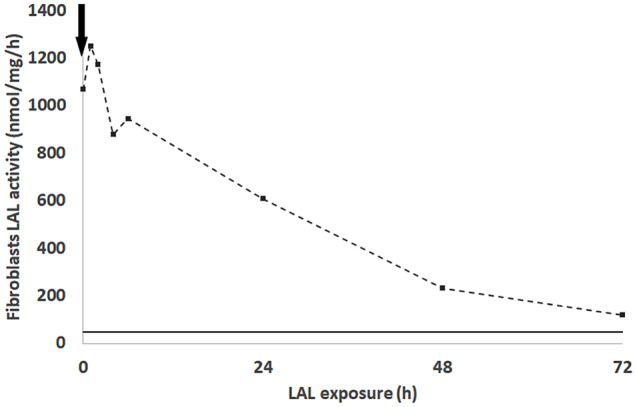
Methods: We recruited 3 patients receiving Sebelipase alfa 5 mg/kg twice weekly. We measured LAL activity in leukocytes and plasma oxysterol concentration in two patients and LAL activity in fibroblasts in one patient. Clinical follow up was also assessed.
Results: Analyses of LAL activity and oxysterols demonstrate that there is short-lived enzyme activity post-dosing which is associated with the release of stored lipids. Clinical data demonstrate that 5 mg/kg twice weekly dosing is well tolerated and effective.
Conclusion: 5 mg/kg twice weekly dosing with Sebelipase alfa rescues severely ill infants with WD by increasing substrate clearance. There is biologically relevant lipid accumulation in the 'trough' periods before the next dosing, even with this intensive regimen.
© 2024. The Author(s).
Conflict of interest statement
María José de Castro, Simon A Jones, Javier de las Heras, Cristobal Colón and Fiona J White have received honoraria and consultancy fees from Alexion. The remaining authors declare that they have no conflict of interest.
Figures


References
-
- Kohli R, Ratziu V, Fiel MI, Waldmann E, Wilson DP, Balwani M. Initial assessment and ongoing monitoring of lysosomal acid lipase deficiency in children and adults: Consensus recommendations from an international collaborative working group. Mol Genet Metab. 2020;129(2):59–66. doi: 10.1016/j.ymgme.2019.11.004. - DOI - PubMed
MeSH terms
Substances
Grants and funding
LinkOut - more resources
Full Text Sources
