. 2024 Jun 26;14(1):14718.
doi: 10.1038/s41598-024-65104-2.

PTPRS is a novel marker for early Tau pathology and synaptic integrity in Alzheimer's disease

Collaborators, Affiliations

PTPRS is a novel marker for early Tau pathology and synaptic integrity in Alzheimer's disease

Alexandre Poirier et al. Sci Rep. .

Abstract

We examined the role of protein tyrosine phosphatase receptor sigma (PTPRS) in the context of Alzheimer's disease and synaptic integrity. Publicly available datasets (BRAINEAC, ROSMAP, ADC1) and a cohort of asymptomatic but "at risk" individuals (PREVENT-AD) were used to explore the relationship between PTPRS and various Alzheimer's disease biomarkers. We identified that PTPRS rs10415488 variant C shows features of neuroprotection against early Tau pathology and synaptic degeneration in Alzheimer's disease. This single nucleotide polymorphism correlated with higher PTPRS transcript abundance and lower p(181)Tau and GAP-43 levels in the CSF. In the brain, PTPRS protein abundance was significantly correlated with the quantity of two markers of synaptic integrity: SNAP25 and SYT-1. We also found the presence of sexual dimorphism for PTPRS, with higher CSF concentrations in males than females. Male carriers for variant C were found to have a 10-month delay in the onset of AD. We thus conclude that PTPRS acts as a neuroprotective receptor in Alzheimer's disease. Its protective effect is most important in males, in whom it postpones the age of onset of the disease.

Keywords: Alzheimer’s disease; Autophagy; Cerebrospinal fluid; Protein-tyrosine phosphatase receptors; Synaptic markers; Tau pathology.


Conflict of interest statement

Dr. Zetterberg has served on scientific advisory boards and/or as a consultant for Abbvie, Acumen, Alector, Alzinova, ALZPath, Annexon, Apellis, Artery Therapeutics, AZTherapies, Cognito Therapeutics, CogRx, Denali, Eisai, Nervgen, Novo Nordisk, Optoceutics, Passage Bio, Pinteon Therapeutics, Prothena, Red Abbey Labs, reMYND, Roche, Samumed, Siemens Healthineers, Triplet Therapeutics, and Wave, has given lectures in symposia sponsored by Alzecure, Biogen, Cellectricon, Fujirebio, Lilly, and Roche, and is a co-founder of Brain Biomarker Solutions in Gothenburg AB (BBS), which is a part of the GU Ventures Incubator Program (outside submitted work). JP serves as a scientific advisor to the Alzheimer Society of France. KB has served as a consultant and at advisory boards for Acumen, ALZPath, BioArctic, Biogen, Eisai, Lilly, Moleac Pte. Ltd, Novartis, Ono Pharma, Prothena, Roche Diagnostics, and Siemens Healthineers; has served at data monitoring committees for Julius Clinical and Novartis; has given lectures, produced educational materials and participated in educational programs for AC Immune, Biogen, Celdara Medical, Eisai and Roche Diagnostics; and is a co-founder of Brain Biomarker Solutions in Gothenburg AB (BBS), which is a part of the GU Ventures Incubator Program, outside the work presented in this paper. JP and MT have received CIHR project grants awarded to the academic institution. JP has received project grants from NSERC, the J.L. Levesque Foundation and FQRS, which were paid to academic institutions. DA is a cofounder of Metabolica Health Inc. All other authors have nothing to disclose.

Figures

Figure 1
Figure 1
Identification of PTPRS rs10415488 variant C as a SNP associated with increased expression. (A) PTPRS mRNA levels versus rs10415488 dosage (CC/CT/TT) and brain area from the BRAINEAC database. (B) Mean PTPRS mRNA levels (Fragments Per Kilobase of transcript per Million mapped reads (FPKM)) in controls and AD subjects (APOE4-carriers). (C) Mean PTPRS mRNA levels in function of CERAD score (1–4). N = 121, 159, 55, 140 for each CERAD score (1–4), respectively. (D) Mean PTPRS mRNA levels in the function of Braak stages (0–6). N = 8, 43, 50, 150, 143, 79, and 2 for each Braak stage (0–6) respectively). Statistical analysis: (A) Simple linear regression with Pearson’s correlation. (B) Bilateral unpaired T-test (CD) One-way ANOVA with Dunnet’s multiple comparison. *p ≤ 0.05, **p ≤ 0.01, ***p ≤ 0.001, ****p ≤ 0.0001.
Figure 2
Figure 2
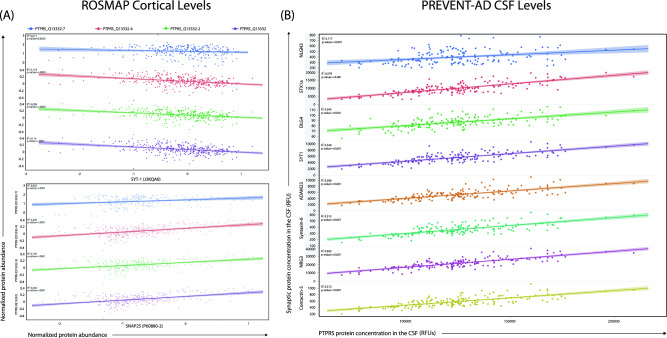
PTPRS protein abundance is tightly correlated to synaptic markers. (A) Correlation between the abundance of four PTPRS protein isoforms (Q13332-7, Q13332-4, Q13332-2 and Q13332) and pre-synaptic markers SYT1 (J3KQA0) and SNAP25 (P60880-2). Data extracted for the ROSMAP study. N(total) = 360. (B) Correlation between the concentration of PTPRS (pg/mL) and the concentration of eight synaptic markers: NLGN3, STX1a, DLG4, SYT1, ADAM23, Syntaxin-6, NRG3 and Contactin-5 (Relative fluorescent units, RFU). Data collected from the CSF of PREVENT-AD subjects, N(total) = 102. Statistical analysis: (A and B) Simple linear regression with Pearson’s correlation (R2). Exact p-values are reported directly in the figures.
Figure 3
Figure 3
Lower CSF p(181)Tau concentration in PTPRS rs10415488 C variant carriers in PREVENT-AD subjects. (A) Mean CSF Taup(181)Tau concentration (pg/mL) in PREVENT-AD rs10415488 CT/CC carriers. N = 36(TT) and 59(CT/CC). (B) Mean CSF Taup(181)Tau concentration (pg/mL) normalized to Aβ42 levels in PREVENT-AD rs10415488 CT/CC carriers. N = 36 (TT) and 59 (CT/CC). (C) LC3 protein abundance normalized to control (CTL) CC/CT carriers in the ROSMAP cohort. N = 29(CTL-TT), 80(CTL-CT/CC), 30(AD-TT) and 58 (AD-CT/CC). Statistical analysis (A and B) Bilateral unpaired T-test (C) One-way ANOVA with Bonferroni’s multiple comparison and correction. ns = non-significant, *p ≤ 0.05, **p ≤ 0.01, ***p ≤ 0.001, ****p ≤ 0.0001.
Figure 4
Figure 4
Correlations between AD biomarkers and the concentration of PTPRS in the CSF of PREVENT-AD APOE4 carriers and non-carriers. PTPRS protein concentration (pg/mL) versus Taup(181)Tau, T-Tau, Aβ42, and T-Tau/Aβ42 levels in the CSF of PREVEN-AD subjects, stratified by APOE4 status. N = 57 and 37 for APOE4(−) and (+) respectively. Statistical analysis: (A and B) Simple linear regression with Pearson’s correlation (R2). Exact p-values are reported directly in the figures.
Figure 5
Figure 5
Increase entorhinal cortex volume in PTPRS rs10415488 homozygous CC carriers. (A) Mean entorhinal cortex volume normalized to intracranial cavity volume in PREVENT-AD rs10415488 TT/CT versus CC carriers. N = 236(TT/TC), 43(CC). (B) Mean PTPRS protein abundance in the CSF of female and male PREVENT-AD subjects (ng/mL). N = 71 and 31, respectively for females and males. Statistical analysis: (A and B) Bilateral unpaired T-tests. *p ≤ 0.05, **p ≤ 0.01, ***p ≤ 0.001, ****p ≤ 0.0001.
Figure 6
Figure 6
Association between PTPRS levels and synaptic integrity in PREVENT-AD subjects. (A) Mean CSF GAP-43 protein concentration in PTPRS rs10415488 C variant non-carriers and carriers. N = 24 and 43 for TT and CT/CC carriers, respectively. (B) Sex stratification from (A). N = 16, 31, 8, and 12 (from left to right). (C) Mean age at AD onset, stratified by sex in the ADCI cohort. N = 321, 536, 344, and 586 (from left to right). Statistical analysis: (AC) Bilateral unpaired T-tests. *p ≤ 0.05, **p ≤ 0.01, ***p ≤ 0.001, ****p ≤ 0.0001.

Update of

References

    1. Martínez-Serra R, Alonso-Nanclares L, Cho K, Giese KP. Emerging insights into synapse dysregulation in Alzheimer’s disease. Brain Commun. 2022;4(2):fcac083. doi: 10.1093/braincomms/fcac083. - DOI - PMC - PubMed
    1. Cornejo F, Cortés BI, Findlay GM, Cancino GI. LAR receptor tyrosine phosphatase family in healthy and diseased brain. Front. Cell Dev. Biol. 2021;9:659951. doi: 10.3389/fcell.2021.659951. - DOI - PMC - PubMed
    1. Chibnik LB, White CC, Mukherjee S, Raj T, Yu L, Larson EB, et al. Susceptibility to neurofibrillary tangles: Role of the PTPRD locus and limited pleiotropy with other neuropathologies. Mol. Psychiatry. 2018;23(6):1521–1529. doi: 10.1038/mp.2017.20. - DOI - PMC - PubMed
    1. Naj AC, Jun G, Beecham GW, Wang L-S, Vardarajan BN, Buros J, et al. Common variants at MS4A4/MS4A6E, CD2AP, CD33 and EPHA1 are associated with late-onset Alzheimer’s disease. Nat. Genet. 2011;43(5):436–441. doi: 10.1038/ng.801. - DOI - PMC - PubMed
    1. Uhl GR, Martinez MJ. PTPRD: Neurobiology, genetics, and initial pharmacology of a pleiotropic contributor to brain phenotypes. Ann. N. Y. Acad. Sci. 2019;1451(1):112–129. doi: 10.1111/nyas.14002. - DOI - PMC - PubMed

MeSH terms