


Enhanced Learning and Memory in Patients with CRB1 Retinopathy
- PMID: 38927596
- PMCID: PMC11203261
- DOI: 10.3390/genes15060660
Enhanced Learning and Memory in Patients with CRB1 Retinopathy
Abstract
Mutations in the CRB1 gene are associated with a diverse spectrum of retinopathies with phenotypic variability causing severe visual impairment. The CRB1 gene has a role in retinal development and is expressed in the cerebral cortex and hippocampus, but its role in cognition has not been described before. This study compares cognitive function in CRB1 retinopathy individuals with subjects with other retinopathies and the normal population.
Methods: Neuropsychological tests of cognitive function were used to test individuals with CRB1 and non-CRB1 retinopathies and compare results with a standardised normative dataset.
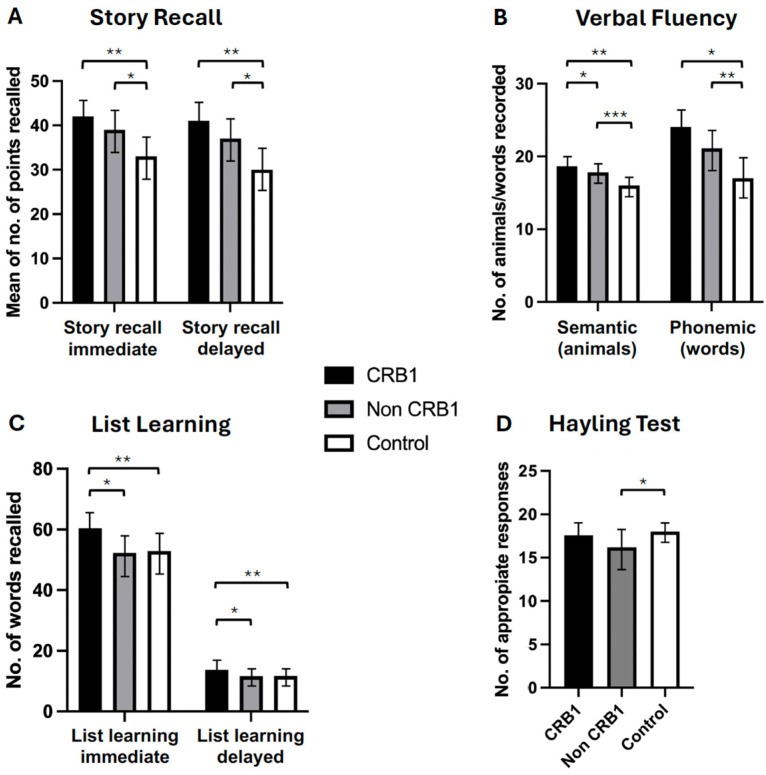
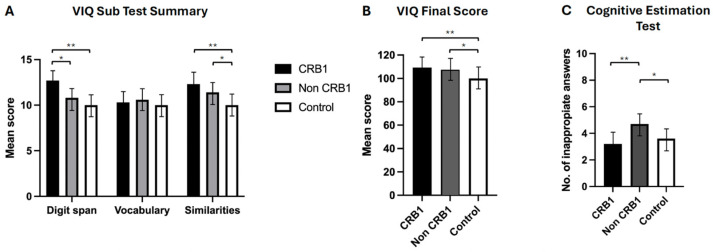
Results: CRB1 retinopathy subjects significantly outperformed those with non-CRB1 retinopathy in list learning tasks of immediate (p = 0.001) and delayed memory (p = 0.007), tests of semantic verbal fluency (p = 0.017), verbal IQ digit span subtest (p = 0.037), and estimation test of higher execution function (p = 0.020) but not in the remaining tests of cognitive function (p > 0.05). CRB1 retinopathy subjects scored significantly higher than the normal population in all areas of memory testing (p < 0.05) and overall verbal IQ tests (p = 0.0012). Non-CRB1 retinopathy subjects scored significantly higher than the normal population in story recall, verbal fluency, and overall verbal IQ tests (p = 0.0016).
Conclusions: Subjects with CRB1 retinopathy may have enhanced cognitive function in areas of memory and learning. Further work is required to understand the role of CRB1 in cognition.
Keywords: CRB1; CRB1 retinopathy; blindness; cognitive function; inherited retinal diseases.
Conflict of interest statement
The authors declare no conflicts of interest.
Figures
References
-
- Varela M.D., Georgiou M., Alswaiti Y., Kabbani J., Fujinami K., Fujinami-Yokokawa Y., Khoda S., Mahroo O.A., Robson A.G., Webster A.R., et al. CRB1-Associated Retinal Dystrophies: Genetics, Clinical Characteristics, and Natural History. Am. J. Ophthalmol. 2023;246:107–121. doi: 10.1016/j.ajo.2022.09.002. - DOI - PMC - PubMed
-
- Nguyen X.T.A., Talib M., van Schooneveld M.J., Wijnhold J., van Genderen M.M., Florijn R.J., ten Brink J.B., Cremers F.P.M., Meester-Smoor M.A., Klaver C.C.W., et al. Acta Ophthalmologica. Wiley; Hoboken, NJ, USA: 2020. A two-year prospective natural history study in patients with CRB1-associated retinal dystrophies: Establishing clinical endpoints for future gene therapy trials.
-
- Owen N., Toms M., Tian Y., Toualbi L., Richardson R., Young R., Tracey-White D., Dhami P., Beck S., Moosajee M. Loss of the crumbs cell polarity complex disrupts epigenetic transcriptional control and cell cycle progression in the developing retina. J. Pathol. 2023;259:441–454. doi: 10.1002/path.6056. - DOI - PMC - PubMed
MeSH terms
Substances
Grants and funding
- 205174/Z/16/Z/WT_/Wellcome Trust/United Kingdom
- Fight for Sight/Fight for Sight
- Moorfields Eye Charity and the NIHR Biomedical Research Centre at Moorfields Eye Hospital NHS Trust and UCL Institute of Ophthalmology/Moorfields Eye Charity and the NIHR Biomedical Research Centre at Moorfields Eye Hospital NHS Trust and UCL Institute of Ophthalmology
LinkOut - more resources
Full Text Sources
Medical
