


Experimental and Numerical Investigation of Macroencapsulated Phase Change Materials for Thermal Energy Storage
- PMID: 38930175
- PMCID: PMC11204953
- DOI: 10.3390/ma17122804
Experimental and Numerical Investigation of Macroencapsulated Phase Change Materials for Thermal Energy Storage
Abstract
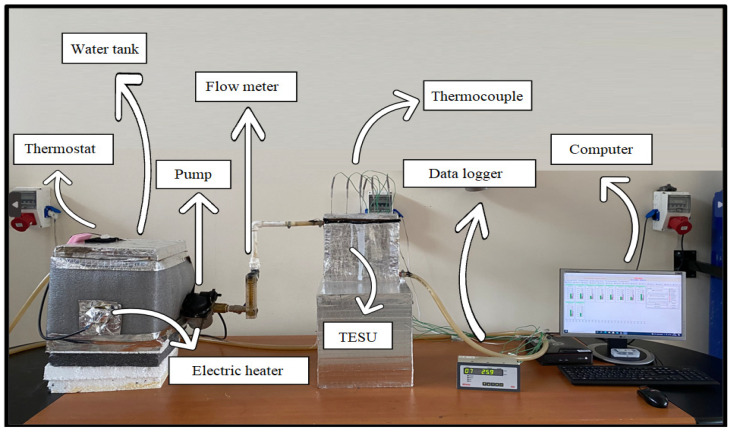
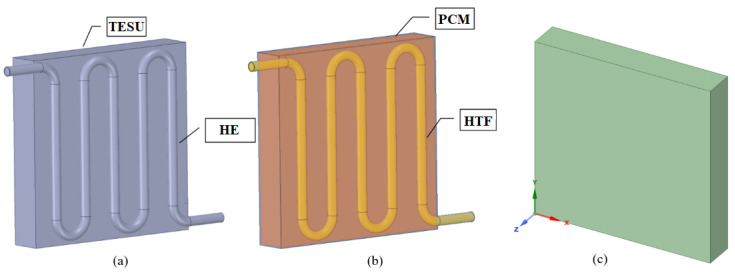
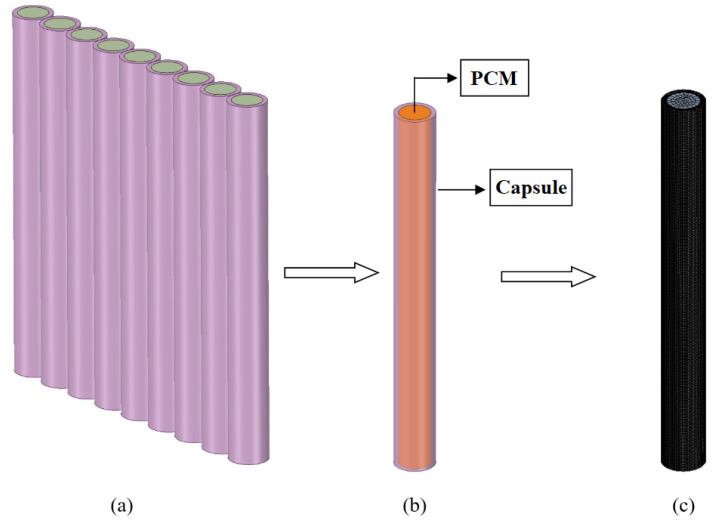
Among the different types of phase change materials, paraffin is known to be the most widely used type due to its advantages. However, paraffin's low thermal conductivity, its limited operating temperature range, and leakage and stabilization problems are the main barriers to its use in applications. In this research, a thermal energy storage unit (TESU) was designed using a cylindrical macroencapsulation technique to minimize these problems. Experimental and numerical analyses of the storage unit using a tubular heat exchanger were carried out. The Ansys 18.2-Fluent software was used for the numerical analysis. Two types of paraffins with different thermophysical properties were used in the TESU, including both encapsulated and non-encapsulated forms, and their thermal energy storage performances were compared. The influence of the heat transfer fluid (HTF) inlet conditions on the charging performance (melting) was investigated. The findings demonstrated that the heat transfer rate is highly influenced by the HTF intake temperature. When the effect of paraffin encapsulation on heat transfer was examined, a significant decrease in the total melting time was observed as the heat transfer surface and thermal conductivity increased. Therefore, the energy stored simultaneously increased by 60.5% with the encapsulation of paraffin-1 (melting temperature range of 52.9-60.4 °C) and by 50.7% with the encapsulation of paraffin-2 (melting temperature range of 32.2-46.1 °C), thus increasing the charging rate.
Keywords: aluminum encapsulation; heat exchanger; heat storage; paraffin; phase change material.
Conflict of interest statement
The authors declare no conflicts of interest.
Figures
References
-
- Mozafari M., Hooman K., Lee A., Cheng S. Numerical study of a dual-PCM thermal energy storage unit with an optimized low-volume fin structure. Appl. Therm. Eng. 2022;215:119026. doi: 10.1016/j.applthermaleng.2022.119026. - DOI
-
- Adine H.A., Qarnia H.E. Numerical analysis of the thermal behaviour of a shell-and-tube heat storage unit using phase change materials. Appl. Math. Model. 2009;33:2132–2144. doi: 10.1016/j.apm.2008.05.016. - DOI
-
- Huang S., Li W., Lu J., Li Y., Wang Z., Zhu S. Experimental study on thermal performances of a solar chimney with and without PCM under different system inclination angles. Energy. 2024;290:130154. doi: 10.1016/j.energy.2023.130154. - DOI
-
- Bashir M.A., Ali H.M. Design and analysis of PCM integrated solar receiver with double-helical tube structure. J. Energy Storage. 2024;84:110872. doi: 10.1016/j.est.2024.110872. - DOI
-
- Soni V., Kumar A., Jain V.K. Fast waste heat recovery in 100–150 °C using close-contact charging of nano-enhanced PCM composite. J. Mol. Liq. 2019;285:347–361. doi: 10.1016/j.molliq.2019.03.132. - DOI
LinkOut - more resources
Full Text Sources
