. 2024 Jun 4;34(6):bhae233.
doi: 10.1093/cercor/bhae233.

Recalled through this day but forgotten next week?-retrieval activity predicts durability of partly consolidated memories

Affiliations

Recalled through this day but forgotten next week?-retrieval activity predicts durability of partly consolidated memories

Hedda T Ness et al. Cereb Cortex. .

Abstract

Even partly consolidated memories can be forgotten given sufficient time, but the brain activity associated with durability of episodic memory at different time scales remains unclear. Here, we aimed to identify brain activity associated with retrieval of partly consolidated episodic memories that continued to be remembered in the future. Forty-nine younger (20 to 38 years; 25 females) and 43 older adults (60 to 80 years, 25 females) were scanned with functional magnetic resonance imaging during associative memory retrieval 12 h post-encoding. Twelve hours is sufficient to allow short-term synaptic consolidation as well as early post-encoding replay to initiate memory consolidation. Successful memory trials were classified into durable and transient source memories based on responses from a memory test ~6 d post-encoding. Results demonstrated that successful retrieval of future durable vs. transient memories was supported by increased activity in a medial prefrontal and ventral parietal area. Individual differences in activation as well as the subjective vividness of memories during encoding were positively related to individual differences in memory performance after 6 d. The results point to a unique and novel aspect of brain activity supporting long-term memory, in that activity during retrieval of memories even after 12 h of consolidation contains information about potential for long-term durability.

Keywords: consolidation; durable long-term memory; fMRI; retrieval; vividness.


Figures

Fig. 1
Fig. 1
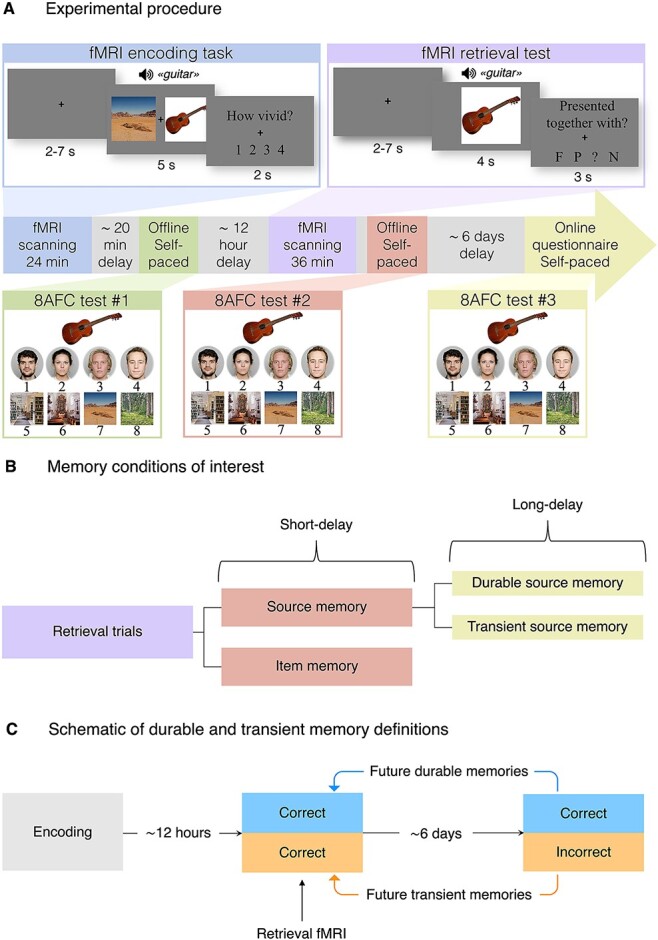
Experimental paradigm and memory conditions. A) Schematic depiction of the experimental procedure. Participants encoded item-face/place associations during fMRI scanning (``fMRI encoding task'' blue). Immediately after scanning and approximately 20 min after the end of the last encoding run, participants’ memory for associations were tested using an eight-alternative forced-choice (8AFC) source memory test (“8AFC test #1”). Approximately 12 h after encoding, participants completed a source memory test during fMRI scanning (“fMRI retrieval test”) and another 8AFC source memory test immediately after this (“8AFC test #2”). Participants’ memory was tested again after an extended delay of approximately 6 d (“8AFC test #3”). Note: The face images presented here are not identical to those used in the task, but a selection of face images in which the individuals depicted have consented to their faces being publicly displayed (from the Oslo Face Database; Chelnokova et al. 2016). B) Schematic of the memory conditions of interest: Source memory included those items that were correctly linked with face or place at the fMRI retrieval test, correctly linked with their specific face- or place associate at the 8AFC test 1 and 2, but regardless of long-delay memory (i.e. regardless of response at the 8AFC test 3). Item memory included those items that were correctly recognized as old, but without source information (i.e. together with their face/place associate) at the fMRI retrieval test only, that is, also regardless of long-delay memory. We divided the pool of short-delay source memory trials into two further conditions of interest based on whether item-face/place associations was still remembered after a longer delay of approximately 6 d: (i) durable memory included those items that were correctly linked face or place at the fMRI retrieval test, correctly linked with their specific face- or place associate at the 8AFC test 1, 2, and 3, while (ii) transient memory included those items that were correctly linked with face or place at the fMRI retrieval test and correctly linked with their specific face- or place associate at the 8AFC test 1 and 2 but incorrectly linked with a specific face- or place associate at the 8AFC test 3. Note that the short-delay memory condition consisted of memories that had already been retained for 12 h; thus, both our short- and long-delay memory conditions were characterized by a more prolonged delay than in most other studies. C) Schematic of how future durable/transient memory categories were defined. “Future durable” and “future transient” were item–face/place pairs which, after being successfully remembered 12 h post-encoding, either continued to be remembered (durable) or were forgotten (transient) 6 d later.
Fig. 2
Fig. 2
Memory performance. Proportion of correct source- and item memory in the short-delay sample and durable- and transient memory in the long-delay sample. Horizontal lines show data from individual participants. The width of the violins is scaled by the number of observations.
Fig. 3
Fig. 3
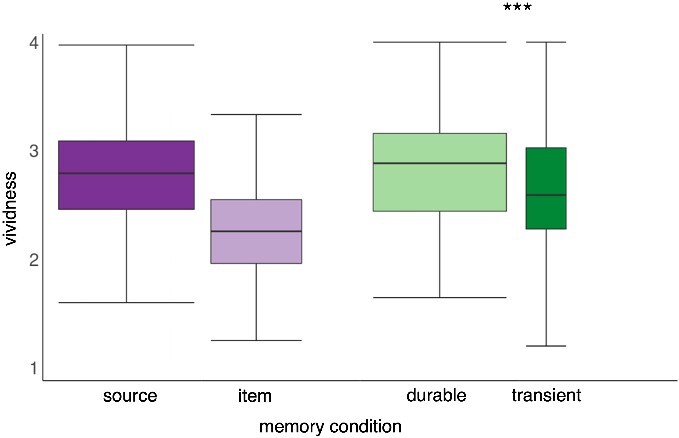
Vividness ratings of encoded source-, item-, durable- and transient memories. Black horizontal lines represent median vividness rating for each memory condition. Boxplot whiskers represent min/max observed vividness rating. Box limits represent quartiles. The width of the boxes is scaled by the number of observations. ***P < 0.001 (paired samples t-test of encoding vividness for durable vs. transient memories).
Fig. 4
Fig. 4
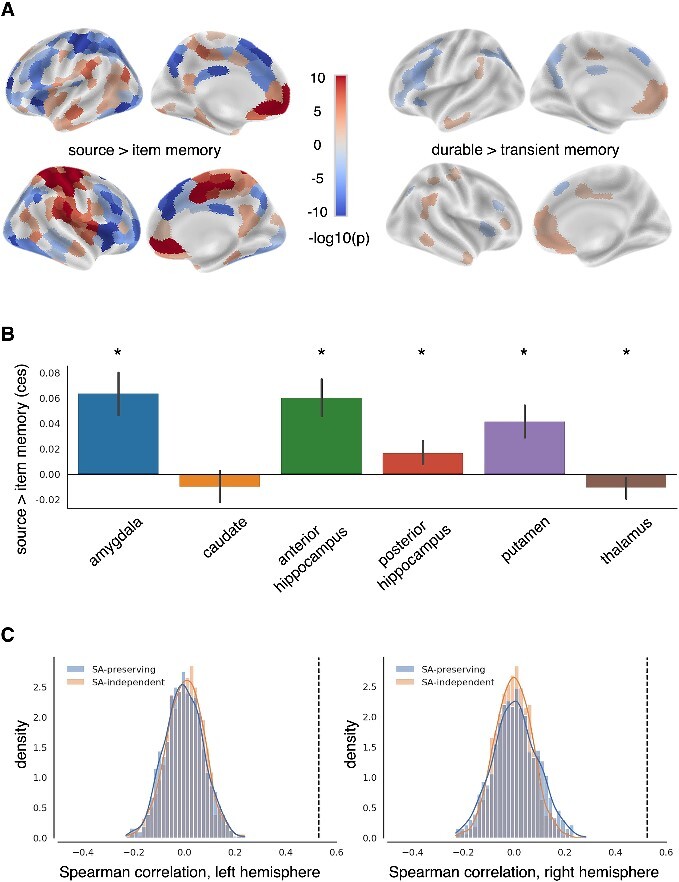
A) Cortical main effects of retrieval activity. BOLD activity for both memory contrasts—short-delay memory (source memory > item memory) and durable memory (durable memory > transient memory contrast). Parcel significance is displayed in clusters surviving multiple comparisons correction by FDR (P < 0.025 (0.05/2) after correction for two main levels of testing—cortical and subcortical. Positive and negative significance patterns are shown in respective red and blue color scales. Abbreviations: BOLD activity, blood-oxygen-level-dependent activity; FDR, false discovery rate. B) Subcortical effects of retrieval activity for the short delay (source vs. item) memory contrast. ROIs are collapsed over hemispheres. Bar heights represent group means. Error bars represent standard error of the mean. C) Spatial correlation between the short-delay and long-delay activity contrast maps per hemisphere. The bars show the permuted null distributions of Spearman correlations between maps either ignoring (SA-independent) or incorporating (SA-preserving) spatial autocorrelation (SA) structures in the data. Dashed vertical lines show the empirical correlation between the activity patterns. Abbreviations: ces, contrast estimates; FDR, false discovery rate. * Significant main effect.
Fig. 5
Fig. 5
Effects of retrieval activity for the short-delay (source vs. item) memory contrast on a network level (Yeo, 2011). Bar heights represent group means. Error bars represent standard error of the mean. Networks: ContA = control a; ContB = control B; DefaultA = default a; DefaultB = default B; DefaultC = default C; DorsAttnA = dorsal attention a; DorsAttnB = dorsal attention B; LimbicA = limbic a; LimbicB = limbic B; SalVentAttnA = salience/ventral attention a; SalVentAttnB = salience/ventral attention B; SomMotA = Somatomotor a; SomMotB = Somatomotor B; TempPar = temporal parietal; VisCent = visual a; VisPeri = visual B. Abbreviations: Ces, contrast estimates. * significant main effect.
Fig. 6
Fig. 6
Results of correlational analysis of behavioral performance and parcel contrast estimates, with age and FD included as covariates. Significant FDR-corrected correlations (at P < 0.025) between the Schafer 400 parcels and proportion of source memories (left) and durable memories (right) are displayed. Positive and negative significance patterns are shown in respective red and blue color scales.

References

    1. Abraham A, Pedregosa F, Eickenberg M, Gervais P, Mueller A, Kossaifi J, Gramfort A, Thirion B, Varoquaux G. Machine learning for neuroimaging with scikit-learn. Front Neuroinform. 2014:8. 10.3389/fninf.2014.00014. - DOI - PMC - PubMed
    1. Andersson JLR, Skare S, Ashburner J. How to correct susceptibility distortions in spin-echo echo-planar images: application to diffusion tensor imaging. NeuroImage. 2003:20(2):870–888. 10.1016/S1053-8119(03)00336-7. - DOI - PubMed
    1. Avants BB, Epstein CL, Grossman M, Gee JC. Symmetric diffeomorphic image registration with cross-correlation: evaluating automated labeling of elderly and neurodegenerative brain. Med Image Anal. 2008:12(1):26–41. 10.1016/j.media.2007.06.004. - DOI - PMC - PubMed
    1. Beck AT, Steer RA, Garbin MG. Psychometric properties of the Beck depression inventory: twenty-five years of evaluation. Clin Psychol Rev. 1988:8(1):77–100. 10.1016/0272-7358(88)90050-5. - DOI
    1. Benedict RH, Zgaljardic DJ. Practice effects during repeated administrations of memory tests with and without alternate forms. J Clin Exp Neuropsychol. 1998:20(3):339–352. 10.1076/jcen.20.3.339.822. - DOI - PubMed

Publication types