. 2023 May 26;2(3):100314.
doi: 10.1016/j.jacadv.2023.100314. eCollection 2023 May.

Treatment Intensity for the Management of Cardiogenic Shock: Comparison Between STEMI and Non-STEMI

Affiliations

Treatment Intensity for the Management of Cardiogenic Shock: Comparison Between STEMI and Non-STEMI

Shashank S Sinha et al. JACC Adv. .

Abstract

Background: Cardiogenic shock is a leading cause of mortality in patients with acute myocardial infarction.

Objectives: The authors sought to compare clinical characteristics, hospital trajectory, and drug and device use between patients with ST-segment elevation myocardial infarction-related cardiogenic shock (STEMI-CS) and those without (non-ST-segment elevation myocardial infarction complicated by cardiogenic shock [NSTEMI-CS]).

Methods: We analyzed data from 1,110 adult admissions with cardiogenic shock complicating acute myocardial infarction (AMI-CS) across 17 centers within Cardiogenic Shock Working Group. The primary end point was in-hospital mortality.

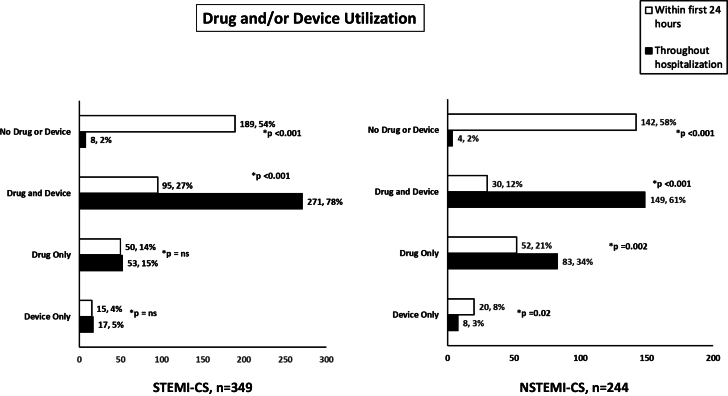
Results: Our study included 1,110 patients with AMI-CS, of which 731 (65.8%) had STEMI-CS and 379 (34.2%) had NSTEMI-CS. Most patients were male (STEMI-CS: 71.6%, NSTEMI-CS: 66.5%) and White (STEMI-CS: 53.8%, NSTEMI-CS: 64.1%). In-hospital mortality was 41% and was similar among patients with STEMI-CS and NSTEMI-CS (43% vs 39%, P = 0.23). Patients with out-of-hospital cardiac arrest had higher in-hospital mortality in patients with NSTEMI-CS (63% vs 36%, P = 0.006) as compared to patients with STEMI-CS (52% vs 41%, P = 0.16). Similar results were observed for in-hospital cardiac arrest in patients with STEMI-CS (63% vs 33%, P < 0.001) and NSTEMI-CS (60% vs 32%, P < 0.001). Only 27% of patients with STEMI-CS and 12% of NSTEMI-CS received both a drug and temporary mechanical circulatory support device during the first 24 hours, which increased to 78% and 61%, respectively, throughout the course of the hospitalization (P < 0.001 for both).

Conclusions: Despite increasing use of inotropic and vasoactive support and mechanical circulatory support throughout the hospitalization, both patients with STEMI-CS and NSTEMI-CS remain at increased risk for in-hospital mortality. Randomized controls trials are needed to elucidate whether timing and sequence of escalation of support improves outcomes in patients with AMI-CS.

Keywords: acute myocardial infarction; cardiogenic shock; heart failure.


Conflict of interest statement

This work was supported by a 10.13039/100000002NIH RO1 grants to Dr Kapur (R01HL139785-01; R01HL159089-01) and institutional grants from 10.13039/100020297Abiomed Inc, 10.13039/100008497Boston Scientific Inc, 10.13039/100001316Abbott Laboratories, Getinge Inc, and 10.13039/100013410LivaNova Inc to Tufts Medical Center. Sponsors had no input on collection, analysis, and interpretation of the data, nor in the preparation, review, or approval of the manuscript. Dr Kapur has received consulting honoraria and institutional grant support from Abbott Laboratories, Abiomed Inc, Boston Scientific, Medtronic, LivaNova, Getinge, and Zoll. Dr Hernandez-Montfort is a consultant for Abiomed Inc. Dr Abraham is a consultant for Abbott Laboratories and Abiomed Inc. Dr Burkhoff has received support from consulting services provided from Abiomed Inc. to Cardiovascular Research Foundation. All other authors have reported that they have no relationships relevant to the contents of this paper to disclose.

Figures

None
Graphical abstract
Figure 1
Figure 1
Distribution of Patients With Cardiogenic Shock Stratified by Etiology of Acute Myocardial Infarction and Associated In-Hospital Mortality with or without Cardiac Arrest (A) Distribution of patients with cardiogenic shock stratified by etiology of acute myocardial infarction. (B) Unadjusted in-hospital mortality rate among total MI-CS, STEMI-CS, and NSTEMI-CS cohorts. (C) In-hospital mortality rate among patients with vs Without OHCA among total MI-CS, STEMI-CS, and NSTEMI-CS cohorts. (D) In-hospital mortality rate among patients with vs without IHCA among total MI, STEMI, and NSTEMI cohorts. IHCA = in-hospital cardiac arrest; MI-CS = cardiogenic shock complicating myocardial infarction; NSTEMI-CS = cardiogenic shock complicating non–ST-segment elevation myocardial infarction; OHCA = out-of-hospital cardiac arrest; STEMI-CS = cardiogenic shock complicating ST-segment elevation myocardial infarction.
Figure 2
Figure 2
Association of In-Hospital Mortality Across Baseline and Maximum SCAI Stage Among Total MI-CS, STEMI-CS, and NSTEMI-CS Patients (A) Bar graphs illustrating the association of in-hospital mortality rate across baseline SCAI stages among total MI-CS, STEMI-CS, and NSTEMI-CS cohorts. (B) Bar graphs illustrating the association of in-hospital mortality rate across maximum SCAI stages among total MI-CS, STEMI-CS, and NSTEMI-CS cohorts. MI-CS = cardiogenic shock complicating myocardial infarction; NSTEMI-CS = cardiogenic shock complicating non–ST-segment elevation myocardial infarction; SCAI = Society for Cardiovascular Angiography and Interventions; STEMI-CS = cardiogenic shock complicating ST-segment elevation myocardial infarction.
Figure 3
Figure 3
Progression to Advanced SCAI Stages Among Total MI-CS, STEMI-CS and NSTEMI-CS Patients (A) Progression rate from baseline to maximum SCAI stages among total MI-CS, STEMI-CS, and NSTEMI-CS cohorts. (B) The mean time to progression from baseline to maximum SCAI stages among total MI-CS, STEMI-CS, and NSTEMI-CS cohorts. (C) Illustration showing trajectory of SCAI stages during hospitalization among total MI-CS, STEMI-CS, and NSTEMI-CS cohorts. The number of patients and percent in-hospital mortality for the maximum Society for Cardiovascular Angiography and Interventions stage achieved stratified by baseline Society for Cardiovascular Angiography and Interventions stage is shown. MI-CS = cardiogenic shock complicating myocardial infarction; NSTEMI-CS = cardiogenic shock complicating non–ST-segment elevation myocardial infarction; SCAI = Society for Cardiovascular Angiography and Interventions; STEMI-CS = cardiogenic shock complicating ST-segment elevation myocardial infarction.
Figure 4
Figure 4
Drug and Device Usage Distribution Within 24 Hours and Throughout Hospitalization in STEMI-CS vs Patients With NSTEMI-CS ns = not statistically significant; NSTEMI-CS = cardiogenic shock complicating non–ST-segment elevation myocardial infarction; STEMI-CS = cardiogenic shock complicating ST-segment elevation myocardial infarction.
Central Illustration
Comparison of ST-Segment-Elevation (STEMI-CS) and Non-ST-Segment-Elevation (NSTEMI-CS) Myocardial Infarction Complicated by Cardiogenic Shock We sought to compare in-hospital mortality, clinical trajectories, and drug and device use between patients with ST-segment elevation myocardial infarction–related cardiogenic shock (STEMI-CS) and those without (non–ST-segment elevation myocardial infarction complicated by cardiogenic shock [NSTEMI-CS]). In-hospital mortality was similar among patients with STEMI-CS and NSTEMI-CS. Patients with out-of-hospital cardiac arrest had higher in-hospital mortality in patients with NSTEMI-CS as compared to patients with STEMI-CS. Similar results were observed for in-hospital cardiac arrest in patients with STEMI-CS and NSTEMI-CS. Only 27% of patients with STEMI-CS and 12% of NSTEMI-CS received both a drug and temporary mechanical circulatory support device during the first 24 hours, which increased to 78% and 61%, respectively, throughout the course of the hospitalization. AMI-CS = cardiogenic shock complicating acute myocardial infarction; IHM = in-hospital mortality; MI = myocardial infarction; NSTEMI = non–ST-segment elevation myocardial infarction; SCAI = Society for Cardiovascular Angiography and Interventions; STEMI = ST-segment elevation myocardial infarction.

References

    1. Samsky M.D., Morrow D.A., Proudfoot A.G., Hochman J.S., Thiele H., Rao S.V. Cardiogenic shock after acute myocardial infarction: a review. JAMA. 2021;326(18):1840–1850. doi: 10.1001/jama.2021.18323. - DOI - PMC - PubMed
    1. van Diepen S., Katz J.N., Albert N.M., et al. Contemporary management of cardiogenic shock: a scientific statement from the American Heart Association. Circulation. 2017;136(16):e232–e268. doi: 10.1161/CIR.0000000000000525. - DOI - PubMed
    1. Thiele H., Akin I., Sandri M., et al. One-year outcomes after PCI strategies in cardiogenic shock. N Engl J Med. 2018;379(18):1699–1710. doi: 10.1056/NEJMoa1808788. - DOI - PubMed
    1. Thiele H., Akin I., Sandri M., et al. PCI strategies in patients with acute myocardial infarction and cardiogenic shock. N Engl J Med. 2017;377(25):2419–2432. doi: 10.1056/NEJMoa1710261. - DOI - PubMed
    1. Thiele H., Zeymer U., Neumann F.J., et al. Intraaortic balloon support for myocardial infarction with cardiogenic shock. N Engl J Med. 2012;367(14):1287–1296. doi: 10.1056/NEJMoa1208410. - DOI - PubMed

LinkOut - more resources