


Idiopathic secondary azoospermia occurrence in men with oligospermia over time
- PMID: 38941005
- PMCID: PMC11339189
- DOI: 10.1007/s10815-024-03179-6
Idiopathic secondary azoospermia occurrence in men with oligospermia over time
Abstract
Purpose: To investigate the occurrence of idiopathic secondary azoospermia (ISA) in men with oligospermia over time and identify risk factors for ISA in this population.
Methods: This was a retrospective cohort study conducted in a university-affiliated male infertility clinic. A total of 1056 oligospermic men (concentration < 15 million/ml (M/ml) and no azoospermia) with at least two SA done between 2000 and 2019 were included. The primary outcome was the occurrence of ISA by oligospermia severity.
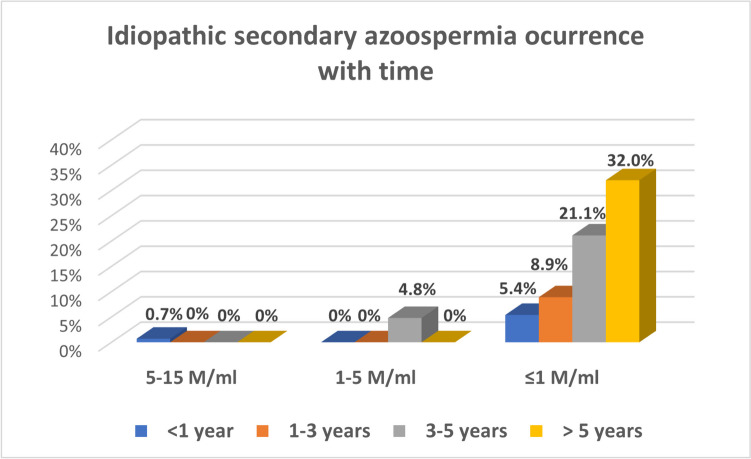
Results: In the entire cohort, 31 patients (2.9%) eventually became azoospermic with time. The ≤ 1 M/ml extremely severe oligospermia (ESO) group (283 patients) had significantly higher rates of ISA in each time period compared to the 1-5 M/ml severe oligospermia (SO) (310 patients) and 5-15 M/ml mild oligospermia (MO) (463 patients) groups (p < 0.05 for all comparisons), with rates of 21.1% in the ESO, 4.8% in the SO, and 0% in the MO group (p = 0.02) after 3-5 years, reaching 32% after 5 years in the ESO group compared to no cases in the other two groups (p = 0.006). Parameters shown to predict ISA were initial concentration < 1 M/ml (OR 22.12, p < 0.001) and time interval of > 3 and 5 years (OR 4.83 and 6.84, p = 0.009 and < 0.001, respectively), whereas testosterone levels were negatively associated with ISA (OR 0.88, p = 0.03).
Conclusions: Men with ≤ 1 M/ml, especially those with low testosterone levels, have a dramatically increased chance of becoming azoospermic with time. Therefore, sperm banking should be recommended in these cases. Men with a sperm concentration above 1 M/ml have low chances of becoming azoospermic, even after 3 or more years.
Keywords: Infertility; Oligospermia; Secondary azoospermia; Sperm banking.
© 2024. The Author(s), under exclusive licence to Springer Science+Business Media, LLC, part of Springer Nature.
Conflict of interest statement
The authors declare no competing interests.
Figures
References
-
- Zegers-Hochschild F, Adamson GD, de Mouzon J, et al. International committee for monitoring assisted reproductive technology (ICMART) and the world health organization (WHO) revised glossary of ART terminology, 2009. Fertil Steril. 2009;92:1520– 4. - PubMed
MeSH terms
Substances
LinkOut - more resources
Full Text Sources
