. 2024 Jun 28;15(1):5498.
doi: 10.1038/s41467-024-49800-1.

VirBR, a transcription regulator, promotes IncX3 plasmid transmission, and persistence of blaNDM-5 in zoonotic bacteria

Affiliations

VirBR, a transcription regulator, promotes IncX3 plasmid transmission, and persistence of blaNDM-5 in zoonotic bacteria

Tengfei Ma et al. Nat Commun. .

Abstract

IncX3 plasmids carrying the New Delhi metallo-β-lactamase-encoding gene, blaNDM-5, are rapidly spreading globally in both humans and animals. Given that carbapenems are listed on the WHO AWaRe watch group and are prohibited for use in animals, the drivers for the successful dissemination of Carbapenem-Resistant Enterobacterales (CRE) carrying blaNDM-5-IncX3 plasmids still remain unknown. We observe that E. coli carrying blaNDM-5-IncX3 can persist in chicken intestines either under the administration of amoxicillin, one of the largest veterinary β-lactams used in livestock, or without any antibiotic pressure. We therefore characterise the blaNDM-5-IncX3 plasmid and identify a transcription regulator, VirBR, that binds to the promoter of the regulator gene actX enhancing the transcription of Type IV secretion systems (T4SS); thereby, promoting conjugation of IncX3 plasmids, increasing pili adhesion capacity and enhancing the colonisation of blaNDM-5-IncX3 transconjugants in animal digestive tracts. Our mechanistic and in-vivo studies identify VirBR as a major factor in the successful spread of blaNDM-5-IncX3 across one-health AMR sectors. Furthermore, VirBR enhances the plasmid conjugation and T4SS expression by the presence of copper and zinc ions, thereby having profound ramifications on the use of universal animal feeds.


Conflict of interest statement

The authors declare no conflict of interest.

Figures

Fig. 1
Fig. 1. In-vivo stability of blaNDM-5-IncX3 plasmid positive E. coli 3R and 8R and transfer of blaNDM-5-IncX3 to microbiota commensal strains.
a Outline of the experimental design illustrating time (days) of inoculum and sample collection of 3R and 3R plus amoxicillin. Black circle indicated strain 3R and white circle indicated time of sampling cecum. The pink highlighted line indicates that chickens in this group were not only orally administered the 3R strains but also treated with amoxicillin. b Cecum abundance (cfu/g) over time (days). Black boxes indicated no antibiotic and red boxes indicated the addition of amoxicillin. “Transfer” with white box indicated transfer of the blaNDM-5 gene into chicken commensal strains. DTL indicated the detection line. Lines are medians, boxes cover the 25th to 75th percentiles, and whiskers show the range; n = 4 biologically independent replicates. c Outline of experimental design illustrating time (days) of inoculum and sample collection of placebo group (white circle), 3R (black circle), and 8R (blue circle). d Cecum abundance (cfu/g) of 3R (black column) and 8R (blue column) over time (days). n = 4 biologically independent replicates examined over three independent experiments. e Abundance of blaNDM genes in cecum of 3R (black line) and 8R (blue line) strains without amoxicillin treatment over time (days). Data are means ± SEM; n = 4 biologically independent replicates. f Abundance of blaNDM-5-positive total strains without amoxicillin treatment over time (days). Dotted lines represent the abundance of transfer of plasmids from 3R (black line) and 8R (blue line) to cecum commensal strains. Data are means ± SEM; n = 4 biologically independent replicates. Source data are provided as a Source Data file.
Fig. 2
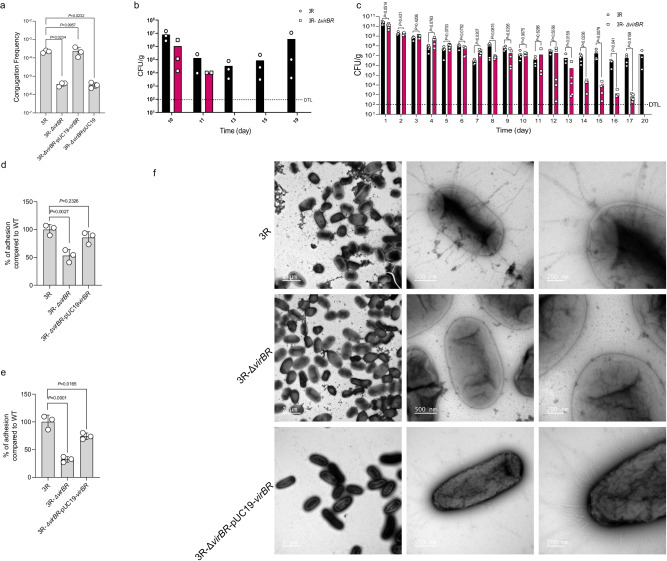
Fig. 2. The conjugation ability of IncX3 plasmid, and the effect of ΔvirBR on colonisation, adhesion and pili formation.
a The in-vitro conjugation frequency of 3R, 3R-ΔvirBR, 3R-ΔvirBR-pUC19-virBR, 3R-ΔvirBR-pUC19 strains. Data are means ± SEM; n = 3 biologically independent replicates obtained from three independent experiments. One-way ANOVA and Tukey’s multiple comparisons test were performed on values. b Abundance in chicken cecum of 3R (circles and black bars) and 3R-ΔvirBR group (squares and red bars) over time (days). n = 3 biologically independent replicates. c Abundance in mice faeces of 3R (circles and black bars) and 3R-ΔvirBR group (squares and red bars) over time (days). The detail experimental design can be found in Fig. S10. n ≥ 3 biologically independent replicates obtained from three independent experiments. Groups were compared using unpaired two-tailed t-test. d The adhesion ability to Caco-2 cells of 3R-ΔvirBR and 3R-ΔvirBR-pUC19-virBR (complemented with intact virBR) compared with 3R parent strain (given as 100%). Data are means ± SEM; n = 3 biologically independent replicates obtained from three independent experiments. One-way ANOVA and Dunnett’s multiple comparisons test were performed on values. e The adhesion ability to IEC-6 cells of 3R-ΔvirBR and 3R-ΔvirBR-pUC19-virBR (complemented with intact virBR) compared with 3R parent strain (given as 100%). Data are means ± SEM; n = 3 biologically independent replicates obtained from three independent experiments. One-way ANOVA and Dunnett’s multiple comparisons test were performed on values. f. Transmission electron micrographs illustrating pili formation of 3R, 3R-ΔvirBR, 3R-ΔvirBR-pUC19-virBR. Scale bars, from left to right - 2 μm, 500 nm and 200 nm. Image is representative of three independent experiments. Source data are provided as a Source Data file.
Fig. 3
Fig. 3. VirBR promotes the transcription of T4SS.
a The fold-change of expression of IncX3 plasmid related genes for 3R-ΔvirBR-pUC19-virBR (complemented virBR), 3R-ΔvirBR, and ΔvirBR-pUC19 (control). Increase in gene expression appears as yellow-red. b Determining the binding region of VirBR immediately upstream of actX. Left side, schematic diagram of PactX and reporter constructs tagged with EGFP; the mapped promoter is shown in red and TSS in bright blue. Right: Fluorescence intensity of EGFP expression in the absence (black bars) or presence (red bars) of virBR. Data are means ± SEM; n = 4 biologically independent replicates obtained from three independent experiments. Groups were compared using two-tailed t-test. c Schematic diagram of PactX regions (1-6 segments) covering between -279 to -159 upstream of the actX start codon. d. Fluorescence intensity of each of the segment (described in c) with VirBR (red bars) or without VirBR (black bars). Data are means ± SEM; n = 3 biologically independent replicates obtained from three independent experiments. Groups were compared using two-tailed t-test. e Gel retardation assays of the labelled PactX-biotin binding with VirBR. Increasing concentrations of VirBR (0–40 μM) were incubated with biotin label PactX fragment. Image is representative of three independent experiments. f Conjugation frequency of IncX3 and IncX3-ΔvirBR in BW25113 in the presence or absence of specific concentration of metal salts. Data are means ± SEM; n  =  3 biologically independent replicates. One-way ANOVA was performed on values. Source data are provided as a Source Data file.
Fig. 4
Fig. 4. The sequence of virBR gene and upstream region, and key amino acids of VirBR.
a Sequence schematic diagram of virBR with upstream region. Predict promoter and TSS are shown in red font. Sequence of virBR is shown in green font. b The predicted secondary structure of VirBR using psipred. The α-helices and β-strands are shown as pink and yellow cylinders, respectively. c The predicted protein structure of VirBR using AlphaFold. The key amino acid was shown in Arg 20, Arg 42 and Arg 67. d Amino acid substitution analysis on conjugation frequency comparing WT VirBR (black bar) to individual substituted arginine residues (Arg 20, 42 and 67) with either alanine (A) or glutamic acid (E). Data are means ± SEM; n  =  3 biologically independent replicates. Groups were compared using two-tailed t-test. e Fluorescence intensity of PactX-EGFP with each of the constructs described in d (red bars) or without VirBR (black bar). Data are means ± SEM; n  =  4 biologically independent replicates. Groups were compared using two-tailed t-test. Source data are provided as a Source Data file.
Fig. 5
Fig. 5. Association of VirBR with IncX family plasmids.
a Multiple-sequence alignment of translated virBR genes (VirBR) among various IncX-type plasmids (IncX1 (CP05347.1), IncX2 (LT827129.1), IncX3 (CP049352.1) and IncX5 (KY062156.1)) using CLUSTALW. b Sequence alignment percentage using the sequences described in a. c Function analysis of various VirBR analogues on the expression on GFP labelled actX. The fluorescence intensity of PactX in IncX1, IncX2, IncX3 and IncX5 plasmid was detected with (red bar) or without (black bar) VirBR. n = 4 biologically independent replicates. Groups were compared using two-tailed t-test. d PactX sequence motif analysis on the VirBR binding region allocated on IncX1, IncX2, IncX3 and IncX5 plasmids. Source data are provided as a Source Data file.

References

    1. Yang W, et al. Current status and trends of antimicrobial resistance among clinical isolates in China: a retrospective study of CHINET from 2018 to 2022. One Health Adv. 2023;1:8. doi: 10.1186/s44280-023-00009-9. - DOI
    1. Bonomo RA, et al. Carbapenemase-producing organisms: a global scourge. Clin. Infect. Dis. 2018;66:1290–1297. doi: 10.1093/cid/cix893. - DOI - PMC - PubMed
    1. Nordmann P, Naas T, Poirel L. Global spread of carbapenemase-producing Enterobacteriaceae. Emerg. Infect. Dis. 2011;17:1791–1798. doi: 10.3201/eid1710.110655. - DOI - PMC - PubMed
    1. Falagas ME, Tansarli GS, Karageorgopoulos DE, Vardakas KZ. Deaths attributable to carbapenem-resistant enterobacteriaceae infections. Emerg. Infect. Dis. 2014;20:1170–1175. doi: 10.3201/eid2007.121004. - DOI - PMC - PubMed
    1. Munoz-Price LS, et al. Clinical epidemiology of the global expansion of Klebsiella pneumoniae carbapenemases. Lancet Infect. Dis. 2013;13:785–796. doi: 10.1016/S1473-3099(13)70190-7. - DOI - PMC - PubMed

MeSH terms