


Knowledge and awareness about temporomandibular disorder among dentists in India: Questionnaire study and review
- PMID: 38946513
- PMCID: PMC11321477
- DOI: 10.4103/jips.jips_573_23
Knowledge and awareness about temporomandibular disorder among dentists in India: Questionnaire study and review
Abstract
Aim: Temporomandibular disorders (TMD) comprise ailments involving the jaw joint (temporomandibular joint) and its associated anatomical structures. The complexity involved in TMD is primarily due to its broad spectrum of conditions, clinical signs and symptoms variability, and multifactorial etiology. Considering the above, the present study was performed to help understand the prevailing knowledge and awareness of TMD among Indian dentists in the context of the new specialty "orofacial pain".
Settings and design: Questinnaire study and review.
Materials and methods: The questionnaire was distributed using a web-based portal nationwide among Indian dentists. Dentists were invited to participate, clearly stating that the intent and purpose of the questionnaire was to record the existing knowledge and awareness concerning temporomandibular disorders among Indian dentists. The questionnaire was segregated into three sections: pathogenesis, diagnosis, and management of TMDs. The questions were recorded using a Likert three-point scale (1=agree; 2=disagree; 3=not aware). 310 dentists participated in the survey, among which 105 were general dentists (BDS [Bachelor of Dental Surgery] graduates), and 205 were dentists with specialist training (MDS [Masters of Dental Surgery] graduates).
Statistical analysis used: The results obtained from the study participants was used to calculate the percentage and frequency, following which tabulations were made based on graduate type and clinical experience. The values obtained from all three sections were recorded, and the responses were analysed using Pearson's Chi-Square test with statistical significance kept at P < 0.05.
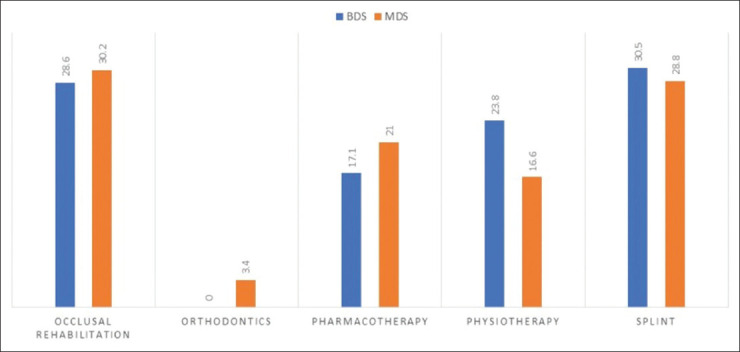
Results: Results of the study disclosed that only 58.1% of general dentists and 46.8% of specialists were confident in handling temporomandibular disorder patients. Splint therapy was the preferred treatment modality for general dentists, whereas dentists with specialist training preferred occlusal rehabilitation.
Conclusion: The results of the current survey indicate that Indian dentists lack sufficient training in dental schools on all three sections and face difficulty diagnosing and treating TMDs.
Copyright © 2024 Copyright: © 2024 The Journal of Indian Prosthodontic Society.
Conflict of interest statement
There are no conflicts of interest.
Figures
References
-
- De Leeuw R, Klasser GD. Quintessence Publishing; Berlin: 2018. Guidelines for Assessment, Diagnosis, and Management Orofacial Pain Sixth Edition.
-
- Gilheaney Ó, Stassen LF, Walshe M. The epidemiology, nature, and impact of eating and swallowing problems in adults presenting with temporomandibular disorders. Cranio. 2022;40:476–84. - PubMed
Publication types
MeSH terms
LinkOut - more resources
Full Text Sources
Medical
Research Materials
Miscellaneous
