


Co-colonization of different species harboring KPC or NDM carbapenemase in the same host gut: insight of resistance evolution by horizontal gene transfer
- PMID: 38946899
- PMCID: PMC11211256
- DOI: 10.3389/fmicb.2024.1416454
Co-colonization of different species harboring KPC or NDM carbapenemase in the same host gut: insight of resistance evolution by horizontal gene transfer
Abstract
Introduction: The dissemination of carbapenem-resistant Enterobacteriales (CRE) in nosocomial settings is primarily associated with the horizontal transfer of plasmids. However, limited research has focused on the in-host transferability of carbapenem resistance. In this study, ten isolates were collected from gut specimens of five individuals, each hosting two different species, including Escherichia coli, Klebsiella pneumoniae, Klebsiella aerogenes, Enterobacter cloacae, or Citrobacter koseri.
Methods: Species identification and antimicrobial susceptibility were determined by MALDI-TOF MS and broth microdilution method. Carbapenemase genes were detected and localized using PCR, S1-PFGE and southern blot. The transferability of carbapenemase genes between species was investigated through filter mating experiments, and the genetic contexts of the plasmids were analyzed using whole genome sequencing.
Results and discussion: Our results revealed that each of the ten isolates harbored a carbapenemase gene, including bla NDM-5, bla NDM-1, or bla KPC-2, on a plasmid. Five different plasmids were successfully transferred to recipient cells of E. coli, K. pneumoniae or A. baumannii by transconjugation. The genetic contexts of the carbapenemase gene were remarkably similar between the two CRE isolates from each individual. This study highlights the potential for interspecies plasmid transmission in human gut, emphasizing the colonization of CRE as a significant risk factor for the dissemination of carbapenemase genes within the host. These findings underscore the need for appropriate intestinal CRE screening and colonization prevention.
Keywords: KPC; NDM; carbapenem-resistant Enterobacteriales; horizontal gene transfer; host gut; interspecies.
Copyright © 2024 Ji, Zhu, Zhao, Zhang, Yao, Zhu, Yu, Zhang and Fu.
Conflict of interest statement
The authors declare that the research was conducted in the absence of any commercial or financial relationships that could be construed as a potential conflict of interest.
Figures
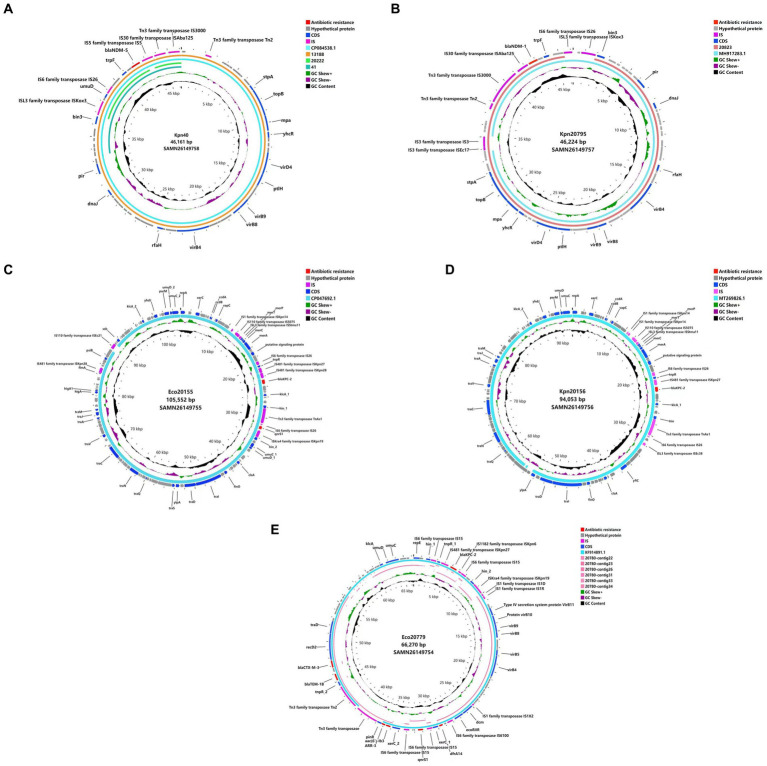
 , antibiotic resistance;
  , hypothetical protein;
  , IS;
, IS;  , CDS;
  , reference sequence;
  , GC Skew+;
  , GC Skew−;
  , GC content;


 , Eae20780 contig22, 23, 26, 31, 33, 34;
  , Ecl20823;
  , Eco13188;
  , Cko20222;
  , Eco41.
References
-
- CLSI (2018). Methods for Dilution Antimicrobial Susceptibility Tests for Bacteria That Grow Aerobically. CLSI Standard M07. 11th Edn. Wayne, PA: Clinical and Laboratory Standards Institute.
-
- CLSI (2020). Performance Standards for Antimicrobial Susceptibility Testing. CLSI Supplement M100. 30th Edn. Wayne, PA, Clinical and Laboratory Standards Institute.
LinkOut - more resources
Full Text Sources
