Editorial
. 2024 Jun 26;4(1):vbae090.
doi: 10.1093/bioadv/vbae090. eCollection 2024.

Perspectives on computational modeling of biological systems and the significance of the SysMod community

Affiliations
Editorial

Perspectives on computational modeling of biological systems and the significance of the SysMod community

Bhanwar Lal Puniya et al. Bioinform Adv. .

Abstract

Motivation: In recent years, applying computational modeling to systems biology has caused a substantial surge in both discovery and practical applications and a significant shift in our understanding of the complexity inherent in biological systems.

Results: In this perspective article, we briefly overview computational modeling in biology, highlighting recent advancements such as multi-scale modeling due to the omics revolution, single-cell technology, and integration of artificial intelligence and machine learning approaches. We also discuss the primary challenges faced: integration, standardization, model complexity, scalability, and interdisciplinary collaboration. Lastly, we highlight the contribution made by the Computational Modeling of Biological Systems (SysMod) Community of Special Interest (COSI) associated with the International Society of Computational Biology (ISCB) in driving progress within this rapidly evolving field through community engagement (via both in person and virtual meetings, social media interactions), webinars, and conferences.

Availability and implementation: Additional information about SysMod is available at https://sysmod.info.


Conflict of interest statement

MV is an employee and shareholder of AstraZeneca. All other authors declared no competing interests.

Figures
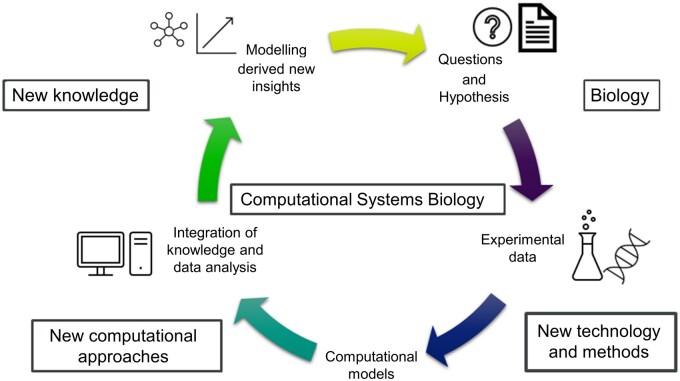
Figure 1.
Figure 1.
Overview of computational systems biology and modeling. The iterative process used in computational systems biology modeling comprises formulating biological questions and hypotheses, using experimental data to support these, and building computational models. The modeling-derived data analysis helps in knowledge integration and new insights, which help formulate new hypotheses. The figure is inspired by Martins dos Santos et al. (2022).
Figure 2.
Figure 2.
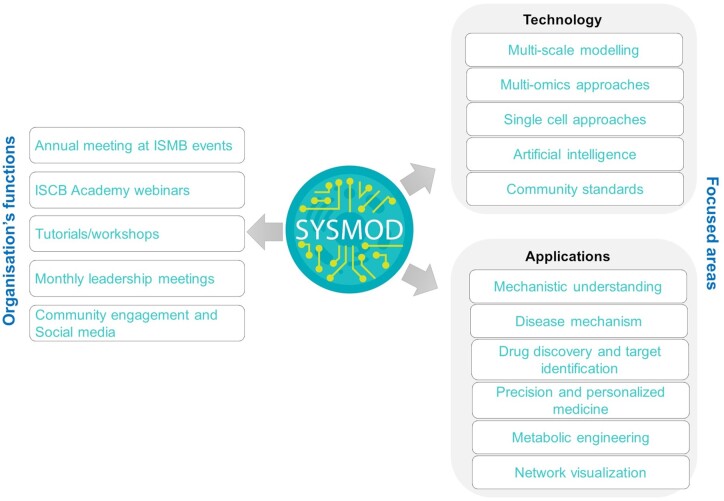
Overview of SysMod organization. SysMod COSI organizes an annual meeting at the ISMB conference and biannual ISCB academy webinars, tutorials, and workshops.
Figure 3.
Figure 3.
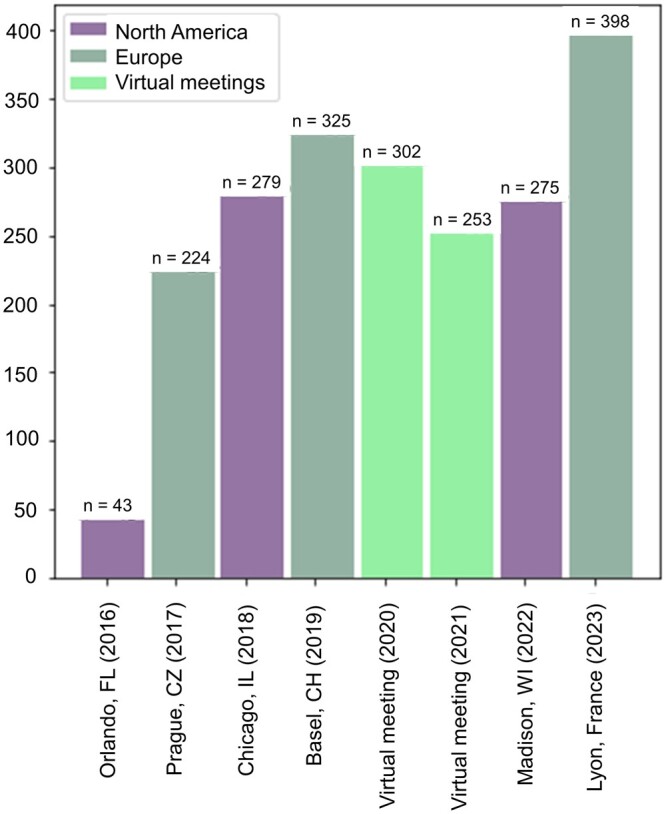
Participants in SysMod annual meeting across the globe. Numbers of registered participants at SysMod meetings (both in-person and virtual) from 2016 to 2023 across North America and Europe.

References

    1. Alber M, Buganza Tepole A, Cannon WR. et al. Integrating machine learning and multiscale modeling-perspectives, challenges, and opportunities in the biological, biomedical, and behavioral sciences. NPJ Digit Med 2019;2:115. - PMC - PubMed
    1. Almendro V, Cheng Y-K, Randles A. et al. Inference of tumor evolution during chemotherapy by computational modeling and in situ analysis of genetic and phenotypic cellular diversity. Cell Rep 2014;6:514–27. - PMC - PubMed
    1. Angione C, Silverman E, Yaneske E. et al. Using machine learning as a surrogate model for agent-based simulations. PLoS One 2022;17:e0263150. - PMC - PubMed
    1. Bai JPF, Earp JC, Strauss DG. et al. A perspective on quantitative systems pharmacology applications to clinical drug development. CPT Pharmacomet Syst Pharmacol 2020;9:675–7. - PMC - PubMed
    1. Bakr S, Brennan K, Mukherjee P et al. . Identifying key multifunctional components shared by critical cancer and normal liver pathways via SparseGMM. Cell Rep Methods 2023;3:100392. - PMC - PubMed

Publication types