. 2024 Jul 15;45(10):e26774.
doi: 10.1002/hbm.26774.

Effects of endogenous testosterone on oscillatory activity during verbal working memory in youth

Affiliations

Effects of endogenous testosterone on oscillatory activity during verbal working memory in youth

Abraham D Killanin et al. Hum Brain Mapp. .

Abstract

Testosterone levels sharply rise during the transition from childhood to adolescence and these changes are known to be associated with changes in human brain structure. During this same developmental window, there are also robust changes in the neural oscillatory dynamics serving verbal working memory processing. Surprisingly, whereas many studies have investigated the effects of chronological age on the neural oscillations supporting verbal working memory, none have probed the impact of endogenous testosterone levels during this developmental period. Using a sample of 89 youth aged 6-14 years-old, we collected salivary testosterone samples and recorded magnetoencephalography during a modified Sternberg verbal working memory task. Significant oscillatory responses were identified and imaged using a beamforming approach and the resulting maps were subjected to whole-brain ANCOVAs examining the effects of testosterone and sex, controlling for age, during verbal working memory encoding and maintenance. Our primary results indicated robust testosterone-related effects in theta (4-7 Hz) and alpha (8-14 Hz) oscillatory activity, controlling for age. During encoding, females exhibited weaker theta oscillations than males in right cerebellar cortices and stronger alpha oscillations in left temporal cortices. During maintenance, youth with greater testosterone exhibited weaker alpha oscillations in right parahippocampal and cerebellar cortices, as well as regions across the left-lateralized language network. These results extend the existing literature on the development of verbal working memory processing by showing region and sex-specific effects of testosterone, and are the first results to link endogenous testosterone levels to the neural oscillatory activity serving verbal working memory, above and beyond the effects of chronological age.

Keywords: MEG; alpha; development; magnetoencephalography; neural oscillations; pubertal hormones; puberty; sex differences; theta.


Conflict of interest statement

The authors declare no conflict of interest.

Figures
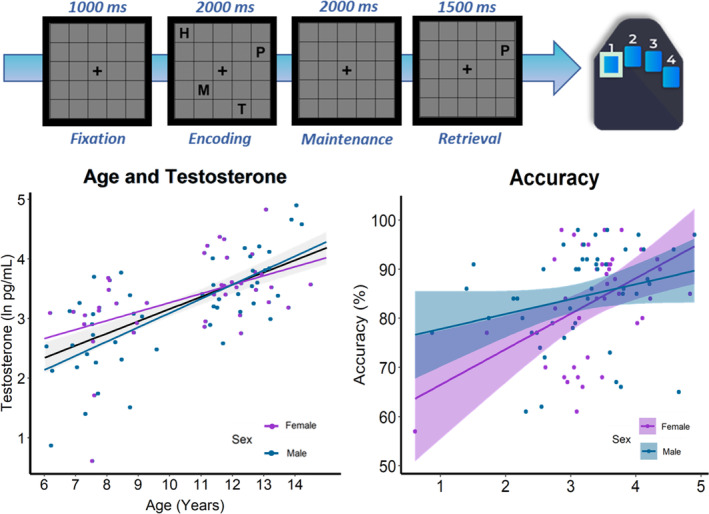
FIGURE 1
FIGURE 1
Modified Sternberg verbal working memory task and behavior. (Top) Example trial of the modified Sternberg verbal working memory task and the corresponding correct response on the button response pad. (Bottom left) Testosterone levels were significantly correlated with chronological age. (Bottom right) Participants with higher levels of testosterone were significantly more accurate on the task, with this relationship being stronger among females than males.
FIGURE 2
FIGURE 2
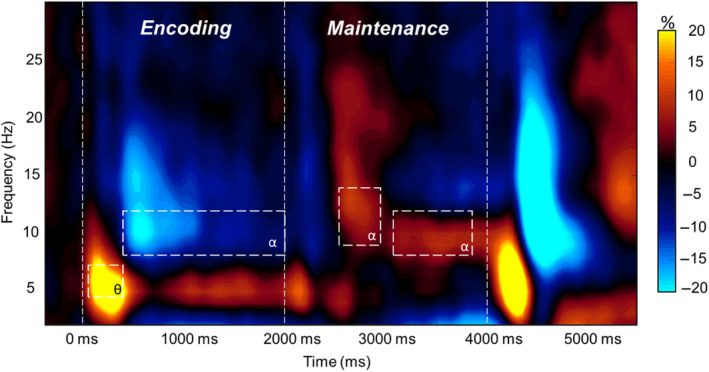
Grand‐Averaged magnetoencephalography (MEG) sensor‐level spectrogram. Grand‐averaged time‐frequency spectrogram taken from a representative sensor (MEG2043). Time is denoted on the x‐axis (0.0 s = encoding onset) and frequency (Hz) is denoted on the y‐axis. Time‐frequency windows that were used for source estimation are denoted by the dashed white boxes. The spectrogram is shown in percent power change from baseline, with the color scale shown to the right of the spectrogram.
FIGURE 3
FIGURE 3
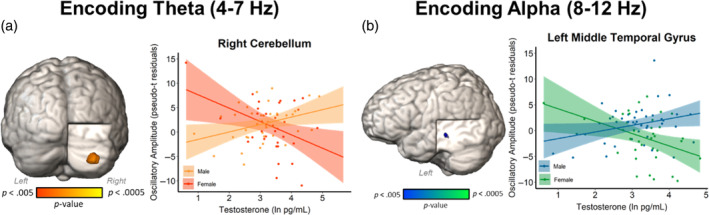
Sexually divergent effects of testosterone on neural oscillations serving working memory encoding. Whole‐brain ANCOVA maps and associated scatterplots showing the interactive effect at the peak voxel, with natural‐log testosterone value (pg/mL) on the x‐axes and residuals of the oscillatory amplitude in pseudo‐t units on the y‐axes, controlling for age and collection time. (a) Females with higher testosterone levels had weaker theta responses than females with lower testosterone levels, with males showing the opposite effect. (b) Females with higher testosterone levels had stronger decreases in alpha power relative to baseline than females with lower testosterone levels. The opposite was true for males.
FIGURE 4
FIGURE 4
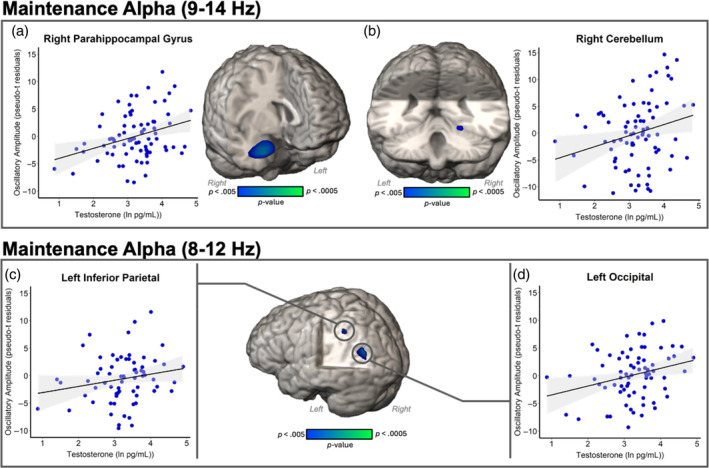
Effects of testosterone on the neural oscillations serving working memory maintenance. Whole‐brain ANCOVA maps and associated scatterplots showing the relationship at the peak voxel, with natural log of testosterone (pg/mL) on the x‐axes and oscillatory amplitude in residuals of pseudo‐t units on the y‐axes. (Top) Alpha power during early maintenance increased relative to baseline with increasing testosterone in the (a) right parahippocampal cortices and (b) right cerebellum. (Bottom) Alpha power during later maintenance became stronger relative to baseline with increasing testosterone in the (c) left inferior parietal cortices and (d) left superior occipital cortices.

References

    1. Alarcón, C. , Cservenka, A. , Fair, D. A. , & Nagel, B. J. (2014). Sex differences in the neural substrates of spatial working memory during adolescence are not mediated by endogenous testosterone. Brain Research, 1593, 40–54. 10.1016/j.brainres.2014.09.057 - DOI - PMC - PubMed
    1. Aminoff, G. , Gronau, N. , & Bar, M. (2007). The parahippocampal cortex mediates spatial and nonspatial associations. Cerebral Cortex, 17(7), 1493–1503. 10.1093/cercor/bhl078 - DOI - PubMed
    1. Andre, P. , Picchioni, M. , Zhang, R. , & Toulopoulou, T. (2016). Working memory circuit as a function of increasing age in healthy adolescence: A systematic review and meta‐analyses. NeuroImage: Clinical, 12, 940–948. 10.1016/j.nicl.2015.12.002 - DOI - PMC - PubMed
    1. Andreano, J. M. , & Cahill, L. (2009). Sex influences on the neurobiology of learning and memory. Learning & Memory, 16(4), 248–266. 10.1101/lm.918309 - DOI - PubMed
    1. Barel, E. , & Tzischinsky, O. (2018). Age and sex differences in verbal and visuospatial abilities. Advances in Cognitive Psychology, 2(14), 51–61. 10.5709/acp-0238-x - DOI - PMC - PubMed

LinkOut - more resources