


An analysis of NHS 111 demand for primary care services: A retrospective cohort study
- PMID: 38949999
- PMCID: PMC11216596
- DOI: 10.1371/journal.pone.0300193
An analysis of NHS 111 demand for primary care services: A retrospective cohort study
Abstract
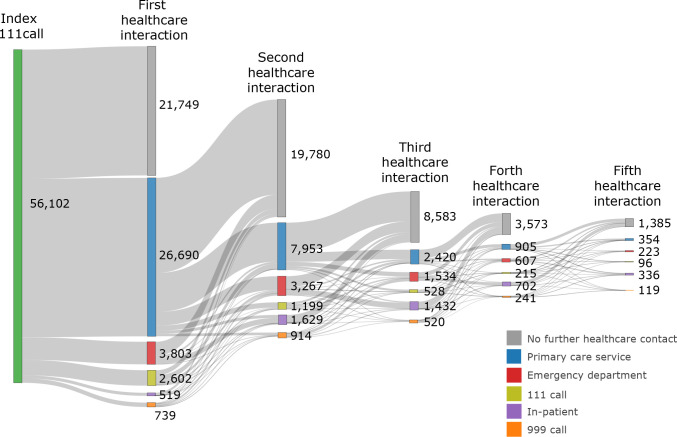
The NHS 111 service triages over 16,650,745 calls per year and approximately 48% of callers are triaged to a primary care disposition, such as a telephone appointment with a general practitioner (GP). However, there has been little assessment of the ability of primary care services to meet this demand. If a timely service cannot be provided to patients, it could result in patients calling 999 or attending emergency departments (ED) instead. This study aimed to explore the patient journey for callers who were triaged to a primary care disposition, and the ability of primary care services to meet this demand. We obtained routine, retrospective data from the Connected Yorkshire research database, and identified all 111 calls between the 1st January 2021 and 31st December 2021 for callers registered with a GP in the Bradford or Airedale region of West Yorkshire, who were triaged to a primary care disposition. Subsequent healthcare system access (111, 999, primary and secondary care) in the 72 hours following the index 111 call was identified, and a descriptive analysis of the healthcare trajectory of patients was undertaken. There were 56,102 index 111 calls, and a primary care service was the first interaction in 26,690/56,102 (47.6%) of cases, with 15,470/26,690 (58%) commenced within the specified triage time frame. Calls to 999 were higher in the cohort who had no prior contact with primary care (58% vs 42%) as were ED attendances (58.2% vs 41.8), although the proportion of avoidable ED attendances was similar (10.5% vs 11.8%). Less than half of 111 callers triaged to a primary care disposition make contact with a primary care service, and even when they do, call triage time frames are frequently not met, suggesting that current primary care provision cannot meet the demand from 111.
Copyright: © 2024 Pilbery et al. This is an open access article distributed under the terms of the Creative Commons Attribution License, which permits unrestricted use, distribution, and reproduction in any medium, provided the original author and source are credited.
Conflict of interest statement
The authors have declared that no competing interests exist.
Figures
References
-
- NHS England. NHS 111 Minimum Data Set 2019-20 [Internet]. 2020. [cited 2020 Dec 29]. Available from: https://www.england.nhs.uk/statistics/statistical-work-areas/nhs-111-min...
-
- UK Government. NHS 111 [Internet]. 2011. [cited 2020 Dec 10]. Available from: https://web.archive.org/web/20130415084921/ http://www.connectingforhealth.nhs.uk/systemsandservices/pathways/news/n...
-
- England N. The NHS Long Term Plan [Internet]. NHS Long Term Plan. 2019. [cited 2020 Dec 10]. Available from: https://www.longtermplan.nhs.uk/publication/nhs-long-term-plan/ doi: 10.1136/bmj.l84 - DOI - PMC - PubMed
-
- Turner J, O’Cathain A, Knowles E, Nicholl J. Impact of the urgent care telephone service NHS 111 pilot sites: A controlled before and after study. BMJ Open [Internet]. 2013. Nov [cited 2020 Dec 10];3(11):e003451. Available from: https://bmjopen.bmj.com/content/3/11/e003451 doi: 10.1136/bmjopen-2013-003451 - DOI - PMC - PubMed
-
- Turner J O’Cathain A, Knowles E, Nicholl J, Tosh J, Sampson F, et al. Evaluation of NHS 111 pilot sites [Internet]. 2012. [cited 2020 Dec 10]. Available from: https://www.sheffield.ac.uk/polopoly_fs/1.227404!/file/NHS_111_final_rep...
MeSH terms
LinkOut - more resources
Full Text Sources
Miscellaneous
