


Remote ischemic conditioning prevents ischemic cerebrovascular events in children with moyamoya disease: a randomized controlled trial
- PMID: 38951456
- PMCID: PMC11422440
- DOI: 10.1007/s12519-024-00824-z
Remote ischemic conditioning prevents ischemic cerebrovascular events in children with moyamoya disease: a randomized controlled trial
Abstract
Background: Moyamoya disease (MMD) is a significant cause of childhood stroke and transient ischemic attacks (TIAs). This study aimed to assess the safety and efficacy of remote ischemic conditioning (RIC) in children with MMD.
Methods: In a single-center pilot study, 46 MMD patients aged 4 to 14 years, with no history of reconstructive surgery, were randomly assigned to receive either RIC or sham RIC treatment twice daily for a year. The primary outcome measured was the cumulative incidence of major adverse cerebrovascular events (MACEs). Secondary outcomes included ischemic stroke, recurrent TIA, hemorrhagic stroke, revascularization rates, and clinical improvement assessed using the patient global impression of change (PGIC) scale during follow-up. RIC-related adverse events were also recorded, and cerebral hemodynamics were evaluated using transcranial Doppler.
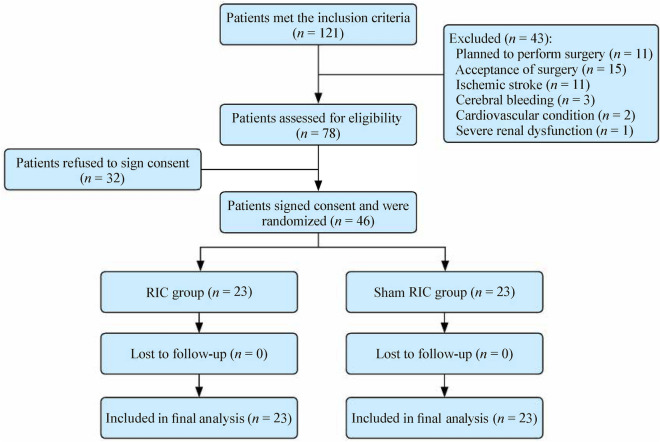
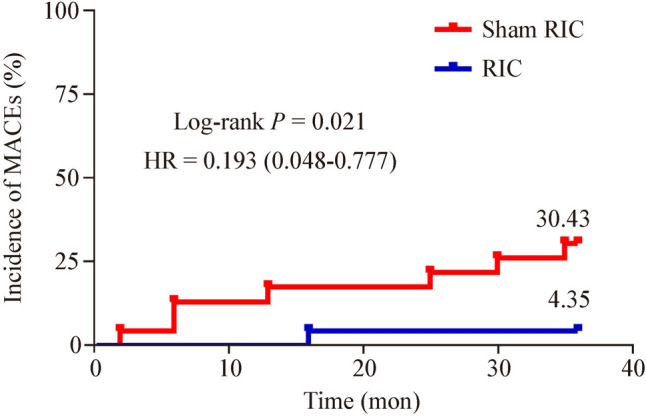
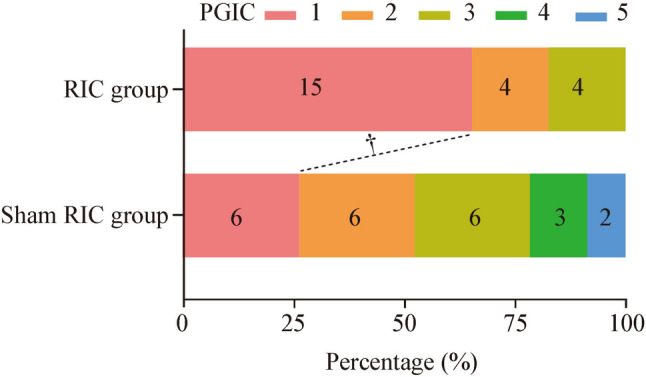
Results: All 46 patients completed the final follow-up (23 each in the RIC and sham RIC groups). No severe adverse events associated with RIC were observed. Kaplan-Meier analysis indicated a significant reduction in MACEs frequency after RIC treatment [log-rank test (Mantel-Cox), P = 0.021]. At 3-year follow-up, two (4.35%) patients had an ischemic stroke, four (8.70%) experienced TIAs, and two (4.35%) underwent revascularization as the qualifying MACEs. The clinical improvement rate in the RIC group was higher than the sham RIC group on the PGIC scale (65.2% vs. 26.1%, P < 0.01). No statistical difference in cerebral hemodynamics post-treatment was observed.
Conclusions: RIC is a safe and effective adjunct therapy for asymptomatic children with MMD. This was largely due to the reduced incidence of ischemic cerebrovascular events.
Keywords: Asymptomatic moyamoya disease; Children; Remote ischemic conditioning; Stroke.
© 2024. The Author(s).
Conflict of interest statement
No financial or non-financial benefits have been received or will be received from any party related directly or indirectly to the subject of this article. The authors have no conflict of interest to declare.
Figures
References
-
- Scott RM, Smith ER. Moyamoya disease and moyamoya syndrome. N Engl J Med. 2009;360:1226–37. - PubMed
-
- Baba T, Houkin K, Kuroda S. Novel epidemiological features of moyamoya disease. J Neurol Neurosurg Psychiatry. 2008;79:900–4. - PubMed
-
- Shang S, Zhou D, Ya J, Li S, Yang Q, Ding Y, et al. Progress in moyamoya disease. Neurosurg Rev. 2020;43:371–82. - PubMed
Publication types
MeSH terms
Grants and funding
LinkOut - more resources
Full Text Sources
