


Effects of irradiation on the survival of Sarcocystis bradyzoites in beef
- PMID: 38952247
- PMCID: PMC11217589
- DOI: 10.1002/vms3.1519
Effects of irradiation on the survival of Sarcocystis bradyzoites in beef
Abstract
Background: Sarcocystis is a food-borne zoonotic protozoan whose final hosts are humans, dogs, cats, and other carnivores and intermediate hosts are birds and mammals, especially humans and herbivores. Humans become infected by eating raw and undercooked meat contaminated with bradyzoites or by consuming water or food contaminated with the sporocyst stage of the parasite.
Objectives: The aim of this study was to investigate the effects of gamma radiation and electron beam on the survival rate of Sarcocystis bradyzoites in infected beef and to determine the effective dose.
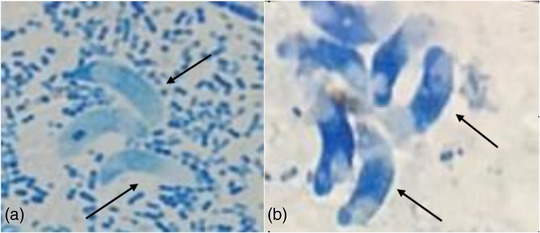
Methods: Three replicates of 100 g of infected meat were treated with different doses (0.5, 1, 1.5 and 2 kGy). As a control, 20 g of contaminated meat was stored separately at 4°C. The viability of the bradyzoites after digestion in pepsin solution was assessed, stained (trypan blue) and unstained, under a stereomicroscope. To assess survival of the bradyzoites, the irradiated meat samples were fed to 30 dogs. After 10 days, faecal samples were examined for sporocysts.
Results: The results showed that the highest and lowest mortality rate of Sarcocystis bradyzoites in infected organs using electron beam at a dose of 2 kGy were 92.5% and 100%, respectively, and the lowest mortality rate at a dose of 0.5 kGy were 2.5% and 7.89%, respectively.
Conclusion: The results of statistical analysis showed that the mortality rate of Sarcocystis bradyzoites was significant between different doses of gamma ray and electron beam, so that gamma rays were better compared to electron beam in destroying Sarcocystis bradyzoites.
Keywords: cattle; decontamination; food‐safety; meat.
© 2024 The Author(s). Veterinary Medicine and Science published by John Wiley & Sons Ltd.
Conflict of interest statement
The authors declare no conflicts of interest.
Figures
References
-
- Agholi, M. , Goodarzi, A. , & Taghinezhad, A. (2021). The present status of Sarcocystis spp. and sarcocystosis in Iran: A literature review. Annals of Parasitology, 67, 567–574. - PubMed
-
- Alabay, B. M. , Emre, Z. , Cerci, H. , Ersen, S. , & Mutluer, B. (1992). Inhibition of viability and infectivity of Cysticercus bovis by irradiation of meat. Turkiye Parazitol Derg, 16, 67–80.
-
- Anvari, D. , Narouei, E. , Hosseini, M. , Narouei, M. R. , Daryani, A. , Shariatzadeh, S. A. , Pagheh, A. S. , Gholami, S. , Sarvi, S. , Sargazi, D. , Saberi, R. , Hosseini, S. A. , & Siyadatpanah, A. (2020). Sarcocystosis in Ruminants of Iran, as Neglected Food‐Borne Disease: A Systematic Review and Meta‐analysis. Acta Parasitol, 65, 555–568. 10.2478/s11686-020-00210-5 - DOI - PubMed
-
- Collins, M. V. , Flick, G. J. , Smith, S. A. , Fayer, R. , Rubendall, E. , & Lindsay, D. S. (2005). The effects of E‐beam irradiation and microwave energy on eastern oysters (Crassostrea virginica) experimentally infected with Cryptosporidium parvum . Journal of Eukaryotic Microbiology, 52, 484–488. - PubMed
-
- Dubey, J. P. , Saville, W. J. A. , Lindsay, D. S. , Stich, R. W. , Stanek, J. F. , Speer, C. A. , Rosenthal, B. M. , Njoku, C. J. , Kwok, O. C. H. , Shen, S. K. , & Reed, S. M. (2000). Completion of the life cycle of Sarcocystis neurona. Journal of Parasitology, 86, 1276–1280. 10.2307/3285013 - DOI - PubMed
Publication types
MeSH terms
Grants and funding
LinkOut - more resources
Full Text Sources
Research Materials
Miscellaneous
