Extensive-stage small-cell lung cancer in patients receiving atezolizumab plus carboplatin-etoposide: stratification of outcome based on a composite score that combines gene expression profiling and immune characterization of microenvironment
- PMID: 38955418
- PMCID: PMC11218000
- DOI: 10.1136/jitc-2024-008974
Extensive-stage small-cell lung cancer in patients receiving atezolizumab plus carboplatin-etoposide: stratification of outcome based on a composite score that combines gene expression profiling and immune characterization of microenvironment
Abstract
Purpose: Small-cell lung cancer (SCLC) is an aggressive disease with a dismal prognosis. The addition of immune checkpoints inhibitors to standard platinum-based chemotherapy in first-line setting achieves a durable benefit only in a patient subgroup. Thus, the identification of predictive biomarkers is an urgent unmet medical need.
Experimental design: Tumor samples from naive extensive-stage (ES) SCLC patients receiving atezolizumab plus carboplatin-etoposide were analyzed by gene expression profiling and two 9-color multiplex immunofluorescence panels, to characterize the immune infiltrate and SCLC subtypes. Associations of tissue biomarkers with time-to-treatment failure (TTF), progression-free survival (PFS) and overall survival (OS), were assessed.
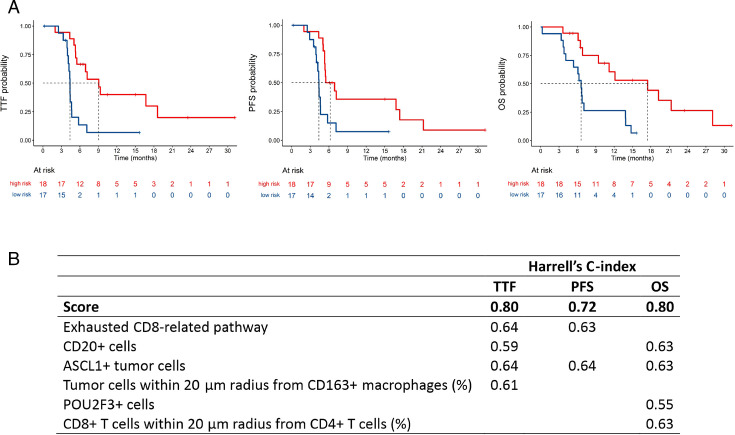
Results: 42 patients were included. Higher expression of exhausted CD8-related genes was independently associated with a longer TTF and PFS while increased density of B lymphocytes correlated with longer TTF and OS. Higher percentage of M2-like macrophages close to tumor cells and of CD8+T cells close to CD4+T lymphocytes correlated with increased risk of TF and longer survival, respectively. A lower risk of TF, disease progression and death was associated with a higher density of ASCL1+tumor cells while the expression of POU2F3 correlated with a shorter survival. A composite score combining the expression of exhausted CD8-related genes, B lymphocyte density, ASCL1 tumor expression and quantification of CD163+macrophages close to tumor cells, was able to stratify patients into high-risk and low-risk groups.
Conclusions: In conclusion, we identified tissue biomarkers and a combined score that can predict a higher benefit from chemoimmunotherapy in ES-SCLC patients.
Keywords: Biomarker; Immune Checkpoint Inhibitor; Lung Cancer; Tumor microenvironment - TME.
© Author(s) (or their employer(s)) 2024. Re-use permitted under CC BY-NC. No commercial re-use. See rights and permissions. Published by BMJ.
Conflict of interest statement
Competing interests: GP reports Advisory Boards/Honoraria/Speakers’ fee/Consultant by Amgen, AstraZeneca, BMS, Eli Lilly, Jansenn, MSD, Novartis, Pfizer, Roche, and unconditioned research support by AstraZeneca, Roche, MSD. VG reports personal fees for advisory board membership for AstraZeneca, Daiichi Sankyo, Eisai, Eli Lilly, Exact Sciences, Gilead, Merck Serono, MSD, Novartis, Pfizer, Olema Oncology, Pierre Fabre; personal fees as an invited speaker for AstraZeneca, Daiichi Sankyo, Eli Lilly, Exact Sciences, Gilead, GSK, Novartis, Roche and Zentiva; personal fees for expert testimony for Eli Lilly.
Figures


References
-
- Howlade N, Noone AM, Krapcho M, et al. . National Cancer Institute SEER cancer Statistics review 1975-2013 National Cancer Institute. In: SEER Cancer Statistics Review 1975-2013. Bethesda, MD, 2016: 1992–2013. Available: http//seer.cancer.gov/csr/1975_2013/, based Novemb. 2015
-
- Paz-Ares L, Dvorkin M, Chen Y, et al. . Durvalumab plus platinum–etoposide versus platinum–etoposide in first-line treatment of extensive-stage small-cell lung cancer (CASPIAN): a randomised, controlled, open-label, phase 3 trial. Lancet 2019;394:1929–39. 10.1016/S0140-6736(19)32222-6 - DOI - PubMed
MeSH terms
Substances
LinkOut - more resources
Full Text Sources
Medical
Research Materials
Miscellaneous