. 2024 Jul 2;14(1):15147.
doi: 10.1038/s41598-024-65895-4.

"How" web searches change under stress

Affiliations

"How" web searches change under stress

Christopher A Kelly et al. Sci Rep. .

Abstract

To adjust to stressful environments, people seek information. Here, we show that in response to stressful public and private events the high-level features of information people seek online alter, reflecting their motives for seeking knowledge. We first show that when people want information to guide action they selectively ask "How" questions. Next, we reveal that "How" searches submitted to Google increased dramatically during the pandemic (controlling for search volume). Strikingly, the proportion of these searches predicted weekly self-reported stress of ~ 17K individuals. To rule out third factors we manipulate stress and find that "How" searches increase in response to stressful, personal, events. The findings suggest that under stress people ask questions to guide action, and mental state is reflected in features that tap into why people seek information rather than the topics they search for. Tracking such features may provide clues regrading population stress levels.


Conflict of interest statement

The authors declare no competing interests.

Figures
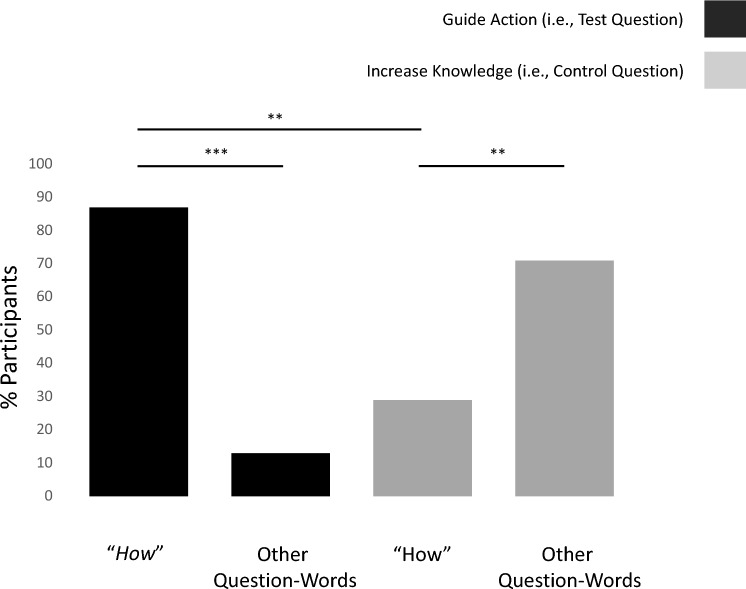
Figure 1
Figure 1
How” questions are associated with guiding actions. Plotted on the y-axis is the percentage of participants selecting a particular question-word. Participants were more likely to select “How” over other question-words when asking a question to help guide their actions to achieve a goal. They also were more likely to ask “How” to help guide their actions than to simply increase their understanding. ***p < 0.001, **p < 0.01.
Figure 2
Figure 2
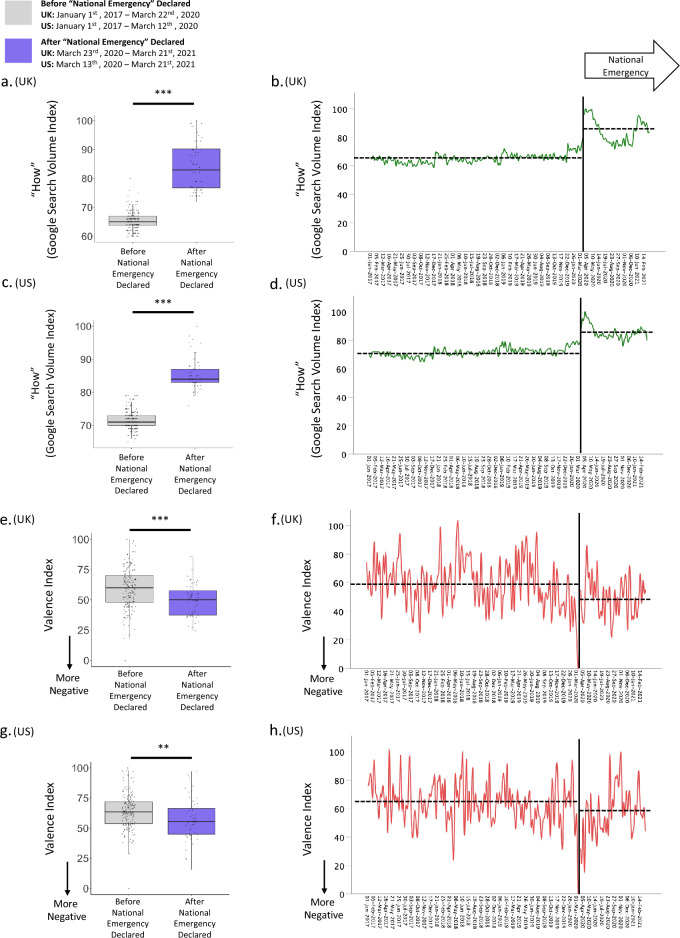
High-level characteristics of web searches alter during the pandemic. Relative volume of “How” searches (i.e., the proportion of “How” searches relative to all searches for that time and place) was greater after the COVID-19 “National Emergency” declaration relative to before in (a,b) the UK and (c,d) the US. The Valence Index [0 (most negative valenced) to 100 (most positive valenced)] reveals that question queries submitted to the Google search engine were more negatively valenced in the (e,f) UK and (g,h) the US after the COVID-19 “National Emergency” declaration relative to before. The period assessed prior to the “National Emergency” was from January 1st, 2017 to the declaration of each country’s “National Emergency”. The “National Emergency” was assessed from March 23rd, 2020 to March 21st, 2021, in the (a,b,e,f) UK and from Match 13th, 2020 to March 21st, 2021 in the (c,d,g,h) US. (a,c,e,g) The horizontal lines indicate median values, boxes indicate 25–75% interquartile range and whiskers indicate 1.5× interquartile range; individual scores are shown as dots. (b,d,f,h) The bold line indicates the declaration of the “National Emergency”, the dashed lines indicate the mean values for before and after the “National Emergency”. ***p < 0.001, **p < 0.01 (two-sided).
Figure 3
Figure 3
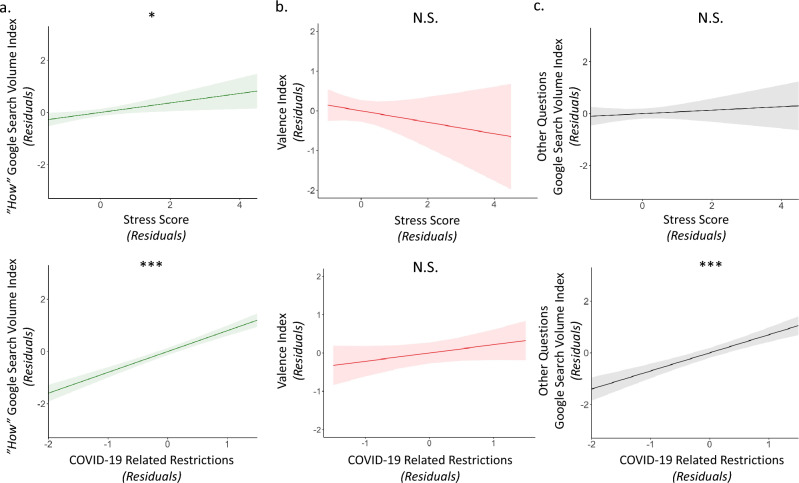
Self-reported stress is selectively associated with an increase in “How” searches. Stress level in the UK was associated with (a) the UK Google Search Volume Index of “How” searches (detrended and Z scored), but not with (b) the Valence Index [0 (most negative valenced) and 100 (most positive valenced)] (detrended and Z scored), nor with (c) the mean UK Google Search Volume Index of other questions (i.e., What, Which, Who, Where, Why, When, and Whose; detrended and Z scored). UK COVID-19 related confinement score (detrended and Z scored; bottom panel) was associated with both (a) the UK Google Search Volume Index of “How” searches and (c) the mean UK Google Search Volume Index of other questions, but not (b) the Valence Index. Stress levels and COVID-19 confinement scores (all detrended and Z-scored) were entered in the same models, controlling for each other. The X and Y values are the residuals (regressing out the respective control variable). The fine line represents the confidence interval. ***p < 0.001, *p < 0.05, N.S. not significant (two-sided).
Figure 4
Figure 4
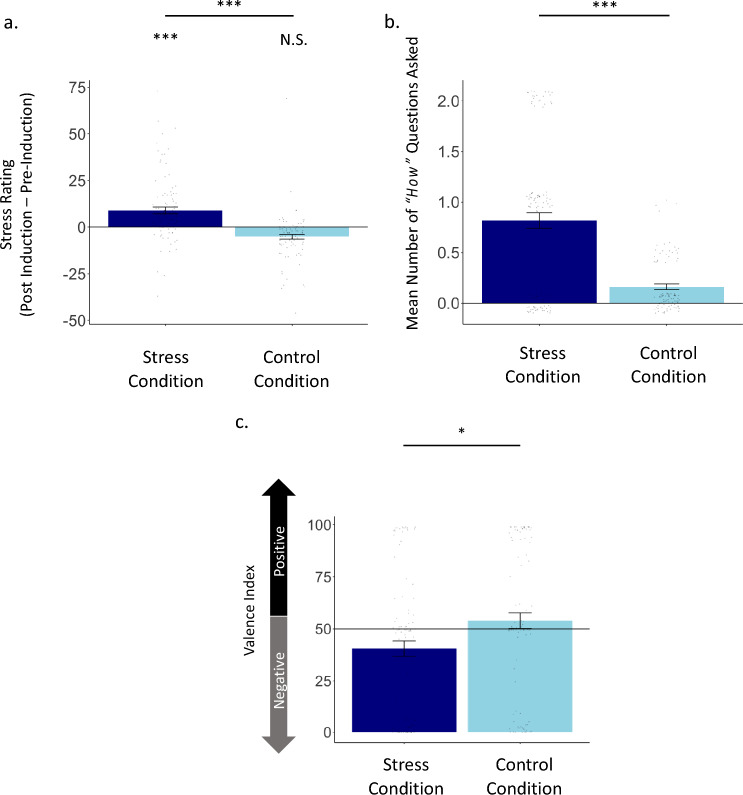
Personal stressful events alter high-level characteristics of searches. (a) Participants were asked to recall in detail, and write about, either a stressful past event (i.e., stress condition) or a relaxing past event (i.e., control condition). Participants reported their stress level on a scale ranging from very calm (− 50) to very stressed (+ 50) before and after recalling the event. Plotted on the y-axis is participant’s post induction stress rating minus their pre-induction stress rating for the stress condition (dark blue) and control condition (light blue). Participants’ stress scores increased post stress induction compared to pre-induction for the stress condition but not the control condition. (b) The mean number of “How” questions asked in the stress condition (x-axis; dark blue) was greater than in the control condition (x-axis; light blue). (c) In the stress condition (x-axis; dark blue) participants asked more negative questions than in the control condition (x-axis; light blue). Individual scores are shown as dots. Error bars = standard error (SEM). ***p < 0.001, *p < 0.05, N.S. not significant (two-sided).

References

    1. Finlay-Jones R, Brown GW. Types of stressful life event and the onset of anxiety and depressive disorders. Psychol. Med. 1981;11(4):803–815. doi: 10.1017/S0033291700041301. - DOI - PubMed
    1. Francis JL, Moitra E, Dyck I, Keller MB. The impact of stressful life events on relapse of generalized anxiety disorder. Depress. Anxiety. 2012;29(5):386–391. doi: 10.1002/da.20919. - DOI - PMC - PubMed
    1. McLaughlin KA, Conron KJ, Koenen KC, Gilman SE. Childhood adversity, adult stressful life events, and risk of past-year psychiatric disorder: A test of the stress sensitization hypothesis in a population-based sample of adults. Psychol. Med. 2010;40(10):1647–1658. doi: 10.1017/S0033291709992121. - DOI - PMC - PubMed
    1. Miloyan B, Joseph Bienvenu O, Brilot B, Eaton WW. Adverse life events and the onset of anxiety disorders. Psychiatry Res. 2018;259:488–492. doi: 10.1016/j.psychres.2017.11.027. - DOI - PMC - PubMed
    1. Suls J, Mullen B. Life events, perceived control and illness: The role of uncertainty. J. Hum. Stress. 1981;7(2):30–34. doi: 10.1080/0097840X.1981.9936824. - DOI - PubMed