


Predictive values of pre-treatment brain age models to rTMS effects in neurocognitive disorder with depression: Secondary analysis of a randomised sham-controlled clinical trial
- PMID: 38963341
- PMCID: PMC11225634
- DOI: 10.1080/19585969.2024.2373075
Predictive values of pre-treatment brain age models to rTMS effects in neurocognitive disorder with depression: Secondary analysis of a randomised sham-controlled clinical trial
Abstract
Introduction: One major challenge in developing personalised repetitive transcranial magnetic stimulation (rTMS) is that the treatment responses exhibited high inter-individual variations. Brain morphometry might contribute to these variations. This study sought to determine whether individual's brain morphometry could predict the rTMS responders and remitters.
Methods: This was a secondary analysis of data from a randomised clinical trial that included fifty-five patients over the age of 60 with both comorbid depression and neurocognitive disorder. Based on magnetic resonance imaging scans, estimated brain age was calculated with morphometric features using a support vector machine. Brain-predicted age difference (brain-PAD) was computed as the difference between brain age and chronological age.
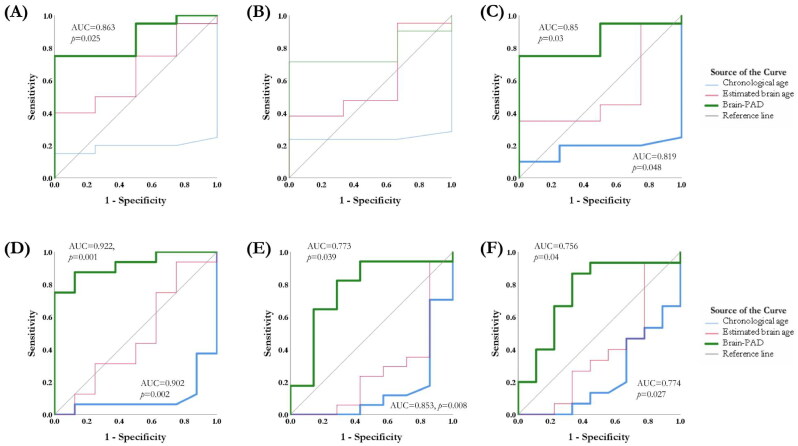
Results: The rTMS responders and remitters had younger brain age. Every additional year of brain-PAD decreased the odds of relieving depressive symptoms by ∼25.7% in responders (Odd ratio [OR] = 0.743, p = .045) and by ∼39.5% in remitters (OR = 0.605, p = .022) in active rTMS group. Using brain-PAD score as a feature, responder-nonresponder classification accuracies of 85% (3rd week) and 84% (12th week), respectively were achieved.
Conclusion: In elderly patients, younger brain age appears to be associated with better treatment responses to active rTMS. Pre-treatment brain age models informed by morphometry might be used as an indicator to stratify suitable patients for rTMS treatment.
Trial registration: ClinicalTrials.gov Identifier: ChiCTR-IOR-16008191.
Keywords: MRI; brain age; cortical features; depression; neurocognitive disorder; neuroplasticity; prediction; rTMS.
Conflict of interest statement
No potential conflict of interest was reported by the author(s).
Figures
References
-
- American Psychiatric Association . 2013. Diagnostic and statistical manual of mental disorders (DSM-5®). Washington: American Psychiatric Pub.
-
- Baeken C, van Beek V, Vanderhasselt MA, Duprat R, Klooster D.. 2021. Cortical thickness in the right anterior cingulate cortex relates to clinical response to left prefrontal accelerated intermittent theta burst stimulation: an exploratory study. Neuromodulation. 24(5):938–949. doi: 10.1111/ner.13380. - DOI - PMC - PubMed
-
- Berk M, Conus P, Kapczinski F, Andreazza AC, Yücel M, Wood SJ, Pantelis C, Malhi GS, Dodd S, Bechdolf A, et al. 2010. From neuroprogression to neuroprotection: implications for clinical care. Med J Aust. 193(S4):S36–S40. - PubMed
Publication types
MeSH terms
LinkOut - more resources
Full Text Sources
Medical
Miscellaneous
