


Musculoskeletal Health and Work: Development and Internal-External Cross-Validation of a Model to Predict Risk of Work Absence and Presenteeism in People Seeking Primary Healthcare
- PMID: 38963652
- PMCID: PMC12360984
- DOI: 10.1007/s10926-024-10223-w
Musculoskeletal Health and Work: Development and Internal-External Cross-Validation of a Model to Predict Risk of Work Absence and Presenteeism in People Seeking Primary Healthcare
Abstract
Purpose: To develop and validate prediction models for the risk of future work absence and level of presenteeism, in adults seeking primary healthcare with musculoskeletal disorders (MSD).
Methods: Six studies from the West-Midlands/Northwest regions of England, recruiting adults consulting primary care with MSD were included for model development and internal-external cross-validation (IECV). The primary outcome was any work absence within 6 months of their consultation. Secondary outcomes included 6-month presenteeism and 12-month work absence. Ten candidate predictors were included: age; sex; multisite pain; baseline pain score; pain duration; job type; anxiety/depression; comorbidities; absence in the previous 6 months; and baseline presenteeism.
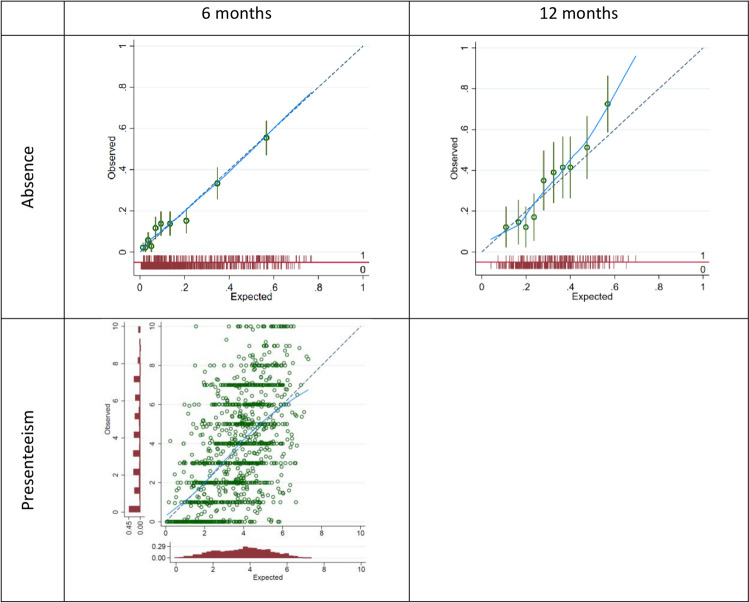
Results: For the 6-month absence model, 2179 participants (215 absences) were available across five studies. Calibration was promising, although varied across studies, with a pooled calibration slope of 0.93 (95% CI: 0.41-1.46) on IECV. On average, the model discriminated well between those with work absence within 6 months, and those without (IECV-pooled C-statistic 0.76, 95% CI: 0.66-0.86). The 6-month presenteeism model, while well calibrated on average, showed some individual-level variation in predictive accuracy, and the 12-month absence model was poorly calibrated due to the small available size for model development.
Conclusions: The developed models predict 6-month work absence and presenteeism with reasonable accuracy, on average, in adults consulting with MSD. The model to predict 12-month absence was poorly calibrated and is not yet ready for use in practice. This information may support shared decision-making and targeting occupational health interventions at those with a higher risk of absence or presenteeism in the 6 months following consultation. Further external validation is needed before the models' use can be recommended or their impact on patients can be fully assessed.
Keywords: Musculoskeletal pain; Primary care; Prognosis; Prognostic model; Work absence.
© 2024. The Author(s).
Conflict of interest statement
Declarations. Competing interests: The authors declare no competing interests.
Figures
References
-
- Versus Arthritis. The state of musculoskeletal health 2021. Chesterfield: Versus Arthritis; 2021.
-
- Ingram M, Symmons DPM. The burden of musculoskeletal conditions. Medicine. 2018;46(3):152–5.
-
- Australian Institute of Health and Welfare. Disease expenditure in Australia 2018–19. 2021. https://www.aihw.gov.au/reports/health-welfare-expenditure/disease-expen.... Accessed 8 Feb 2024.
Publication types
MeSH terms
Grants and funding
LinkOut - more resources
Full Text Sources
