


Aclarubicin: contemporary insights into its mechanism of action, toxicity, pharmacokinetics, and clinical standing
- PMID: 38965080
- PMCID: PMC11390774
- DOI: 10.1007/s00280-024-04693-1
Aclarubicin: contemporary insights into its mechanism of action, toxicity, pharmacokinetics, and clinical standing
Abstract
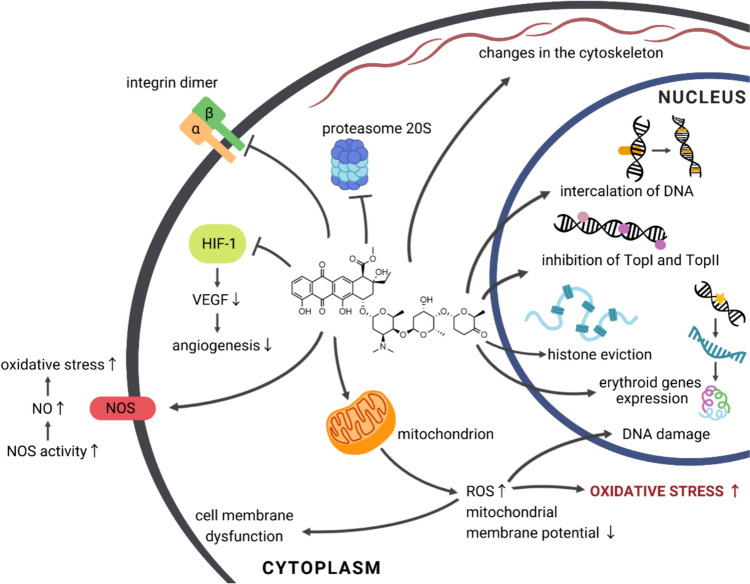
Aclarubicin (aclacinomycin A) is one of the anthracycline antineoplastic antibiotics with a multifaceted mechanism of antitumor activity. As a second-generation drug, it offers several advantages compared to standard anthracycline drugs such as doxorubicin or daunorubicin, which could position it as a potential blockbuster drug in antitumor therapy. Key mechanisms of action for aclarubicin include the inhibition of both types of topoisomerases, suppression of tumor invasion processes, generation of reactive oxygen species, inhibition of chymotrypsin-like activity, influence on cisplatin degradation, and inhibition of angiogenesis. Therefore, aclarubicin appears to be an ideal candidate for antitumor therapy. However, despite initial interest in its clinical applications, only a limited number of high-quality trials have been conducted thus far. Aclarubicin has primarily been evaluated as an induction therapy in acute myeloid and lymphoblastic leukemia. Studies have indicated that aclarubicin may hold significant promise for combination therapies with other anticancer drugs, although further research is needed to confirm its potential. This paper provides an in-depth exploration of aclarubicin's diverse mechanisms of action, its pharmacokinetics, potential toxicity, and the clinical trials in which it has been investigated.
Keywords: Aclacinomycin A; Aclarubicin; Anthracycline; Antibiotic; Antineoplastic drug; Antitumor therapy.
© 2024. The Author(s).
Conflict of interest statement
The authors declare that they have no conflict of interest.
Figures
References
-
- Cresteil T (2017) Aclarubicin. Ref Modul Biomed Sci. 10.1016/B978-0-12-801238-3.97571-8 10.1016/B978-0-12-801238-3.97571-8 - DOI
-
- Jensen PB, Sørensen BS, Sehested M, Demant EJF, Kjeldsen E, Friche E, Hansen HH (1993) Different modes of anthracycline interaction with topoisomerase II. Separate structures critical for DNA-cleavage, and for overcoming topoisomerase II-related drug resistance. Biochem Pharmacol 45:2025–2035. 10.1016/0006-2952(93)90013-M 10.1016/0006-2952(93)90013-M - DOI - PubMed
Publication types
MeSH terms
Substances
Grants and funding
LinkOut - more resources
Full Text Sources
Research Materials
