. 2024 Jul 5;73(9):180.
doi: 10.1007/s00262-024-03766-7.

Blockade of the TIGIT-CD155/CD112 axis enhances functionality of NK-92 but not cytokine-induced memory-like NK cells toward CD155-expressing acute myeloid leukemia

Affiliations

Blockade of the TIGIT-CD155/CD112 axis enhances functionality of NK-92 but not cytokine-induced memory-like NK cells toward CD155-expressing acute myeloid leukemia

Katharina Seel et al. Cancer Immunol Immunother. .

Abstract

TIGIT is an alternative checkpoint receptor (CR) whose inhibition promotes Graft-versus-Leukemia effects of NK cells. Given the significant immune-permissiveness of NK cells circulating in acute myeloid leukemia (AML) patients, we asked whether adoptive transfer of activated NK cells would benefit from additional TIGIT-blockade. Hence, we characterized cytokine-induced memory-like (CIML)-NK cells and NK cell lines for the expression of inhibitory CRs. In addition, we analyzed the transcription of CR ligands in AML patients (CCLE and Beat AML 2.0 cohort) in silico and evaluated the efficacy of CR blockade using in vitro cytotoxicity assays, CD69, CD107a and IFN-γ expression. Alternative but not classical CRs were abundantly expressed on healthy donor NK cells and even further upregulated on CIML-NK cells. In line with our finding that CD155, one important TIGIT-ligand, is reliably expressed on AMLs, we show improved killing of CD155+-AML blasts by NK-92 but interestingly not CIML-NK cells in the presence of TIGIT-blockade. Additionally, our in silico data (n = 671) show that poor prognosis AML patients rather displayed a CD86low CD112/CD155high phenotype, whereas patients with a better outcome rather exhibited a CD86high CD112/CD155low phenotype. Collectively, our data evidence that the complex CR ligand expression profile on AML blasts may be one explanation for the intrinsic NK cell exhaustion observed in AML patients which might be overcome with adoptive NK-92 transfer in combination with TIGIT-blockade.

Keywords: Acute myeloid leukemia; Checkpoint receptor inhibition; NK-92 cell line; Natural killer cells; TIGIT.


Conflict of interest statement

None of the authors declares a conflict of interest.

Figures
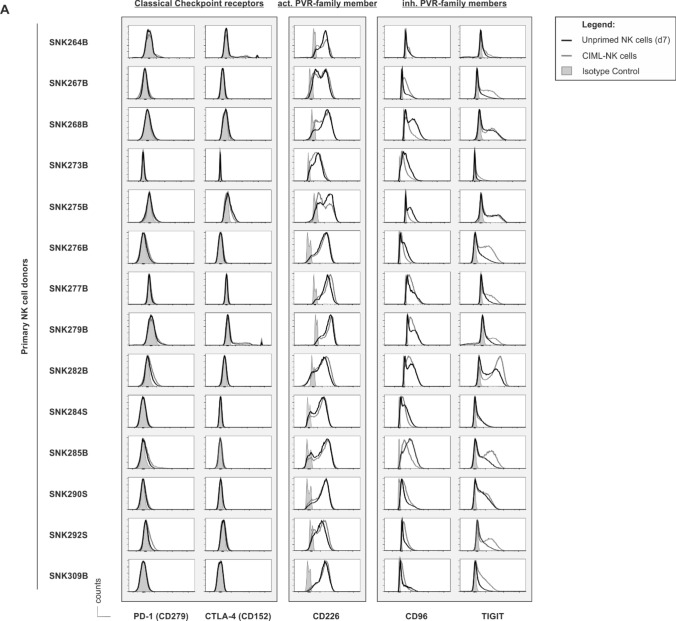
Fig. 1
Fig. 1
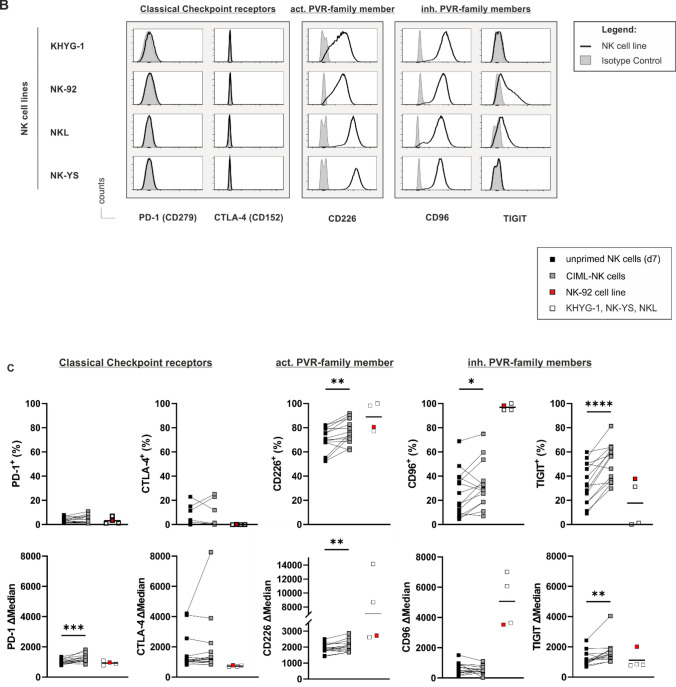
Unprimed and CIML-NK cells express PVR/Nectin family members but not classical immune CRs to a significant extent. Flow cytometric analyses of classical CRs (PD-1, CTLA-4) and activating (CD226) or inhibitory (CD96, TIGIT) alternative PVR/Nectin CRs on A unprimed NK cells (d7) and CIML-NK cells in comparison with B typical NK cell lines. A and B Overlay of the original histogram data displaying the respective antigen expression on unprimed NK cells or NK cell lines (black lines), respectively, or on CIML-NK cells (gray line), together with the corresponding isotype control (shaded in light gray). C NK cell subpopulation (%) and delta Median (ΔMedian) positive for one given CR. The ΔMedian was analyzed by subtracting the fluorescence intensity of the isotype staining from the specific staining of the respective antibody. Note that the process of memory cell conversion is accompanied by a significant upregulation of alternative but not classical CRs on CIML-NK cells. Each donor is represented with unprimed and CIML-NK cells. Statistical significance was calculated using the Student`s t-test for comparison of paired data and defined as * p ≤ 0.05, ** p ≤ 0.01, *** p ≤ 0.001 and **** p ≤ 0.0001
Fig. 1
Fig. 1
Unprimed and CIML-NK cells express PVR/Nectin family members but not classical immune CRs to a significant extent. Flow cytometric analyses of classical CRs (PD-1, CTLA-4) and activating (CD226) or inhibitory (CD96, TIGIT) alternative PVR/Nectin CRs on A unprimed NK cells (d7) and CIML-NK cells in comparison with B typical NK cell lines. A and B Overlay of the original histogram data displaying the respective antigen expression on unprimed NK cells or NK cell lines (black lines), respectively, or on CIML-NK cells (gray line), together with the corresponding isotype control (shaded in light gray). C NK cell subpopulation (%) and delta Median (ΔMedian) positive for one given CR. The ΔMedian was analyzed by subtracting the fluorescence intensity of the isotype staining from the specific staining of the respective antibody. Note that the process of memory cell conversion is accompanied by a significant upregulation of alternative but not classical CRs on CIML-NK cells. Each donor is represented with unprimed and CIML-NK cells. Statistical significance was calculated using the Student`s t-test for comparison of paired data and defined as * p ≤ 0.05, ** p ≤ 0.01, *** p ≤ 0.001 and **** p ≤ 0.0001
Fig. 2
Fig. 2
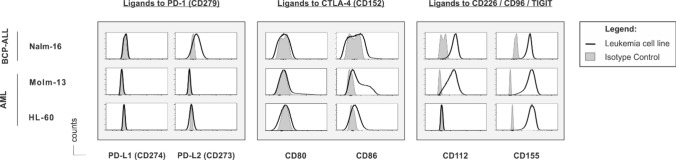
Acute lymphoblastic and myeloid leukemia cell lines express ligands to PVR/Nectin family receptors but not to classical CRs to a significant extent. Flow cytometric analyses showing the ligand expression to classical CRs (PD-L1 (CD274), PD-L2 (CD273), CD80 and CD86) but also to PVR/Nectin family members (CD112 and CD155) on the (pediatric) acute B-cell precursor lymphoblastic leukemia (BCP-ALL) cell line (Nalm-16) and two adult acute myeloid leukemia (AML) cell lines (Molm-13 and HL-60). Overlay of the original histogram data displaying the respective antigen expression (black lines) and the corresponding isotype control (shaded in light gray)
Fig. 3
Fig. 3
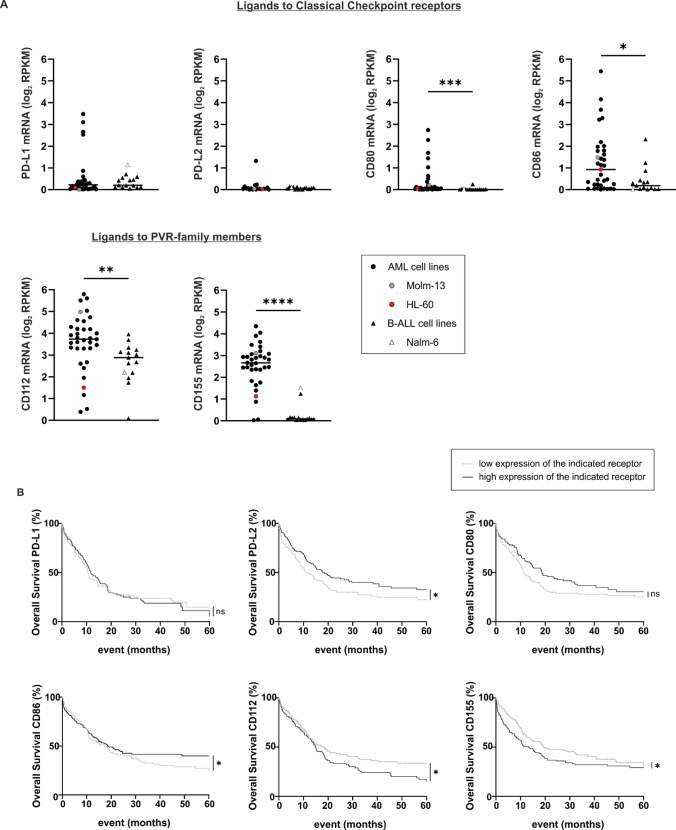
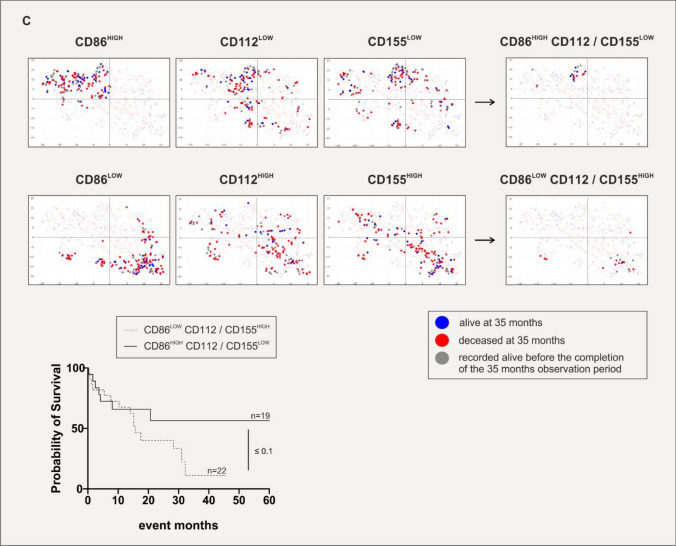
The complex alternative CR ligand profile on AML (but not B-ALL) blasts may have prognostic implications. For differential CR ligand mRNA expression analysis, the 2019 Cancer Cell Line Encyclopedia was frequented [24], and all available samples were included. Samples were stratified based on their primary diagnosis at specimen acquisition. A Differential mRNA expression of PD-L1, PD-L2, CD80, CD86, CD112 and CD155. Statistical significance was calculated using the Mann–Whitney U-test and defined as * p ≤ 0.05, ** p ≤ 0.01, *** p ≤ 0.001 and **** p ≤ 0.0001. Note that we show Nalm-6 as a related and similar substitute for Nalm-16 [30] in this Fig. as information on Nalm-16 was not available in the Encyclopedia. B Survival data of patients obtained from large-scale cancer genomics datasets through the cBio Portal [26, 27] as a function of high (black, solid line) or low (light gray, dashed line) mRNA expression of the respective CR ligand PD-L1, PD-L2, CD80, CD86, CD112 and CD155. Statistical significance was calculated using the Mantel–Cox test and was defined as * p ≤ 0.05. C Survival based on phenotype association. Two-dimensional t-SNEs plot of the AML patients in the Beat AML 2.0 cohort [25]. Each dot represents one specimen (n = 707). The normalized CR ligand mRNA transcripts (PD-L1, PD-L2, CD80, CD86, CD112 and CD155) demonstrating variance (with a perplexity score of 30 and a θ-value of 0.5) were subjected to t-SNE analysis. Patient samples are color-coded based on survival status at 35 months: “alive” (blue), “deceased” (red) and “recorded alive before completion of the 35 months observation period” (gray). Included is also a Kaplan–Meier plot showing that AML patients with a CD86lo CD155/CD112hi phenotype (light gray, dashed line) exhibit a poorer prognosis, whereas AML patients with a CD86hi CD155/CD112lo ligand profile (black, solid line) display an overall better outcome. Statistical significance was calculated using the Mantel–Cox test
Fig. 3
Fig. 3
The complex alternative CR ligand profile on AML (but not B-ALL) blasts may have prognostic implications. For differential CR ligand mRNA expression analysis, the 2019 Cancer Cell Line Encyclopedia was frequented [24], and all available samples were included. Samples were stratified based on their primary diagnosis at specimen acquisition. A Differential mRNA expression of PD-L1, PD-L2, CD80, CD86, CD112 and CD155. Statistical significance was calculated using the Mann–Whitney U-test and defined as * p ≤ 0.05, ** p ≤ 0.01, *** p ≤ 0.001 and **** p ≤ 0.0001. Note that we show Nalm-6 as a related and similar substitute for Nalm-16 [30] in this Fig. as information on Nalm-16 was not available in the Encyclopedia. B Survival data of patients obtained from large-scale cancer genomics datasets through the cBio Portal [26, 27] as a function of high (black, solid line) or low (light gray, dashed line) mRNA expression of the respective CR ligand PD-L1, PD-L2, CD80, CD86, CD112 and CD155. Statistical significance was calculated using the Mantel–Cox test and was defined as * p ≤ 0.05. C Survival based on phenotype association. Two-dimensional t-SNEs plot of the AML patients in the Beat AML 2.0 cohort [25]. Each dot represents one specimen (n = 707). The normalized CR ligand mRNA transcripts (PD-L1, PD-L2, CD80, CD86, CD112 and CD155) demonstrating variance (with a perplexity score of 30 and a θ-value of 0.5) were subjected to t-SNE analysis. Patient samples are color-coded based on survival status at 35 months: “alive” (blue), “deceased” (red) and “recorded alive before completion of the 35 months observation period” (gray). Included is also a Kaplan–Meier plot showing that AML patients with a CD86lo CD155/CD112hi phenotype (light gray, dashed line) exhibit a poorer prognosis, whereas AML patients with a CD86hi CD155/CD112lo ligand profile (black, solid line) display an overall better outcome. Statistical significance was calculated using the Mantel–Cox test
Fig. 4
Fig. 4
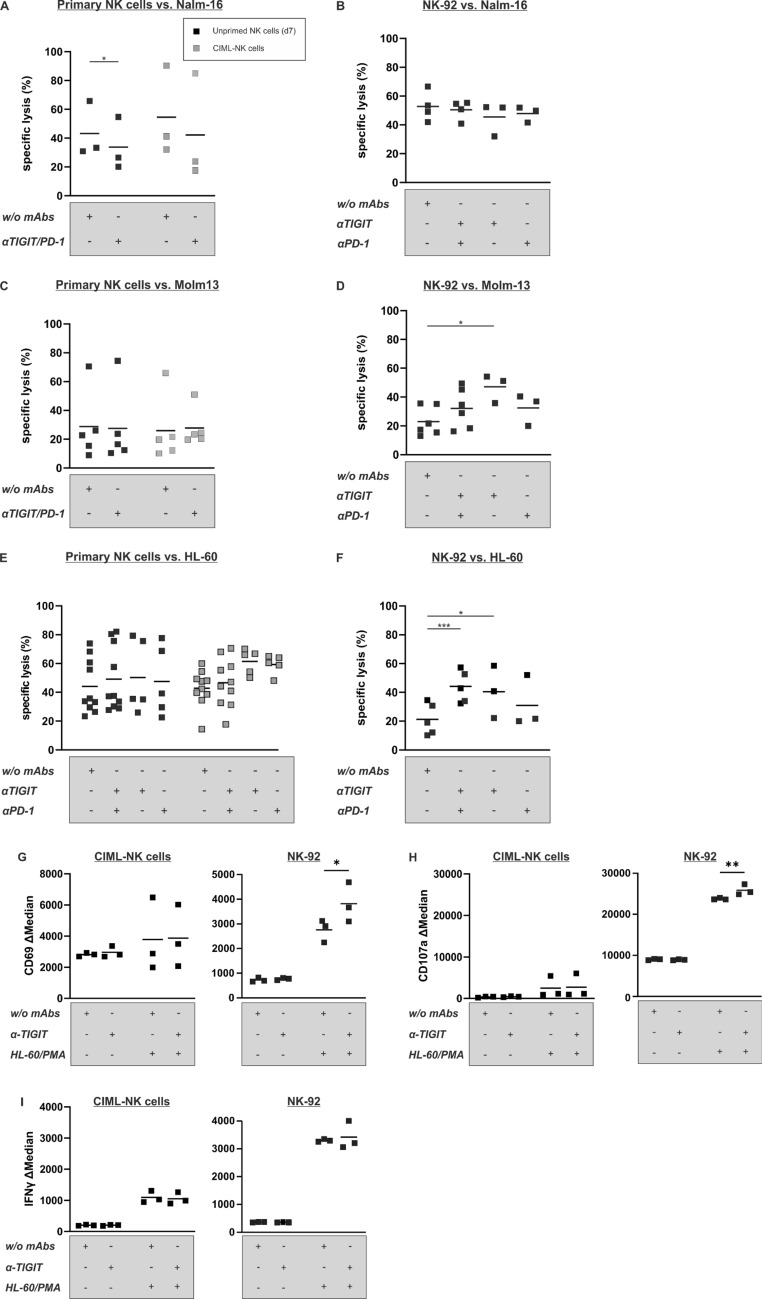
Anti-tumor functionality of the NK-92 cell line toward AML is enhanced by PVR/Nectin family member CR blockade. In vitro cytotoxicity was determined using unprimed NK cells (d7) and corresponding CIML-NK cells (d7) from healthy NK cell donors A, C and E or the NK-92 cell line B, D and F as effectors and Nalm-16, Molm-13 and HL-60 as targets. The following donors were used: testing against Nalm-16: SNK267B, SNK282B, SNK276B, testing against Molm-13: SNK285B, SNK267B, SNK292S, SNK309B, SNK268B and testing against HL-60: SNK275B, SNK268B, SNK309B, SNK264B, SNK279B, SNK313R, SNK314S, SNK294B, SNK295B, SNK278B, SNK304B. Please note that not all donors were tested in every single experimental condition as cell numbers were limited. The following effector-to-target (E:T) ratios were used: primary NK cells vs. Nalm-16 20:1, primary NK cells vs. Molm-13 20:1, primary NK cells vs. HL-60 5:1, NK-92 vs. Nalm-16 3:1, NK-92 vs. Molm-13 10:1 and NK-92 vs. HL-60 1:1. Experiments were performed in the absence or presence of PD-1 (EH12.2H7, 10 μg/ml)- and/or TIGIT (A15153G, 25 μg/ml)-blocking mAbs. Data represent n = 3–8 healthy NK cell donors and n = 3–6 independent experiments with the NK-92 cell line as effector. All experiments were performed in triplicates. (GI) Extended functionality testing in co-culture experiments of CIML-NK cells of the donors SNK307B, SNK304B and SNK330L, NK-92 cells and HL-60. Functionality was determined in the presence or absence of TIGIT-blocking mAb (A15153G, 25 μg/ml) using the CIML-NK cells or the NK-92 cell line, respectively, as effectors and HL-60 as target cell line (ratio 1:1). G Level of activation as determined by CD69 expression. H Ability for degranulation as determined by intracellular CD107a expression. (I) Ability for cytokine secretion as determined by intracellular IFN-γ expression. Shown is the ΔMedian. Data represent n = 3 independent experiments. Significances in all experiments are indicated with * p < 0.05 and *** p < 0.001
Fig. 5
Fig. 5
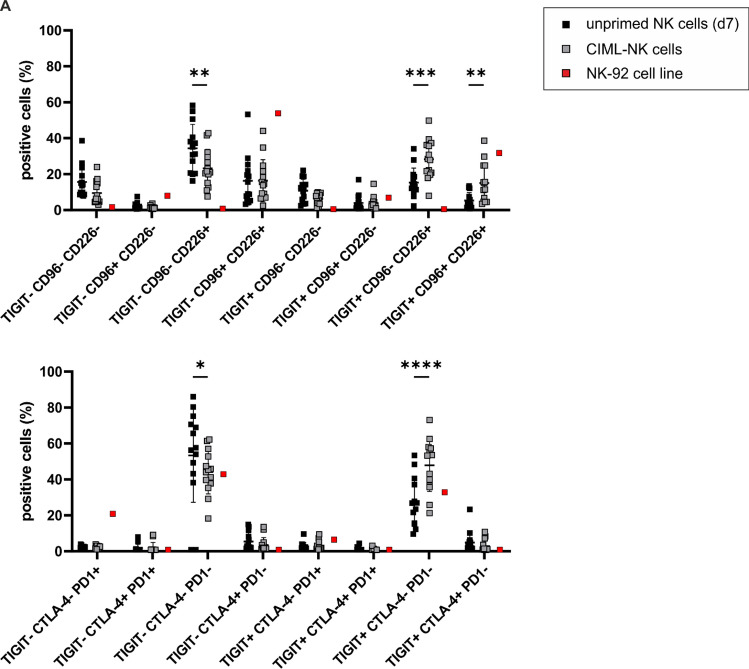
Subset analysis of alternative CR expression on unprimed and CIML-NK cells, and on NK-92 cells. Based on data of the flow cytometric analyses illustrated in Fig. 1C, the size of the individual subsets which are positive for a given combination of receptors is shown. Note that the process of memory cell conversion is accompanied by a significant upregulation of the double (TIGIT+ CD96 CD226+) and triple (TIGIT+ CD96+ CD226+) positive NK cell subset at the expense of the single (TIGIT CD96 CD226.+) positive subset. Significances as calculated with the Student`s t-test for comparison of paired data are indicated with * p < 0.05, ** p < 0.01 and *** p < 0.001
Fig. 6
Fig. 6
Hypothesis. The effect of a therapeutic TIGIT-blockade will depend on the balance between NK cell activation and exhaustion. This balance will be significantly different in healthy donors or tumor-bearing patients. The proximity of NK cells and tumor cells in the microenvironment of a solid tumor probably induces the highest level of functional exhaustion and as such the greatest likelihood to respond to therapeutic TIGIT-blockade. The group of healthy donor NK cells consists of unprimed NK cells, IL-2 or IL-12/15/18 short-term activated NK cells, CIML-NK cells and feeder-induced long-term activated NK cells. The group of NK cells from tumor-bearing patients comprises NK-92 cells, AML-NK cells, B-ALL-NK cells and solid tumor-resident or solid tumor-circulating NK cells. Note that the putative number of TIGIT receptors varies according to the assumed level of exhaustion. Activation levels are marked in varying shades of yellow to red. Indicated is also the increasing level of cell–cell contact between NK cells and different forms of tumor disease. ST: solid tumor

References

    1. Boissel N, Rea D, Tieng V, Dulphy N, Brun M, Cayuela JM et al (2006) BCR/ABL oncogene directly controls MHC class I chain-related molecule a expression in chronic myelogenous leukemia. J Immunol 176(8):5108–5116 - PubMed
    1. Epling-Burnette PK, Bai F, Painter JS, Rollison DE, Salih HR, Krusch M et al (2007) Reduced natural killer (NK) function associated with high-risk myelodysplastic syndrome (MDS) and reduced expression of activating NK receptors. Blood 109(11):4816–4824 - PMC - PubMed
    1. Jinushi M, Vanneman M, Munshi NC, Tai YT, Prabhala RH, Ritz J et al (2008) MHC class I chain-related protein A antibodies and shedding are associated with the progression of multiple myeloma. Proc Natl Acad Sci U S A 105(4):1285–1290 - PMC - PubMed
    1. Kiladjian JJ, Bourgeois E, Lobe I, Braun T, Visentin G, Bourhis JH et al (2006) Cytolytic function and survival of natural killer cells are severely altered in myelodysplastic syndromes. Leukemia 20(3):463–470 - PubMed
    1. Maki G, Hayes GM, Naji A, Tyler T, Carosella ED, Rouas-Freiss N et al (2008) NK resistance of tumor cells from multiple myeloma and chronic lymphocytic leukemia patients: implication of HLA-G. Leukemia 22(5):998–1006 - PubMed