Randomized Controlled Trial
. 2024 Jul 1;7(7):e2418129.
doi: 10.1001/jamanetworkopen.2024.18129.

Probiotics and Antibiotic-Induced Microbial Aberrations in Children: A Secondary Analysis of a Randomized Clinical Trial

Collaborators, Affiliations
Randomized Controlled Trial

Probiotics and Antibiotic-Induced Microbial Aberrations in Children: A Secondary Analysis of a Randomized Clinical Trial

Thomas H Dierikx et al. JAMA Netw Open. .

Abstract

Importance: Probiotics are often considered in children to prevent antibiotic-associated diarrhea. However, the underlying mechanistic effects and impact of probiotics on antibiotic-induced microbiota changes are not well understood.

Objective: To investigate the effects of a multispecies probiotic on the gut microbiota composition in children receiving antibiotics.

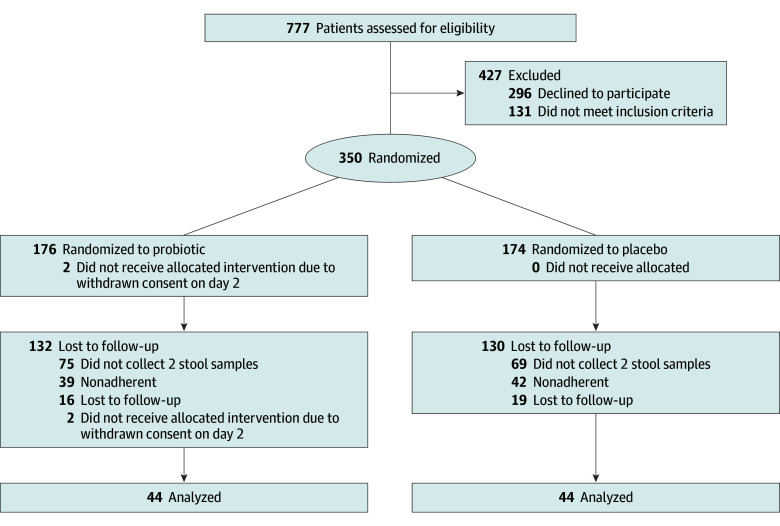
Design, setting, and participants: This is a secondary analysis of a randomized, quadruple-blind, placebo-controlled clinical trial from February 1, 2018, to May 31, 2021, including 350 children receiving broad-spectrum antibiotics in the inpatient and outpatient settings. Patients were followed up until 1 month after the intervention period. Fecal samples and data were analyzed between September 1, 2022, and February 28, 2023. Eligibility criteria included 3 months to 18 years of age and recruitment within 24 hours following initiation of broad-spectrum systemic antibiotics. In total, 646 eligible patients were approached and 350 participated in the trial.

Intervention: Participants were randomly assigned to receive daily placebo or a multispecies probiotic formulation consisting of 8 strains from 5 different genera during antibiotic treatment and for 7 days afterward.

Main outcomes and measures: Fecal stool samples were collected at 4 predefined times: (1) inclusion, (2) last day of antibiotic use, (3) last day of the study intervention, and (4) 1 month after intervention. Microbiota analysis was performed by 16S ribosomal RNA gene sequencing.

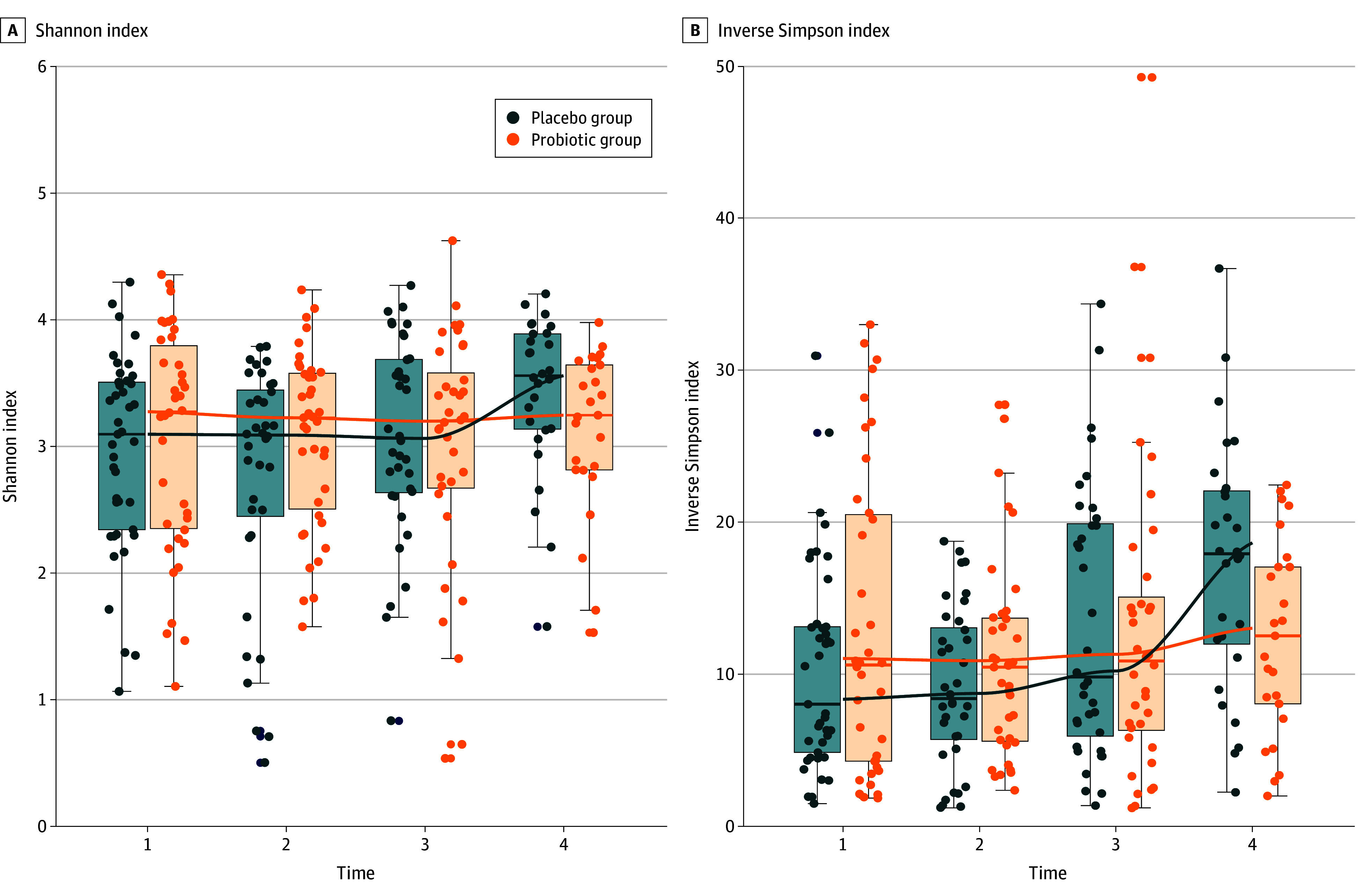
Results: A total of 350 children were randomized and collected stool samples from 88 were eligible for the microbiota analysis (54 boys and 34 girls; mean [SD] age, 47.09 [55.64] months). Alpha diversity did not significantly differ between groups at the first 3 times. Shannon diversity (mean [SD], 3.56 [0.75] vs 3.09 [1.00]; P = .02) and inverse Simpson diversity (mean [SD], 3.75 [95% CI, 1.66-5.82] vs -1.31 [95% CI, -3.17 to 0.53]; P = 1 × 10⁻⁴) indices were higher in the placebo group compared with the probiotic group 1 month after intervention. Beta diversity was not significantly different at any of the times. Three of 5 supplemented genera had higher relative abundance during probiotic supplementation, but this difference had disappeared after 1 month.

Conclusions and relevance: The studied probiotic mixture had minor and transient effects on the microbiota composition during and after antibiotic treatment. Further research is needed to understand their working mechanisms in manipulating the microbiome and preventing antibiotic-associated dysbiosis and adverse effects such as antibiotic-associated diarrhea.

Trial registration: ClinicalTrials.gov Identifier: NCT03334604.


Conflict of interest statement

Conflict of Interest Disclosures: Dr Dierikx reported receiving grant funding from Winclove Probiotics BV during the conduct of the study. Dr Łukasik reported receiving grant funding and nonfinancial support from Winclove Probiotics BV during the conduct of the study. Dr Szajewska reported receiving nonfinancial support from Winclove Probiotics BV during the conduct of the study and personal fees from BioGaia, Biocodex, Danone SA, Dicofarm, Nestlé SA, Novo Nordisk Inc, and Nutricia outside the submitted work. Dr de Meij reported receiving grant funding from Winclove Probiotics BV during the conduct of the study. No other disclosures were reported.

Figures

Figure 1.
Figure 1.. Study Flowchart
Figure 2.
Figure 2.. Alpha Diversity
Trajectory of alpha diversity changes in time differed between groups since the interaction term between group and time was statistically significant in linear mixed models explaining the Shannon index and the inverse Simpson index. A, Mean (SD) Shannon indices for the placebo compared with probiotic groups. B, Mean (SD) inverse Simpson indices for the placebo compared with probiotic groups. Both diversity indices were higher at time 4 (1-month follow-up) compared with time 1 (first sample after inclusion) and time 2 (last day of antibiotic treatment) in the placebo group. Boxes indicate upper and lower quartiles; horizontal lines in boxes, median; and whiskers, minimum and maximum.
Figure 3.
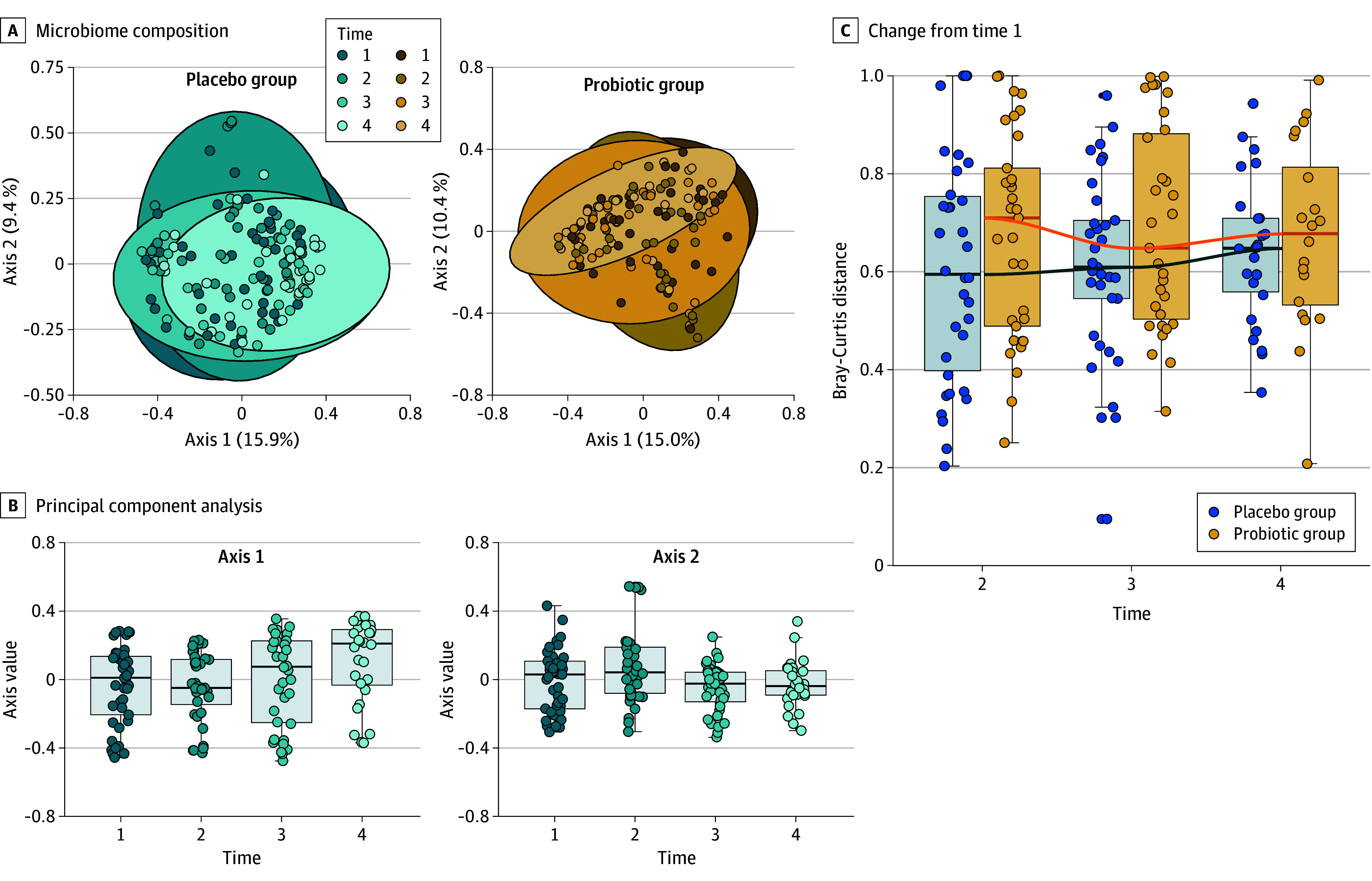
Figure 3.. Beta Diversity
A, Overall microbiome composition was associated with time in the placebo group (R2 = 1.76%; P = .004) but not in the probiotic group (P = .08). B, Samples from time 4 were significantly further from samples in times 1 (P = .001), 2 (P < .001), and 3 (P = .02) on the first axis in the placebo group. Samples from time 2 were significantly further from samples in times 1 (P = .04), 3 (P = .005), and 4 (P = .04) on the second axis in the placebo group. C, The dispersion of samples from each time point in the probiotic group was not equal, therefore the association of overall microbiome composition with time could not be assessed in this group (time effect P > .99 for the probiotic group and P = .70 for the placebo group; P = .53 for interaction in the probiotic group). Boxes indicate upper and lower quartiles; horizontal lines in boxes, median; and whiskers, minimum and maximum.
Figure 4.
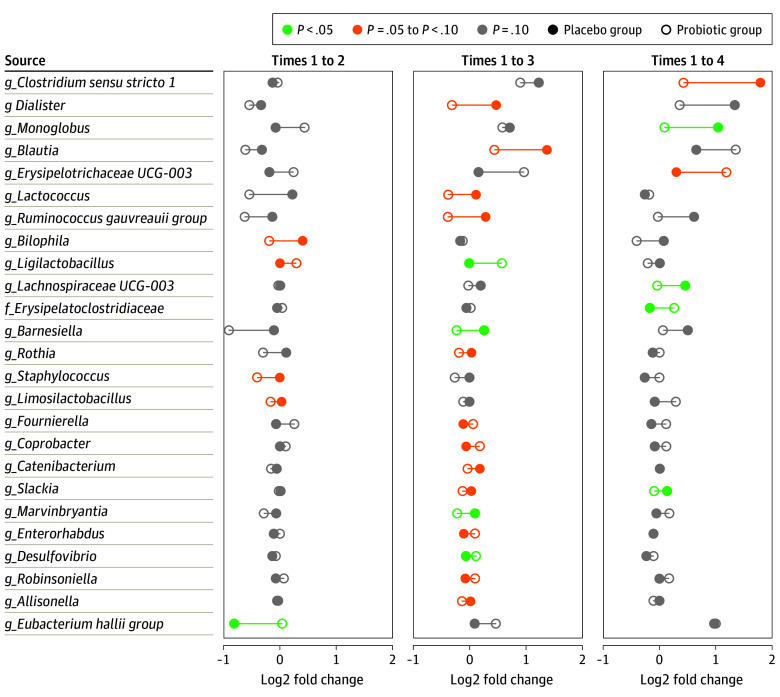
Figure 4.. Log Fold Changes Compared With Time 1
Differences between the placebo and probiotic groups in changes in relative abundance of taxa between times with P < .10. A point below 0 indicates a decrease compared with time 1, whereas a point above 0 indicates an increase compared with time 1. Lower case f indicates family; lower case g, genus.

References

    1. Allwell-Brown G, Hussain-Alkhateeb L, Kitutu FE, Strömdahl S, Mårtensson A, Johansson EW. Trends in reported antibiotic use among children under 5 years of age with fever, diarrhoea, or cough with fast or difficult breathing across low-income and middle-income countries in 2005-17: a systematic analysis of 132 national surveys from 73 countries. Lancet Glob Health. 2020;8(6):e799-e807. doi:10.1016/S2214-109X(20)30079-6 - DOI - PubMed
    1. Jackson C, Hsia Y, Bielicki JA, et al. . Estimating global trends in total and childhood antibiotic consumption, 2011-2015. BMJ Glob Health. 2019;4(1):e001241. doi:10.1136/bmjgh-2018-001241 - DOI - PMC - PubMed
    1. Youngster I, Avorn J, Belleudi V, et al. . Antibiotic use in children—a cross-national analysis of 6 countries. J Pediatr. 2017;182:239-244.e1. doi:10.1016/j.jpeds.2016.11.027 - DOI - PubMed
    1. McDonnell L, Gilkes A, Ashworth M, et al. . Association between antibiotics and gut microbiome dysbiosis in children: systematic review and meta-analysis. Gut Microbes. 2021;13(1):1-18. doi:10.1080/19490976.2020.1870402 - DOI - PMC - PubMed
    1. Antunes LC, Han J, Ferreira RB, Lolić P, Borchers CH, Finlay BB. Effect of antibiotic treatment on the intestinal metabolome. Antimicrob Agents Chemother. 2011;55(4):1494-1503. doi:10.1128/AAC.01664-10 - DOI - PMC - PubMed

Publication types

Substances

Associated data