. 2024;18(4):101376.
doi: 10.1016/j.jcmgh.2024.101376. Epub 2024 Jul 3.

Inhibition of EZH2 Reduces Aging-Related Decline in Interstitial Cells of Cajal of the Mouse Stomach

Affiliations

Inhibition of EZH2 Reduces Aging-Related Decline in Interstitial Cells of Cajal of the Mouse Stomach

Negar Taheri et al. Cell Mol Gastroenterol Hepatol. 2024.

Abstract

Background & aims: Restricted gastric motor functions contribute to aging-associated undernutrition, sarcopenia, and frailty. We previously identified a decline in interstitial cells of Cajal (ICC; gastrointestinal pacemaker and neuromodulator cells) and their stem cells (ICC-SC) as a key factor of gastric aging. Altered functionality of the histone methyltransferase enhancer of zeste homolog 2 (EZH2) is central to organismal aging. Here, we investigated the role of EZH2 in the aging-related loss of ICC/ICC-SC.

Methods: klotho mice, a model of accelerated aging, were treated with the most clinically advanced EZH2 inhibitor, EPZ6438 (tazemetostat; 160 mg/kg intraperitoneally twice a day for 3 weeks). Gastric ICC were analyzed by Western blotting and immunohistochemistry. ICC and ICC-SC were quantified by flow cytometry. Gastric slow wave activity was assessed by intracellular electrophysiology. Ezh2 was deactivated in ICC by treating KitcreERT2/+;Ezh2fl/fl mice with tamoxifen. TRP53, a key mediator of aging-related ICC loss, was induced with nutlin 3a in gastric muscle organotypic cultures and an ICC-SC line.

Results: In klotho mice, EPZ6438 treatment mitigated the decline in the ICC growth factor KIT ligand/stem cell factor and gastric ICC. EPZ6438 also improved gastric slow wave activity and mitigated the reduced food intake and impaired body weight gain characteristic of this strain. Conditional genomic deletion of Ezh2 in Kit-expressing cells also prevented ICC loss. In organotypic cultures and ICC-SC, EZH2 inhibition prevented the aging-like effects of TRP53 stabilization on ICC/ICC-SC.

Conclusions: Inhibition of EZH2 with EPZ6438 mitigates aging-related ICC/ICC-SC loss and gastric motor dysfunction, improving slow wave activity and food intake in klotho mice.

Keywords: Ezh2(fl/fl); Food Intake; Gastric Motility; Kit(creERT2/+); klotho.


Figures

Figure 1
Figure 1
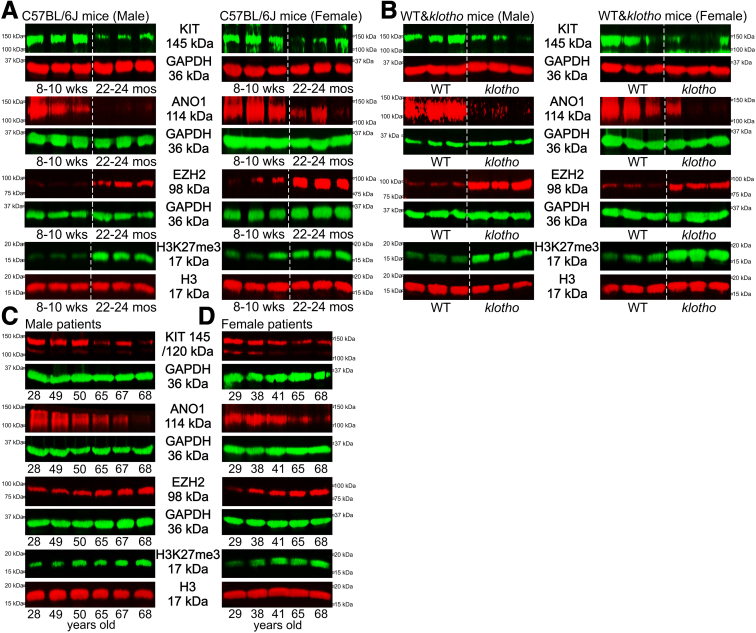
Upregulation of PRC2 regulates gastric tissue aging. (A and B) Downregulated ICC makers (KIT and ANO1 protein) and upregulated EZH2 protein and increased H3K27me3 levels in gastric tissues of klotho relative to WT mice and in old mice (22–24 months old) compared with young control animals (8–10 weeks old). The klotho and WT mice were used between 60 and 70 days of age. Glyceraldehyde-3-phosphate dehydrogenase (GAPDH) was used as a loading control. (C and D) Age-associated downregulation of KIT and ANO1 and upregulation of EZH2 protein and H3K27me3 levels in gastric muscles of patients between 28 and 68 years of age in (C) men and (D) women.
Figure 2
Figure 2
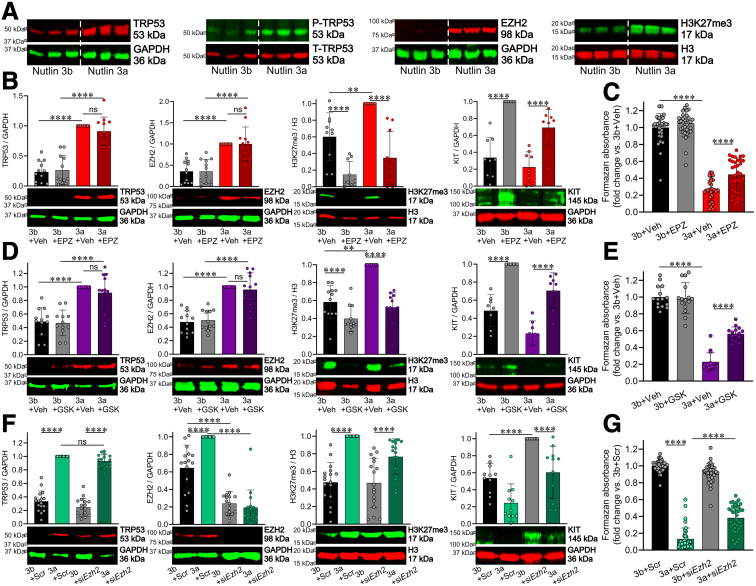
PRC2 regulates ICC-SC aging.(A) Activation of TRP53 by nutlin 3a (30 μmol/L, 72 hours) upregulated EZH2 protein and increased H3K27me3 levels in D2211B ICC-SC without affecting TRP53 phosphorylation (P-TRP53). The 150-fold less potent enantiomer nutlin 3b (30 μmol/L, 72 hours) used as control for nutlin 3a. (B–E) Ezh2 inhibitors (EPZ6438 [EPZ] and GSK126 [GSK]) applied at 500 nmol/L for 72 hours prevented nutlin 3a (30 μmol/L, 72 hours)-induced H3K27me3 (n = 8–9/group) and cell growth arrest (n = 15/group) without affecting TRP53 and EZH2 protein expression in ICC-SC (D2211B cells). The inactive enantiomer nutlin 3b (3b; 30 μmol/L) served as a control for nutlin 3a. (F and G) siRNA-mediated knockdown Ezh2 (siEzh2) prevented nutlin 3a-induced EZH2 upregulation (n = 9/group) and cell growth arrest (n = 30/group) without affecting TRP53 protein expression and H3K27me3 levels in ICC-SC (D2211B cells). Corresponding Scr served as a control for siEzh2. Statistical significance was determined using Kruskal-Wallis 1-way analysis of variance (on ranks). ∗P < .05, ∗∗P < .01, ∗∗∗∗P < .0001. ns, not significant.
Figure 3
Figure 3
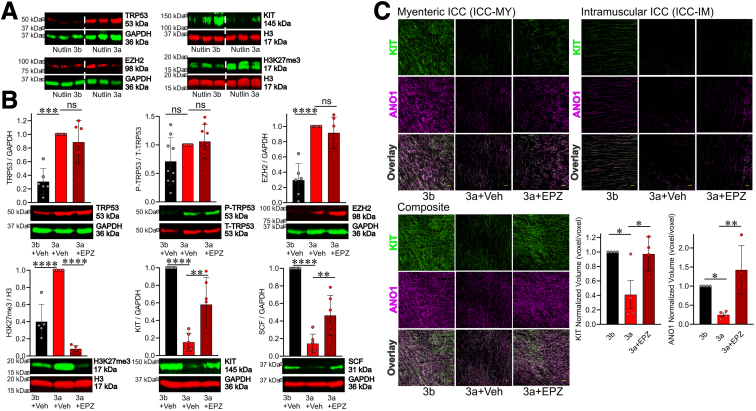
Inhibition of H3K27me3 by EPZ6438 mitigates TRP53-induced ICC loss.(A) Activation of TRP53 by nutlin 3a (30 μmol/L, 72 hours) downregulated KIT protein, upregulated EZH2 protein, and increased H3K27me3 levels in gastric organotypic cultures from stomachs of C57BL/6 mouse aged 12–14 days old. The 150-fold less potent enantiomer nutlin 3b (30 μmol/L, 72 hours) used as control for nutlin 3a. (B) EPZ6438 (500 nmol/L) mitigated nutlin 3a-induced (30 μmol/L) upregulated H3K27me3 levels (lower left), reduced KIT protein (lower middle), and reduced SCF protein (lower right) in gastric corpus + antrum tunica muscularis organotypic cultures from 12- to 14-day-old C57BL/6J mice (n = 6/group). EPZ6438 had no effect on nutlin 3a-induce upregulated TRP53 protein (upper left), TRP53 phosphorylation (upper middle) and upregulated EZH2 protein expression (upper right). The inactive enantiomer nutlin 3b (3b; 30 μmol/L) served as a control for nutlin 3a. Glyceraldehyde-3-phosphate dehydrogenase (GAPDH) was used as a loading control. Statistical significance was determined using Kruskal-Wallis 1-way analysis of variance (on ranks). (C) Reduced gastric ICC networks by nutlin 3a (30 μmol/L) in gastric corpus + antrum tunica muscularis organotypic cultures from 12- to 14-day-old C57BL/6J mice were restored by EPZ6438 (500 nmol/L) treatment. Representative confocal stacks showing KIT+ (green) and ANO1+ (magenta) myenteric ICC (ICC-MY) and intramuscular ICC (ICC-IM) in corresponding regions of the gastric corpus (greater curvature, full thickness) of nutlin 3b (3b; 30 μmol/L) + vehicle, nutlin 3a (30 μmol/L) + vehicle, and nutlin 3a (3a; 30 μmol/L) + EPZ6438 (EPZ; 500 nmol/L). n = 4 /group. Scale bar: 50 μm Statistical significance was determined using Kruskal–Wallis 1-way analysis of variance (on ranks). ∗P < .05, ∗∗P < .01, ∗∗∗P < .001, ∗∗∗∗P < .0001. ns, not significant.
Figure 4
Figure 4
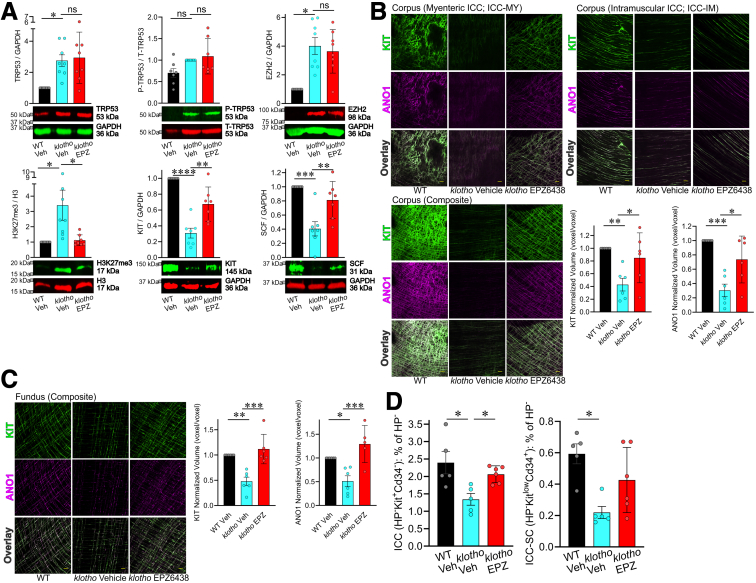
EPZ6438 treatment restored age-related ICC/ICC-SC decline via activation of the SCF-KIT pathway in klotho mice. (A) EPZ6438 (EPZ) restored upregulated H3K27me3 levels (lower left), reduced KIT protein (lower middle), and reduced SCF protein (lower right) in gastric tunica muscularis of klotho mice (n = 7/group). EPZ6438 had no effect on upregulated TRP53 protein (upper left), TRP53 phosphorylation (upper middle), and upregulated EZH2 protein expression (upper right). Vehicle (Veh) was used as a control for EPZ6438. Glyceraldehyde-3-phosphate dehydrogenase (GAPDH) was used as a loading control. (B) Reduced gastric ICC networks in klotho mice were restored by EPZ6438 treatment. Representative confocal stacks showing KIT+ (green) and ANO1+ (magenta) myenteric ICC (ICC-MY), and intramuscular ICC (ICC-IM) in corresponding regions of the gastric corpus (B; greater curvature, full thickness) and fundus (C; greater curvature, full thickness) of a WT and klotho mice. n = 5/group. Scale bar: 50 μm. (D) Normalized ICC (KIT+CD34- cells) and ICC-SC (KITlowCD34+ cells) numbers detected by flow cytometry in the nonhematopoietic of gastric muscles of klotho mice (n = 5–6/group). Statistical significance was determined using Kruskal-Wallis 1-way analysis of variance (on ranks). ∗P < .05, ∗∗P < .01, ∗∗∗P < .001, ∗∗∗∗P < .0001. ns, not significant.
Figure 5
Figure 5
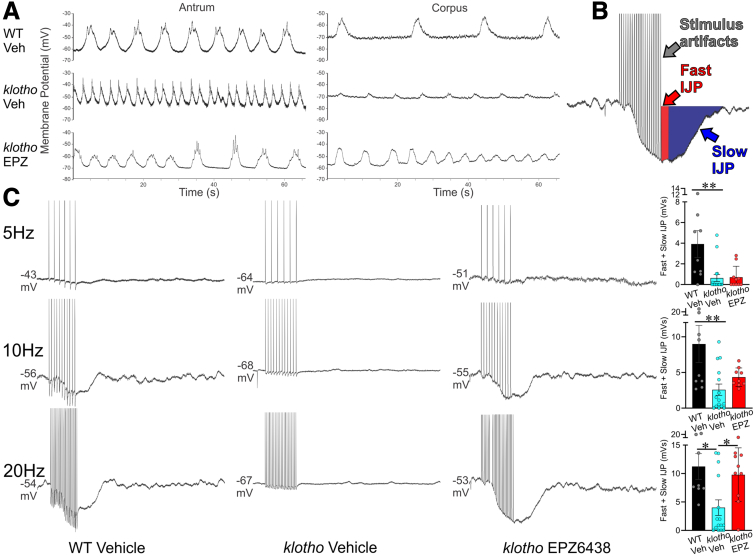
EPZ6438 treatment partially restores reduced slow wave amplitudes and inhibitory neuromuscular transmission in klotho mice. (A) Representative traces show diminished slow wave amplitudes in the corpus and antrum of klotho mice relative to WT control animals. EPZ6438 treatment led to partial restoration of these amplitudes in klotho mice. (B) Illustration of separation of fast and slow inhibitory junction potentials (IJPs). (C) Representative recordings of electrical responses to electrical field stimulation (square pulses delivered by parallel platinum electrodes; 0.3 ms; 5–20 Hz for 1 second; supramaximal voltage). EPZ6438 treatment led to partial restoration of fast and slow IJPs in klotho mice. Quantitative analysis of fast and slow IJPs and excitatory junction potentials is shown in Table 1. Statistical significance was determined using Kruskal-Wallis 1-way analysis of variance (on ranks). ∗P < .05, ∗∗P < .01.
Figure 6
Figure 6
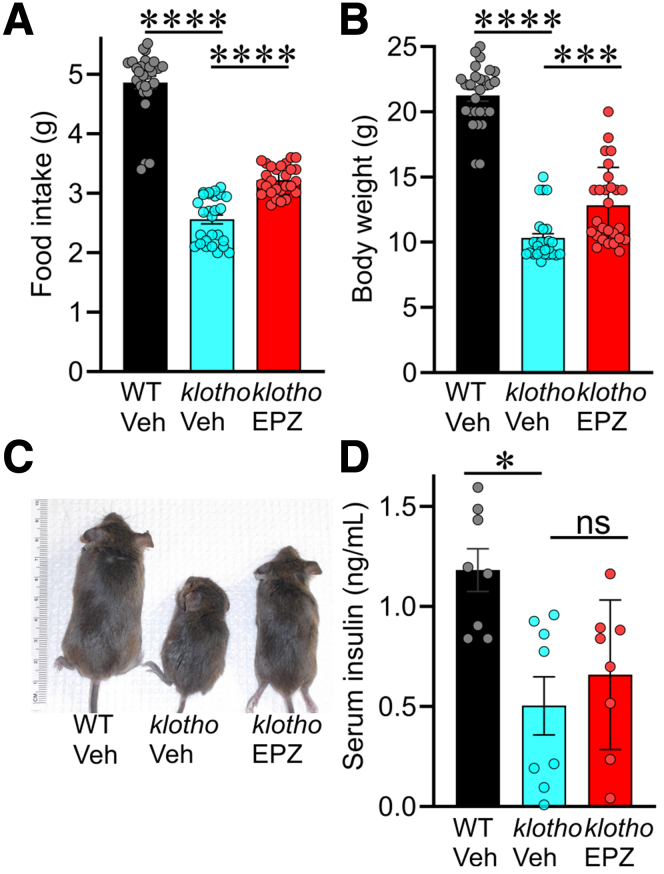
EPZ6438 treatment restored reduced food intake and impaired body weight gain without significantly affecting insulin secretion in klotho mice. EPZ6438 treatment restored reduced food intake and impaired body weight gain of klotho mice. Restoration of reduced food intake (A) and body weight gain (B and C) of klotho mice by EPZ6438 (EPZ) treatment (n = 27/group). (D) Reduced serum insulin levels in klotho mice were not alleviated by EPZ6438 treatment (n = 8/group). Statistical significance was determined using Kruskal-Wallis 1-way analysis of variance (on ranks). ∗P < .05, ∗∗∗P < .001, ∗∗∗∗P < .0001. ns, not significant.
Figure 7
Figure 7
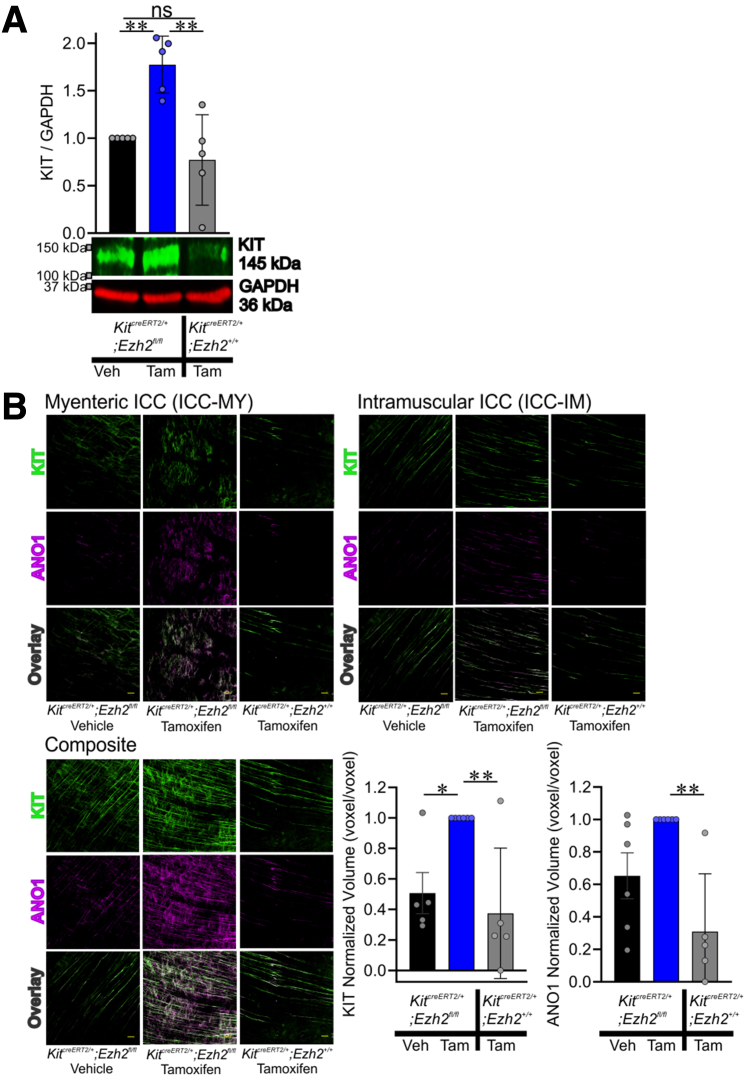
Genomic deletion of Ezh2 in Kit-positive ICC lineage preserved ICC of KitcreERT2/+;Ezh2fl/flmice with age. (A) Tamoxifen (Tam; 0.075 mg/g intraperitoneally for consecutive 3 days at 18 months of age)-induced recombination restored reduced KIT protein of KitcreERT2/+;Ezh2fl/fl mice compared with vehicle (Veh)-treated control mice. Tam-treated KitcreERT2/+;Ezh2+/+ mice were served as alternative control. n = 5/group. (B) Reduced gastric ICC networks in KitcreERT2/+;Ezh2fl/fl mice were restored by Tam treatment. Representative confocal stacks showing KIT+ (green) and ANO1+ (magenta) myenteric ICC (ICC-MY) and intramuscular ICC (ICC-IM) in corresponding regions of the gastric corpus (greater curvature, full thickness) of a KitcreERT2/+;Ezh2fl/fl and KitcreERT2/+;Ezh2+/+ mice. n = 5–6/group. Scale bar: 50 μm. Statistical significance was determined using Kruskal-Wallis 1-way analysis of variance (on ranks). ∗P < .05, ∗∗P < .01. ns, not significant.
Figure 8
Figure 8
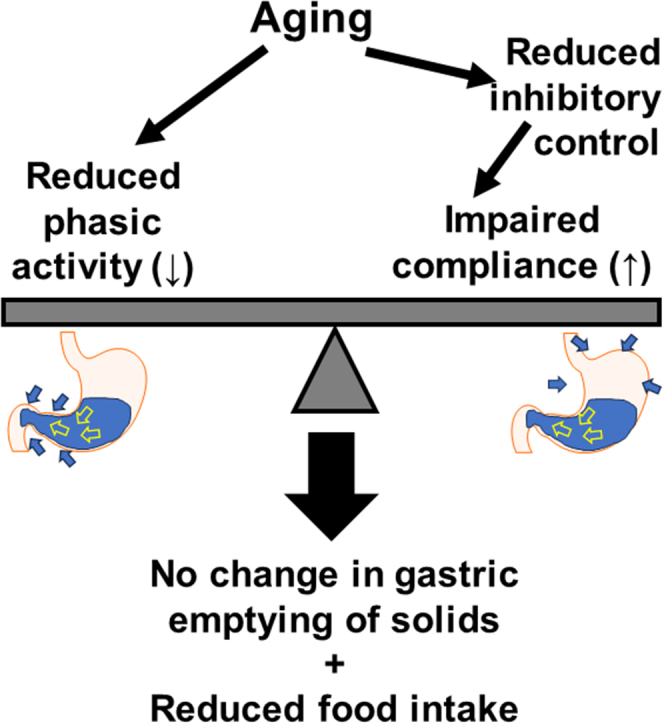
Proposed mechanisms regulating gastric emptying of solids and food intake during aging. Loss of ICC with aging is associated with diminished phasic activity (reduced slow wave amplitudes) and decreased inhibitory (nitrergic) control over smooth muscle relaxation, resulting in impaired compliance. Having opposite effects on gastric emptying, these 2 processes cancel out each other’s effects on gastric emptying, while together restricting gastric functions, leading to reduced food intake.
Figure 9
Figure 9
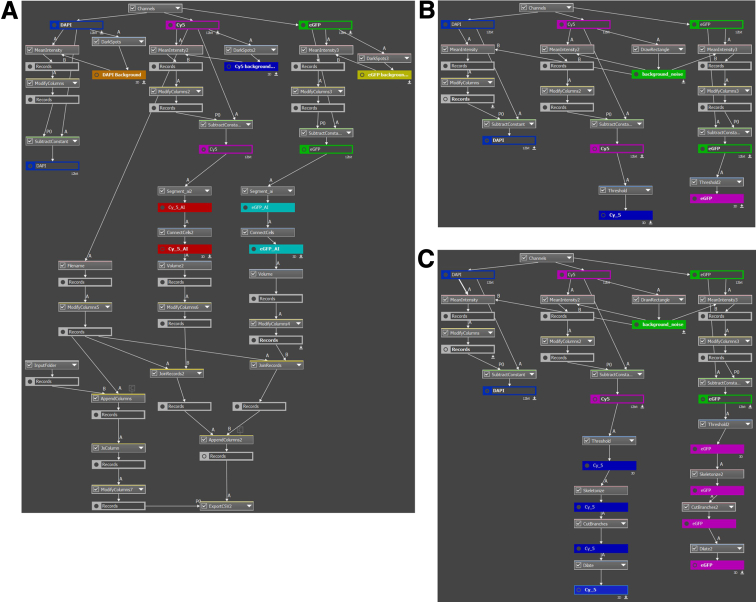
Quantitative image analysis workflow diagrams. (A) GA3 recipe for setting background removal, AI-based segmentation, volume quantification, and export. (B) GA3 recipe for obtaining the volumes of KIT (enhanced green fluorescent protein; eGFP) or ANO1 (cyanine 5; Cy5) within the flattened segmented areas of KIT (eGFP) or ANO1-positive intramuscular ICC (ICC-IM), which are used for AI training. (C) GA3 recipe for obtaining the volumes of KIT (eGFP) or ANO1 (Cy5) within flattened segmented areas of KIT (eGFP) or ANO1-positive myenteric ICC (ICC-MY) that are used for AI training.

References

    1. Moqri M., Herzog C., Poganik J.R., et al. Biomarkers of aging for the identification and evaluation of longevity interventions. Cell. 2023;186:3758–3775. - PMC - PubMed
    1. Nguyen V.T.T., Taheri N., Chandra A., et al. Aging of enteric neuromuscular systems in gastrointestinal tract. Neurogastroenterol Motil. 2022;34 - PMC - PubMed
    1. Choi E.L., Taheri N., Chandra A., et al. Cellular senescence, inflammation, and cancer in the gastrointestinal tract. Int J Mol Sci. 2023;24:9810. - PMC - PubMed
    1. Camilleri M., Cowen T., Koch T.R. Enteric neurodegeneration in ageing. Neurogastroenterol Motil. 2008;20:185–196. - PubMed
    1. Parker B.A., Chapman I.M. Food intake and ageing: the role of the gut. Mech Ageing Dev. 2004;125:859–866. - PubMed

MeSH terms