Review
. 2024 Jul 5;22(1):353.
doi: 10.1186/s12964-024-01726-3.

The crosstalk between copper-induced oxidative stress and cuproptosis: a novel potential anticancer paradigm

Affiliations
Review

The crosstalk between copper-induced oxidative stress and cuproptosis: a novel potential anticancer paradigm

Thi Thuy Tien Vo et al. Cell Commun Signal. .

Abstract

Copper is a crucial trace element that plays a role in various pathophysiological processes in the human body. Copper also acts as a transition metal involved in redox reactions, contributing to the generation of reactive oxygen species (ROS). Under prolonged and increased ROS levels, oxidative stress occurs, which has been implicated in different types of regulated cell death. The recent discovery of cuproptosis, a copper-dependent regulated cell death pathway that is distinct from other known regulated cell death forms, has raised interest to researchers in the field of cancer therapy. Herein, the present work aims to outline the current understanding of cuproptosis, with an emphasis on its anticancer activities through the interplay with copper-induced oxidative stress, thereby providing new ideas for therapeutic approaches targeting modes of cell death in the future.

Keywords: Copper; Cuproptosis; Oxidative stress; Reactive oxygen species.


Conflict of interest statement

The authors declare no competing interests.

Figures
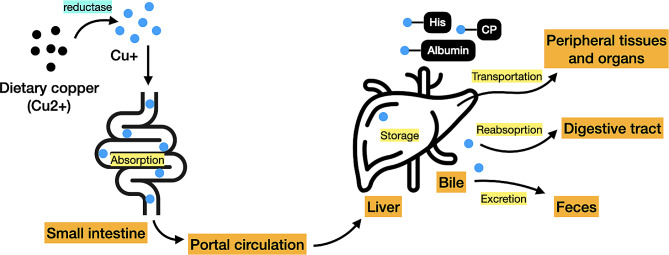
Fig. 1
Fig. 1
Schematic illustration of copper metabolism. Dietary copper, mostly exists in the Cu2 + form, is converted to Cu + through reductase actions, which is primarily absorbed by the small intestine and in turn directed to the liver for storage and transportation through the portal circulation. The copper is further distributed to other peripheral tissues and organs via the bloodstream. Serum copper are bound to proteins such as ceruloplasmin (CP), albumins and free amino acids instead of being free. Excess copper is exported to the bile, which is either excreted through feces or reabsorbed through the digestive tract
Fig. 2
Fig. 2
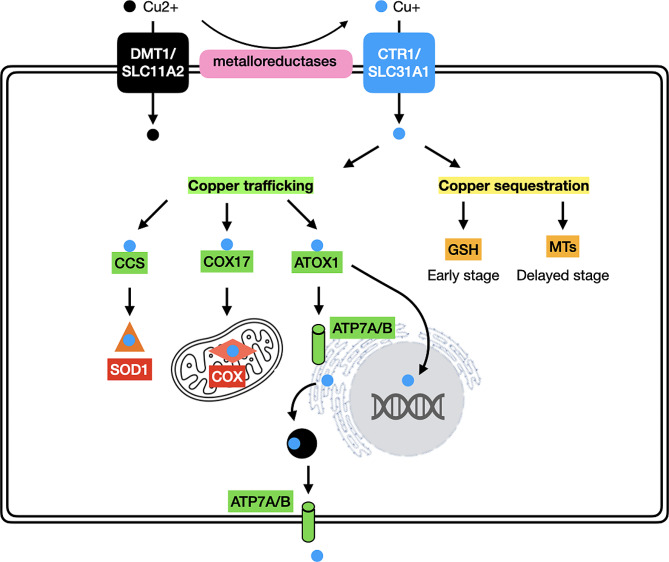
Schematic illustration of intracellular copper trafficking and sequestration. Since the extracellular copper in the form of Cu2 + is directly transported by divalent metal transporter 1 (DMT1), or also called solute carrier family 11 member 2 (SLC11A2), but unable to be used directly by the cells, it is typically converted to Cu + through metalloreductases. The entry of Cu + is mainly controlled in a manner dependent on copper transporter 1 (CTR1), or also called solute carrier family 31 member 1 (SLC31A1). After incorporation, the ions are delivered to various cellular components including the cytoplasm, mitochondria, Golgi apparatus, and nucleus by a sophisticated system of high-affinity copper chaperones. In the cytoplasm, copper chaperone for superoxide dismutase (CCS) transports Cu + to superoxide dismutase (SOD1). Cu + is also directed to the mitochondria by cytochrome c oxidase copper chaperone 17 (COX17), where it is used by cytochrome c oxidase (COX) to activate the activity of enzymes in the respiratory chain. Another important copper chaperone is antioxidant 1 copper chaperone (ATOX1), which delivers Cu + to the nucleus. ATOX1 also transports Cu + to ATPase copper-transporting α (ATP7A) and ATPase copper-transporting β (ATP7B) located in the trans-Golgi network, both of which play a role for copper distribution and copper excretion. The sequestration of excess Cu + is determined by molecules such as GSH and metallothioneins (MTs)
Fig. 3
Fig. 3
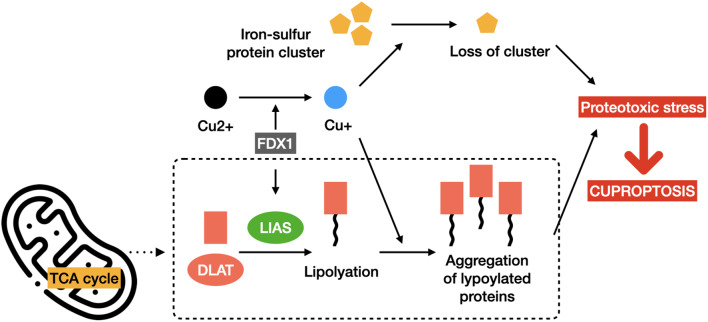
Schematic illustration of cuproptosis mechanism. Cuproptosis is a copper-dependent form of regulated cell death that is distinct from other known mechanisms including apoptosis, necroptosis, and ferroptosis. Mechanistically, ferrodoxin 1 (FDX1) encodes a reductase to reduce Cu2 + to Cu + and promotes the lipoylation of dihydrolipoamide S-acetyltransferase (DLAT), a protein target involved in the TCA cycle. Excess Cu + leads to the loss of iron-sulfur protein clusters and aggregation of lipoylated proteins, triggering proteotoxic stress and eventually cell death
Fig. 4
Fig. 4
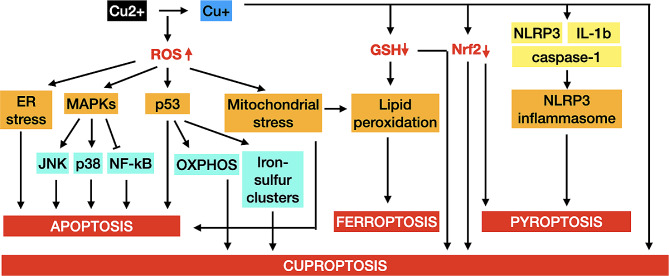
Schematic illustration of the crosstalk between cuproptosis and other regulated cell death pathways. Cuproptosis is a unique form of regulated cell death that is dependent on copper accumulation. Moreover, copper can induce or catalyze the breakdown of hydrogen peroxide into hydroxyl radicals via Fenton reactions and Haber-Weiss reactions, contributing to ROS generation. Under physiological conditions, the cells maintain a balance between ROS generation and antioxidant defenses. Any disturbances in this balance would lead to oxidative stress, resulting in damage to biomolecules and disruption of signaling pathways that implicate in different cell death mechanism such as apoptosis and ferroptosis. From the inflammation perspectives, copper can activate the nucleotide-binding oligomerization domain, leucine-rich repeat and pyrin domain-containing protein 3 (NLRP3) inflammasome pathway, resulting in pyroptosis. Taken together, it is possible to establish an intricate linkage between cuproptosis with apoptosis, ferroptosis and pyroptosis through ROS-induced signaling pathways and cellular events. Which may trigger a series of cell death events, thereby overcoming the cell death resistance of cancer cells

References

    1. Chen L, Min J, Wang F. Copper homeostasis and cuproptosis in health and disease. Signal Transduct Target Therapy. 2022;7(1):378. doi: 10.1038/s41392-022-01229-y. - DOI - PMC - PubMed
    1. Cobine PA, Moore SA, Leary SC. Getting out what you put in: copper in mitochondria and its impacts on human disease. Biochim et Biophys Acta Mol Cell Res. 2021;1868(1):118867. doi: 10.1016/j.bbamcr.2020.118867. - DOI - PMC - PubMed
    1. Tsvetkov P, Coy S, Petrova B, Dreishpoon M, Verma A, Abdusamad M, Rossen J, Joesch-Cohen L, Humeidi R, Spangler RD, Eaton JK, Frenkel E, Kocak M, Corsello SM, Lutsenko S, Kanarek N, Santagata S. Golub T.R. Copper induces cell death by targeting lipoylated TCA cycle proteins. Sci (New York) 2022;375(6586):1254–61. doi: 10.1126/science.abf0529. - DOI - PMC - PubMed
    1. World Health Organization. Global cancer burden growing, amidst mounting need for services. 2024. https://www.who.int/news/item/01-02-2024-global-cancer-burden-growing--a... (Accessed on 04 April 2024). - PMC - PubMed
    1. Hayes JD, Dinkova-Kostova AT, Tew KD. Oxidative stress in cancer. Cancer Cell. 2020;38(2):167–97. doi: 10.1016/j.ccell.2020.06.001. - DOI - PMC - PubMed

Publication types

LinkOut - more resources