


Impact of non-emergency surgical timing on postoperative recovery quality in mild or asymptomatic SARS-CoV-2 infected patients: a grouped cohort study
- PMID: 38971737
- PMCID: PMC11227204
- DOI: 10.1186/s12871-024-02600-y
Impact of non-emergency surgical timing on postoperative recovery quality in mild or asymptomatic SARS-CoV-2 infected patients: a grouped cohort study
Abstract
Objective: To explore the relationship between the timing of non-emergency surgery in mild or asymptomatic SARS-CoV-2 (severe acute respiratory syndrome coronavirus 2) infected individuals and the quality of postoperative recovery from the time of confirmed infection to the day of surgery.
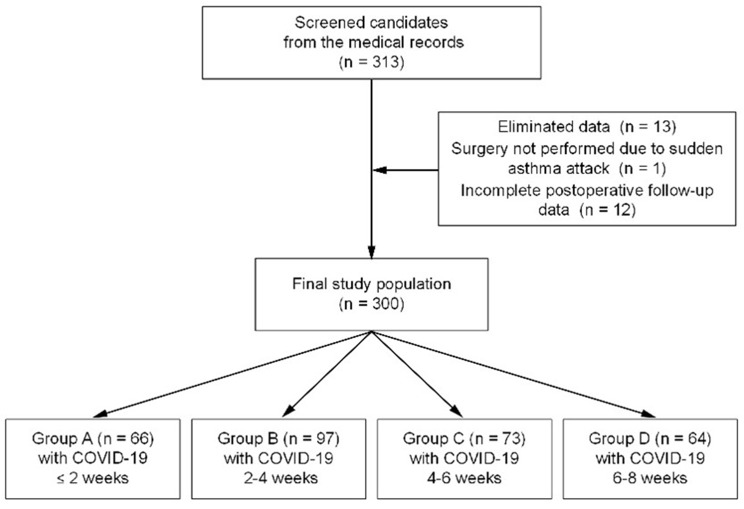
Methods: We retrospectively reviewed the medical records of 300 cases of mild or asymptomatic SARS-CoV-2 infected patients undergoing elective general anaesthesia surgery at Yijishan Hospital between January 9, 2023, and February 17, 2023. Based on the time from confirmed SARS-CoV-2 infection to the day of surgery, patients were divided into four groups: ≤2 weeks (Group A), 2-4 weeks (Group B), 4-6 weeks (Group C), and 6-8 weeks (Group D). The primary outcome measures included the Quality of Recovery-15 (QoR-15) scale scores at 3 days, 3 months, and 6 months postoperatively. Secondary outcome measures included postoperative mortality, ICU admission, pulmonary complications, postoperative length of hospital stay, extubation time, and time to leave the PACU.
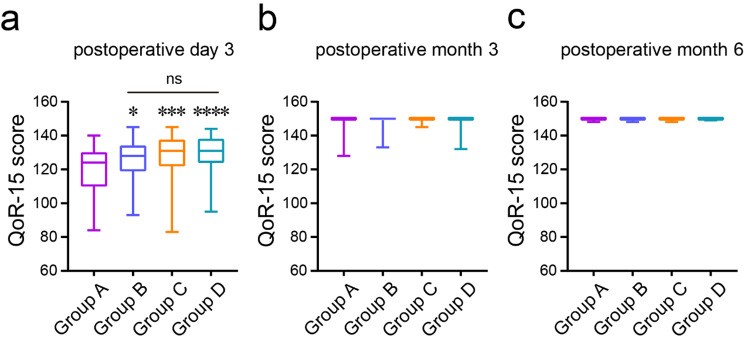
Results: Concerning the primary outcome measures, the QoR-15 scores at 3 days postoperatively in Group A were significantly lower compared to the other three groups (P < 0.05), while there were no statistically significant differences among the other three groups (P > 0.05). The QoR-15 scores at 3 and 6 months postoperatively showed no statistically significant differences among the four groups (P > 0.05). In terms of secondary outcome measures, Group A had a significantly prolonged hospital stay compared to the other three groups (P < 0.05), while other outcome measures showed no statistically significant differences (P > 0.05).
Conclusion: The timing of surgery in mild or asymptomatic SARS-CoV-2 infected patients does not affect long-term recovery quality but does impact short-term recovery quality, especially for elective general anaesthesia surgeries within 2 weeks of confirmed infection. Therefore, it is recommended to wait for a surgical timing of at least greater than 2 weeks to improve short-term recovery quality and enhance patient prognosis.
Keywords: General anaesthesia; Omicron; Postoperative recovery quality; Quality of recovery-15 scale; SARA-CoV-2; Surgical timing.
© 2024. The Author(s).
Conflict of interest statement
The authors declare no competing interests.
Figures
References
Publication types
MeSH terms
Grants and funding
- No. WK2022F03/Wannan Medical College Research Fund Project
- No. 2023AH051745/Anhui University Research Project
- No. 2023AH040252/Anhui University Research Project
- No.2208085MC55/Natural Science Foundation of Anhui Province
- the Key Project of Anhui Province 'Leading the Charge with Open Competition', Anhui, China./the Key Project of Anhui Province 'Leading the Charge with Open Competition', Anhui, China.
LinkOut - more resources
Full Text Sources
Medical
Miscellaneous
