


Perfusion deficits may underlie lung and kidney injury in severe COVID-19 disease: insights from a multicenter international cohort study
- PMID: 38971842
- PMCID: PMC11227201
- DOI: 10.1186/s44158-024-00175-1
Perfusion deficits may underlie lung and kidney injury in severe COVID-19 disease: insights from a multicenter international cohort study
Abstract
Background: Lung perfusion defects, mainly due to endothelial and coagulation activation, are a key contributor to COVID-19 respiratory failure. COVID-19 patients may also develop acute kidney injury (AKI) because of renal perfusion deficit. We aimed to explore AKI-associated factors and the independent prediction of standardized minute ventilation (MV)-a proxy of alveolar dead space-on AKI onset and persistence in COVID-19 mechanically ventilated patients.
Methods: This is a multicenter observational cohort study. We enrolled 157 COVID-19 patients requiring mechanical ventilation and intensive care unit (ICU) admission. We collected clinical information, ventilation, and laboratory data. AKI was defined by the 2012 KDIGO guidelines and classified as transient or persistent according to serum creatinine criteria persistence within 48 h. Ordered univariate and multivariate logistic regression analyses were employed to identify variables associated with AKI onset and persistence.
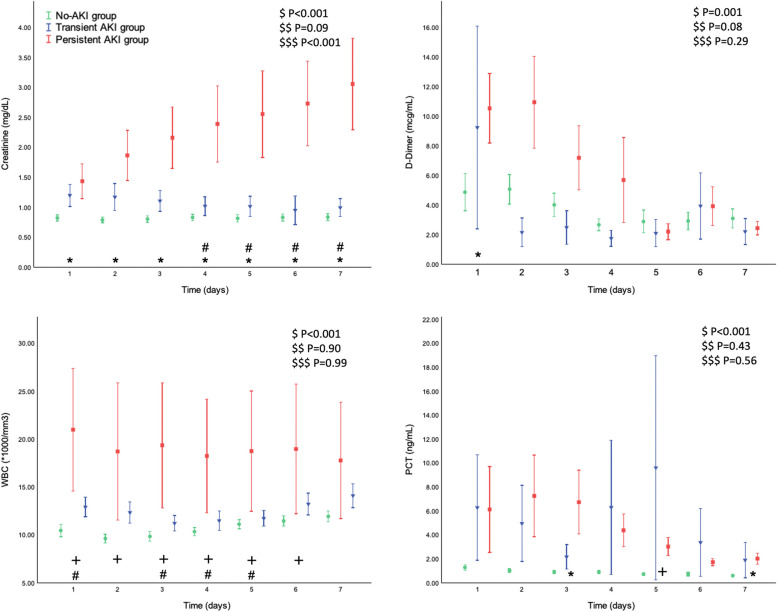
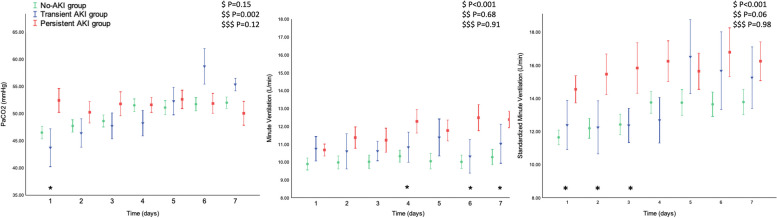
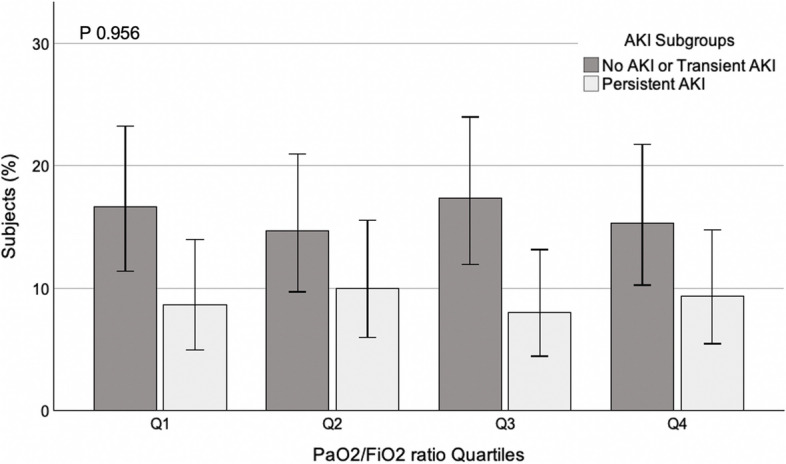
Results: Among 157 COVID-19 patients on mechanical ventilation, 47% developed AKI: 10% had transient AKI, and 37% had persistent AKI. The degree of hypoxia was not associated with differences in AKI severity. Across increasing severity of AKI groups, despite similar levels of paCO2, we observed an increased MV and standardized MV, a robust proxy of alveolar dead space. After adjusting for other clinical and laboratory covariates, standardized MV remained an independent predictor of AKI development and persistence. D-dimer levels were higher in patients with persistent AKI.
Conclusions: In critically ill COVID-19 patients with respiratory failure, increased wasted ventilation is independently associated with a greater risk of persistent AKI. These hypothesis-generating findings may suggest that perfusion derangements may link the pathophysiology of both wasted ventilation and acute kidney injury in our population.
Keywords: Acute kidney injury; Dead space; Mechanical ventilation; Minute ventilation; Perfusion; Respiratory failure.
© 2024. The Author(s).
Conflict of interest statement
The authors declare no competing interests.
Figures

Similar articles
-
Early recovery status and outcomes after sepsis-associated acute kidney injury in critically ill patients.Zhong Nan Da Xue Xue Bao Yi Xue Ban. 2022 May 28;47(5):535-545. doi: 10.11817/j.issn.1672-7347.2022.210368. Zhong Nan Da Xue Xue Bao Yi Xue Ban. 2022. PMID: 35753723 Free PMC article.
-
Severe Acute Kidney Injury in Critically Ill Patients with COVID-19 Admitted to ICU: Incidence, Risk Factors, and Outcomes.J Clin Med. 2021 Mar 15;10(6):1217. doi: 10.3390/jcm10061217. J Clin Med. 2021. PMID: 33804100 Free PMC article.
-
Outcomes of critically ill patients with acute kidney injury in COVID-19 infection: an observational study.Ren Fail. 2021 Dec;43(1):911-918. doi: 10.1080/0886022X.2021.1933530. Ren Fail. 2021. PMID: 34057014 Free PMC article.
-
When the Renal (Function) Begins to Fall: A Mini-Review of Acute Kidney Injury Related to Acute Respiratory Distress Syndrome in Critically Ill Patients.Front Nephrol. 2022 Apr 21;2:877529. doi: 10.3389/fneph.2022.877529. eCollection 2022. Front Nephrol. 2022. PMID: 37675005 Free PMC article. Review.
-
Bidirectional pressure: a mini review of ventilator-lung-kidney interactions.Front Physiol. 2024 Jun 20;15:1428177. doi: 10.3389/fphys.2024.1428177. eCollection 2024. Front Physiol. 2024. PMID: 38966229 Free PMC article. Review.
Cited by
-
Host Response Protein Biomarkers Indicative of Persistent Acute Kidney Injury in Critically Ill COVID-19 Patients.Crit Care Explor. 2025 Mar 13;7(3):e1222. doi: 10.1097/CCE.0000000000001222. eCollection 2025 Mar 1. Crit Care Explor. 2025. PMID: 40079888 Free PMC article.
References
-
- McNicholas BA, Rezoagli E, Pham T, et al. Impact of early acute kidney injury on management and outcome in patients with acute respiratory distress syndrome: a secondary analysis of a multicenter observational study. Crit Care Med. 2019;47(9):12161225. doi: 10.1097/CCM.0000000000003832. - DOI - PubMed
-
- Bellani G, Laffey JG, Pham T, et al. Epidemiology, patterns of care, and mortality for patients with acute respiratory distress syndrome in intensive care units in 50 countries [published correction appears in JAMA. 2016 Jul 19;316(3):350] [published correction appears in JAMA. 2016 Jul 19;316(3):350] JAMA. 2016;315(8):788–800. doi: 10.1001/jama.2016.0291. - DOI - PubMed