. 2024 Dec;56(1):2361825.
doi: 10.1080/07853890.2024.2361825. Epub 2024 Jul 8.

Melatonin mediates intestinal barrier dysfunction and systemic inflammation in moderate-severe OSA patients

Affiliations

Melatonin mediates intestinal barrier dysfunction and systemic inflammation in moderate-severe OSA patients

Zhicheng Wei et al. Ann Med. 2024 Dec.

Abstract

Background: Intestinal barrier dysfunction and systemic inflammation are common in obstructive sleep apnoea (OSA). We aimed to investigate the role of melatonin, an anti-inflammatory mediator, in mediating the relationships between OSA, intestinal barrier dysfunction and systemic inflammation.

Methods: Two hundred and thirty-five male participants who complained with sleep problems and underwent whole night polysomnography at our sleep centre between 2017 and 2018 were enrolled. Polysomnographic data, anthropometric measurements and biochemical indicators were collected. Serum melatonin, intestinal barrier function biomarker zonula occludens-1 (ZO-1) and inflammatory biomarkers C-reactive protein (CRP) with lipopolysaccharide (LPS) were detected. Spearman's correlation analysis assessed the correlations between sleep parameters, melatonin and biomarkers (ZO-1, LPS and CRP). Mediation analysis explored the effect of OSA on intestinal barrier dysfunction and systemic inflammation in moderate-severe OSA patients.

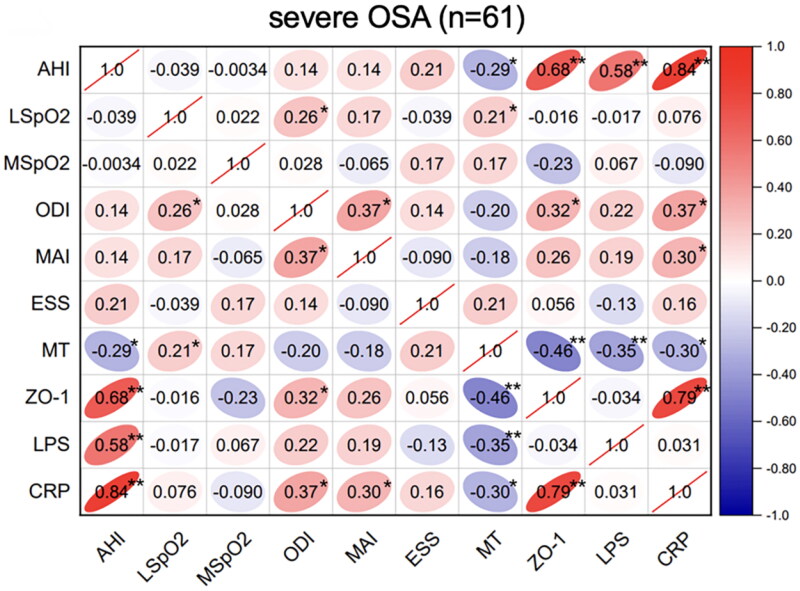
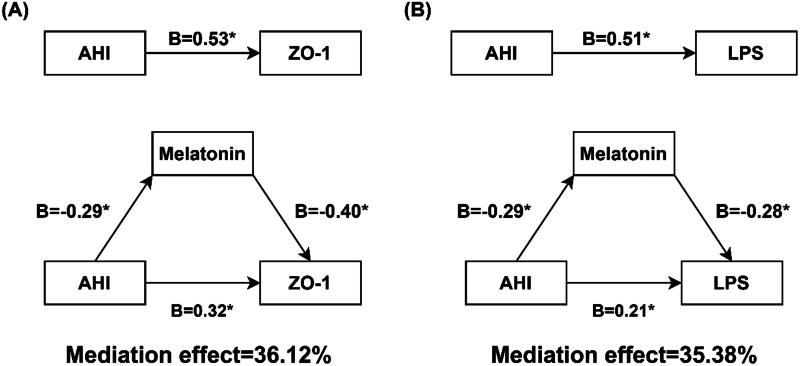
Results: As OSA severity increased, serum melatonin decreased, whereas ZO-1, LPS and CRP increased. Spearman's correlation analysis showed that serum melatonin was significantly negatively correlated with ZO-1 (r = -0.19, p < .05) and LPS (r = -0.20, p < .05) in the moderate-OSA group; serum melatonin was significantly negatively correlated with ZO-1 (r = -0.46, p < .01), LPS (r = -0.35, p < .01) and CPR (r = -0.30, p < .05) in the severe-OSA group. Mediation analyses showed melatonin explain 36.12% and 35.38% of the effect of apnoea-hypopnea index (AHI) on ZO-1 and LPS in moderate to severe OSA patients.

Conclusions: Our study revealed that melatonin may be involved in mediating intestinal barrier dysfunction and systemic inflammation in moderate-to-severe OSA patients.

Keywords: CRP; LPS; Obstructive sleep apnoea; ZO-1; intestinal barrier dysfunction; melatonin; systemic inflammation.


Conflict of interest statement

No potential conflict of interest was reported by the author(s).

Figures
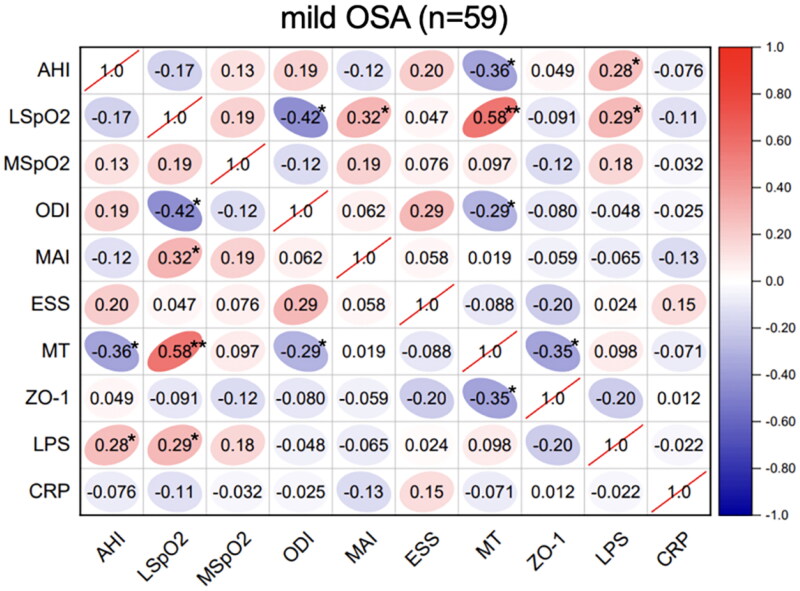
Figure 1.
Figure 1.
Correlations between sleep data and serum biomarkers in mild OSA. Spearman’s rank correlation coefficients were calculated to determine the influence of PSG variables on the levels of serum biomarkers in mild OSA (n = 59). The r values are represented by gradient colors, with red cells indicating positive correlations and the blue cells indicating negative correlations. *p < .05; **p < .01. AHI: apnea-hypopnea index; MSpO2: mean pulse oxygen saturation; LSpO2: lowest pulse oxygen saturation; ODI: oxygen desaturation index; MAI: micro-arousal index; ESS: Epworth sleepiness scale; MT: melatonin; ZO-1: zonula occludens-1; LPS: lipopolysaccharide; CRP: C-reactive protein; PSG: polysomnography.
Figure 2.
Figure 2.
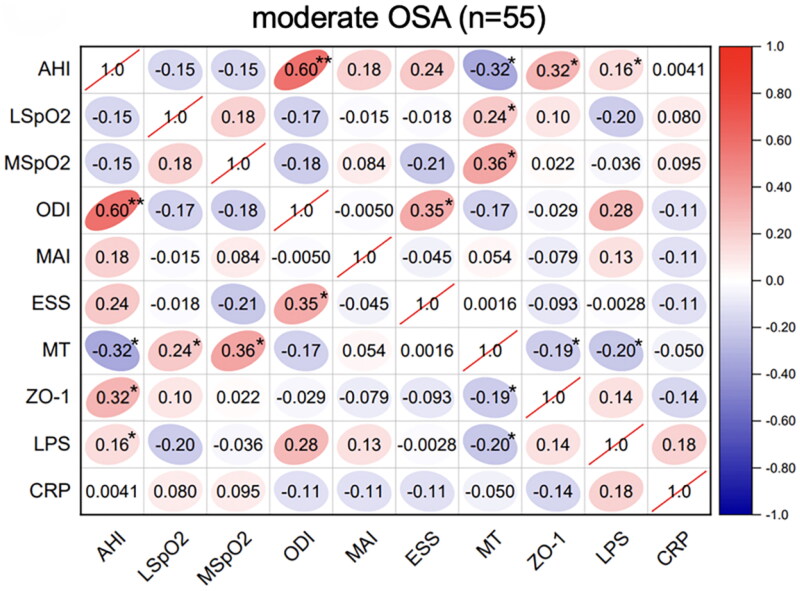
Correlations between sleep data and serum biomarkers in moderate OSA. Spearman’s rank correlation coefficients were calculated to determine the influence of PSG variables on the levels of serum biomarkers in moderate OSA (n = 55). The r values are represented by gradient colors, with red cells indicating positive correlations and the blue cells indicating negative correlations. *P < .05; **P < .01. Abbreviations: AHI: apnea-hypopnea index, MSpO2: mean pulse oxygen saturation, LSpO2: lowest pulse oxygen saturation, ODI: oxygen desaturation index, MAI: micro-arousal index, ESS: Epworth sleepiness scale, MT: melatonin, ZO-1: zonula occludens-1, LPS: lipopolysaccharide, CRP: C-reactive protein, PSG: polysomnography.
Figure 3.
Figure 3.
Correlations between sleep data and serum biomarkers in severe OSA. Spearman’s rank correlation coefficients were calculated to determine the influence of PSG variables on the levels of serum biomarkers in severe OSA (n = 61). The r values are represented by gradient colors, with red cells indicating positive correlations and the blue cells indicating negative correlations. *P < .05; **P < .01. Abbreviations: AHI: apnea-hypopnea index, MSpO2: mean pulse oxygen saturation, LSpO2: lowest pulse oxygen saturation, ODI: oxygen desaturation index, MAI: micro-arousal index, ESS: Epworth sleepiness scale, MT: melatonin, ZO-1: zonula occludens-1, LPS: lipopolysaccharide, CRP: C-reactive protein, PSG: polysomnography.
Figure 4.
Figure 4.
Path diagram showing how melatonin mediated the effect of AHI on intestinal barrier dysfunction and systemic inflammation in moderate-severe OSA patients. (A)shows melatonin mediates association between AHI and ZO-1; (B)shows melatonin mediates association between AHI and LPS. *means P< .05. B: the unstandardized coefficient. AHI: apnea-hypopnea index; ZO-1: zonula occludens-1, LPS: lipopolysaccharide.
Figure 5.
Figure 5.
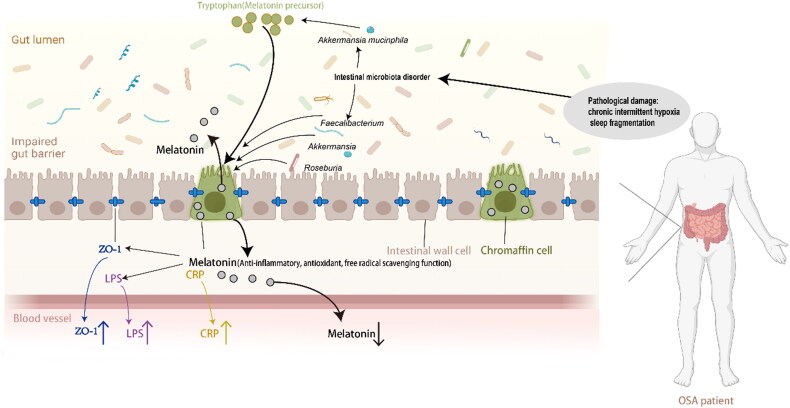
Schematic representation of the relationship between melatonin and intestinal barrier damage (biomarker: ZO-1) and systemic inflammation (biomarker: LPS, CRP). This figure was created using BioRender.com and further edited with Adobe Photoshop 2023 and Adobe Illustrator 2021. ZO-1: zonula occludens-1, LPS: lipopolysaccharide, CRP: C-reactive protein.

References

    1. Benjafield AV, Ayas NT, Eastwood PR, et al. . Estimation of the global prevalence and burden of obstructive sleep apnoea: a literature-based analysis. Lancet Respir Med. 2019;7(8):1–12. doi: 10.1016/S2213-2600(19)30198-5. - DOI - PMC - PubMed
    1. Peppard PE, Young T, Barnet JH, et al. . Increased prevalence of sleep-disordered breathing in adults. Am J Epidemiol. 2013;177(9):1006–1014. doi: 10.1093/aje/kws342. - DOI - PMC - PubMed
    1. Yeghiazarians Y, Jneid H, Tietjens JR, et al. . Obstructive sleep apnea and cardiovascular disease: a scientific statement from the American Heart Association. Circulation. 2021;144(3):e56–e67. doi: 10.1161/CIR.0000000000000988. - DOI - PubMed
    1. Patel SR. Obstructive sleep apnea. Ann Intern Med. 2019;171(11):ITC81–ITC96. doi: 10.7326/AITC201912030. - DOI - PubMed
    1. Veasey SC, Rosen IM.. Obstructive sleep apnea in adults. N Engl J Med. 2019;380(15):1442–1449. doi: 10.1056/NEJMcp1816152. - DOI - PubMed