


Modified Si Miao Powder granules alleviates osteoarthritis progression by regulating M1/M2 polarization of macrophage through NF-κB signaling pathway
- PMID: 38974041
- PMCID: PMC11224909
- DOI: 10.3389/fphar.2024.1361561
Modified Si Miao Powder granules alleviates osteoarthritis progression by regulating M1/M2 polarization of macrophage through NF-κB signaling pathway
Erratum in
-
Corrigendum: Modified Si Miao powder granules alleviates osteoarthritis progression by regulating M1/M2 polarization of macrophage through NF-κB signaling pathway.Front Pharmacol. 2024 Aug 22;15:1480427. doi: 10.3389/fphar.2024.1480427. eCollection 2024. Front Pharmacol. 2024. PMID: 39239659 Free PMC article.
Abstract
Background: Osteoarthritis (OA) is a chronic degenerative disease mainly characterized by cartilage damage and synovial inflammation. Si Miao Powder, an herbal formula, was recorded in ancient Chinese medicine prescription with excellent anti-inflammatory properties. Based on the classical formula, the modified Si Miao Powder (MSMP) was developed with the addition of two commonly Chinese orthopedic herbs, which had the efficacy of strengthening the therapeutic effect for OA.
Methods: In the in vivo experiments, thirty-six 8-week-old male C57BL/6 mice were randomly divided into six groups: sham group, OA group, celecoxib group, low-MSMP group, middle-MSMP group, and high-MSMP group. OA mice were constructed by destabilization of medial meniscus (DMM) and treated with MSMP granules or celecoxib by gavage. The effects of MSMP on cartilage, synovitis and inflammatory factor of serum were tested. For in vitro experiments, control serum and MSMP-containing serum were prepared from twenty-five C57BL/6 mice. Macrophages (RAW264.7 cells) were induced by lipopolysaccharide (LPS) and then treated with MSMP-containing serum. The expression of inflammatory factors and the change of the NF-κB pathway were tested.
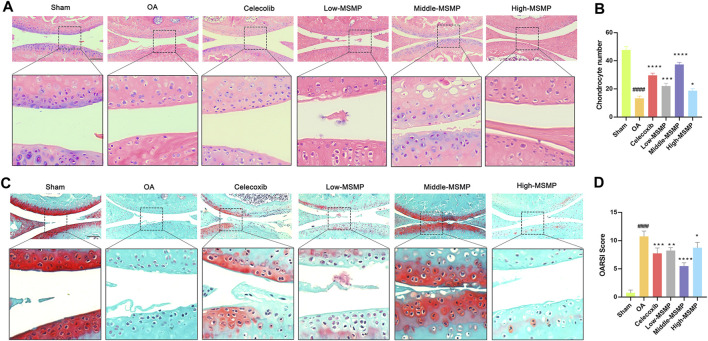
Results: In vivo, celecoxib and MSMP alleviated OA progression in the treated groups compared with OA group. The damage was partly recovered in cartilage, the synovial inflammatory were reduced in synovium, and the concentrations of IL-6 and TNF-α were reduced and the expression of IL-10 was increased in serum. The function of the middle MSMP was most effective for OA treatment. The results of in vitro experiments showed that compared with the LPS group, the MSMP-containing serum significantly reduced the expression levels of pro-inflammatory (M1-type) factors, such as CD86, iNOS, TNF-α and IL-6, and promoted the expression levels of anti-inflammatory (M2-type) factors, such as Arg1 and IL-10. The MSMP-containing serum further inhibited NF-κB signaling pathway after LPS induction.
Conclusion: The study demonstrated that MSMP alleviated OA progression in mice and MSMP-containing serum modulated macrophage M1/M2 phenotype by inhibiting the NF-κB signaling pathway. Our study provided experimental evidence and therapeutic targets of MSMP for OA treatment.
Keywords: NF-κB signaling pathway; inflammation; macrophage polarization; modified Si Miao Powder; osteoarthritis.
Copyright © 2024 He, Tian, Wang, Zheng, Zhi, Ma, An and Zhang.
Conflict of interest statement
The authors declare that the research was conducted in the absence of any commercial or financial relationships that could be construed as a potential conflict of interest.
Figures


References
-
- Cheleschi S., Tenti S., Lorenzini S., Seccafico I., Barbagli S., Frati E., et al. (2022). Synovial fluid regulates the gene expression of a pattern of microRNA via the NF-κB pathway: an in vitro study on human osteoarthritic chondrocytes. Int. J. Mol. Sci. 23, 8334. 10.3390/ijms23158334 - DOI - PMC - PubMed
LinkOut - more resources
Full Text Sources
Research Materials
Miscellaneous
