


Mapping Dysphagia Research Trends in Community Dwelling Older Adults: A Bibliometric Analysis
- PMID: 38974375
- PMCID: PMC11227311
- DOI: 10.2147/JMDH.S461046
Mapping Dysphagia Research Trends in Community Dwelling Older Adults: A Bibliometric Analysis
Abstract
Background: In recent years, research on dysphagia has gained significant traction as one of the key topics of oral health research pertaining to the aged. Numerous academics have studied dysphagia in great detail and have produced numerous excellent scientific research findings.
Objective: To review the literature regarding dysphagia in community-dwelling older adults and identify the knowledge and trends using bibliometric methods.
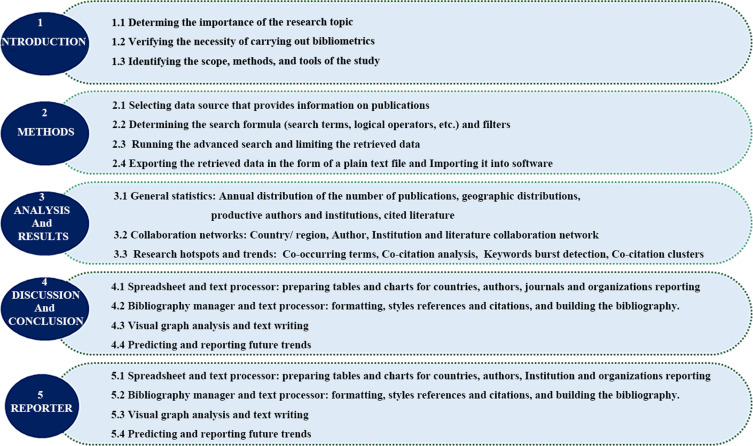
Methods: The literature on dysphagia in older adults in the community was gathered from the Web of Science Core Collection (WoSCC), with inclusion criteria specifying English-language publications. The retrieval deadline was November 28, 2022. We extracted the following data: title, year, abstract, author, keywords, institution, and cited literature, and used CiteSpace (version 6.1.R3) to visualize the data through the knowledge map, burst keyword analysis, cluster analysis, and collaborative network analysis.
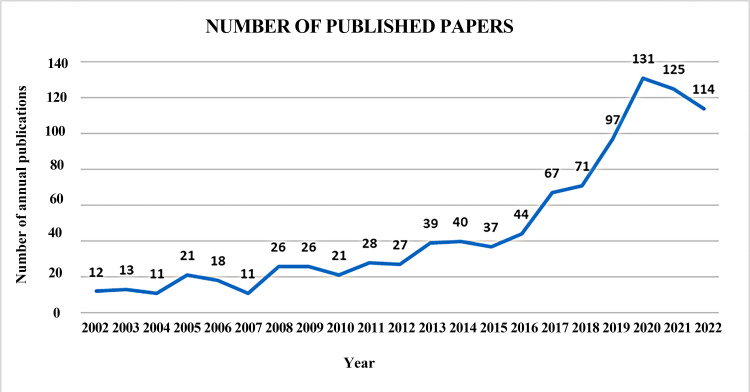
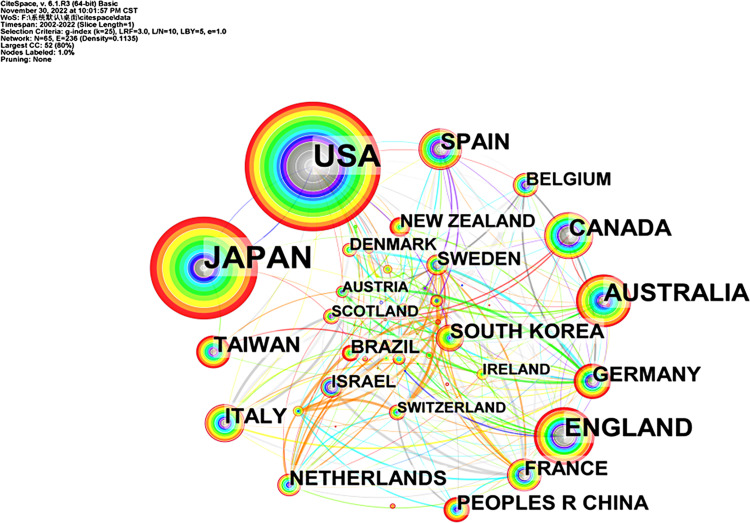
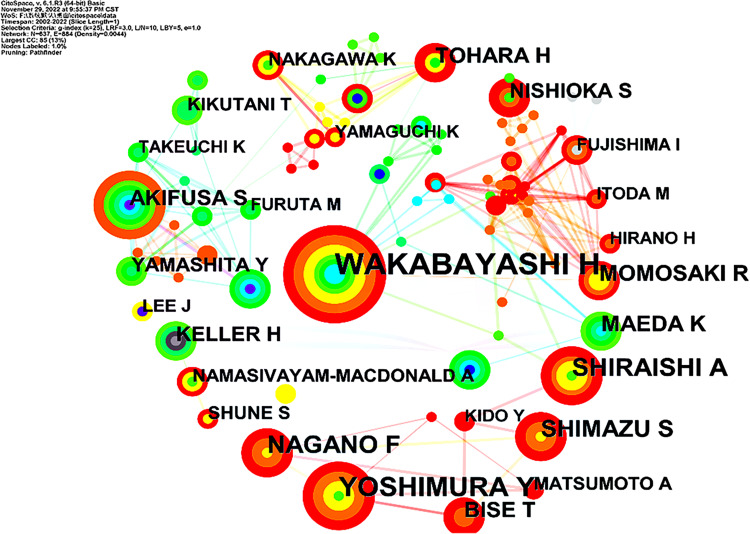
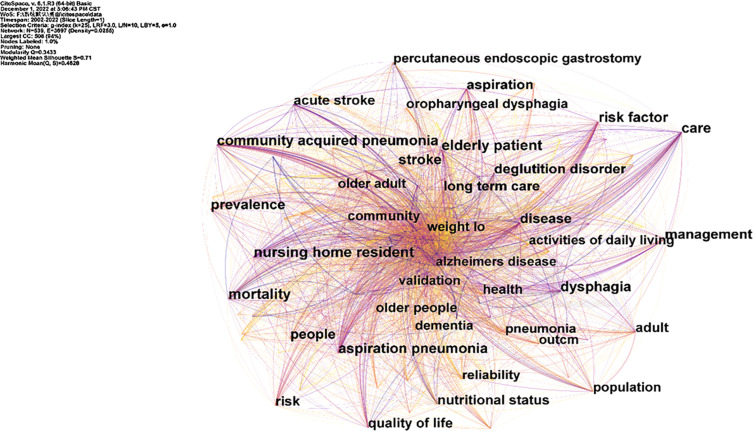
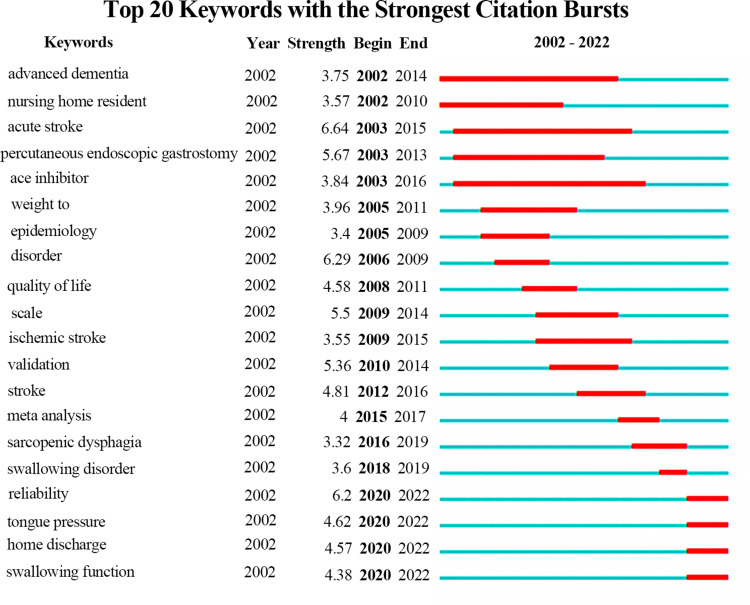
Results: A total of 979 articles and reviews were retrieved. Regarding productivity, the top 2 countries were the United States (n =239) and Japan (n =236). Hidetaka Wakabayashi (n =26) was one of the most prolific writers. The first paper in the frequency ranking of references cited was a white paper: European Society for Swallowing Disorders and European Union Geriatric Medicine Society white paper: oropharyngeal dysphagia as a geriatric syndrome (n =53). "Prevalence" (n =173), "risk factor" (n =119), and "aspiration pneumonia" (n =108) were the most frequently occurring keywords (excluding defining nouns). The study identified reliability, tongue pressure, home discharge, and swallowing function as research hotspots from 2020 to 2022.
Conclusion: Prevalence, risk factors, and pneumonia are significant areas of study. Tongue pressure and sarcopenia are research hotspots and potential targets. In the future, research on dysphagia needs to refine strategies for prevention and control, as well as provide tertiary preventative services.
Keywords: bibliometric analysis; citespace; community; dysphagia; older adults.
© 2024 He et al.
Conflict of interest statement
The authors affirm that the research was carried out without any commercial or financial affiliations that could be seen as a potential conflict of interest.
Figures
References
-
- Wilkinson JM, Codipilly DC, Wilfahrt RP. Dysphagia: evaluation and collaborative management. Am Fam Physician. 2021;103(2):97–106. - PubMed
-
- Barrera MAW, O’ Connor B. Presbyphagia versus dysphagia: normal versus abnormal swallowing symptoms in older adults with Parkinson disease and multiple sclerosis. Top Geriatr Rehabil. 2019;35(3):217–233. doi:10.1097/TGR.0000000000000237 - DOI
-
- McCoy YM, Desai RV. Presbyphagia versus dysphagia: identifying age-related changes in swallow function. Perspective ASHA Spec Interest Groups. 2018;3(15):15–21. doi:10.1044/persp3.sig15.15 - DOI
Publication types
LinkOut - more resources
Full Text Sources
